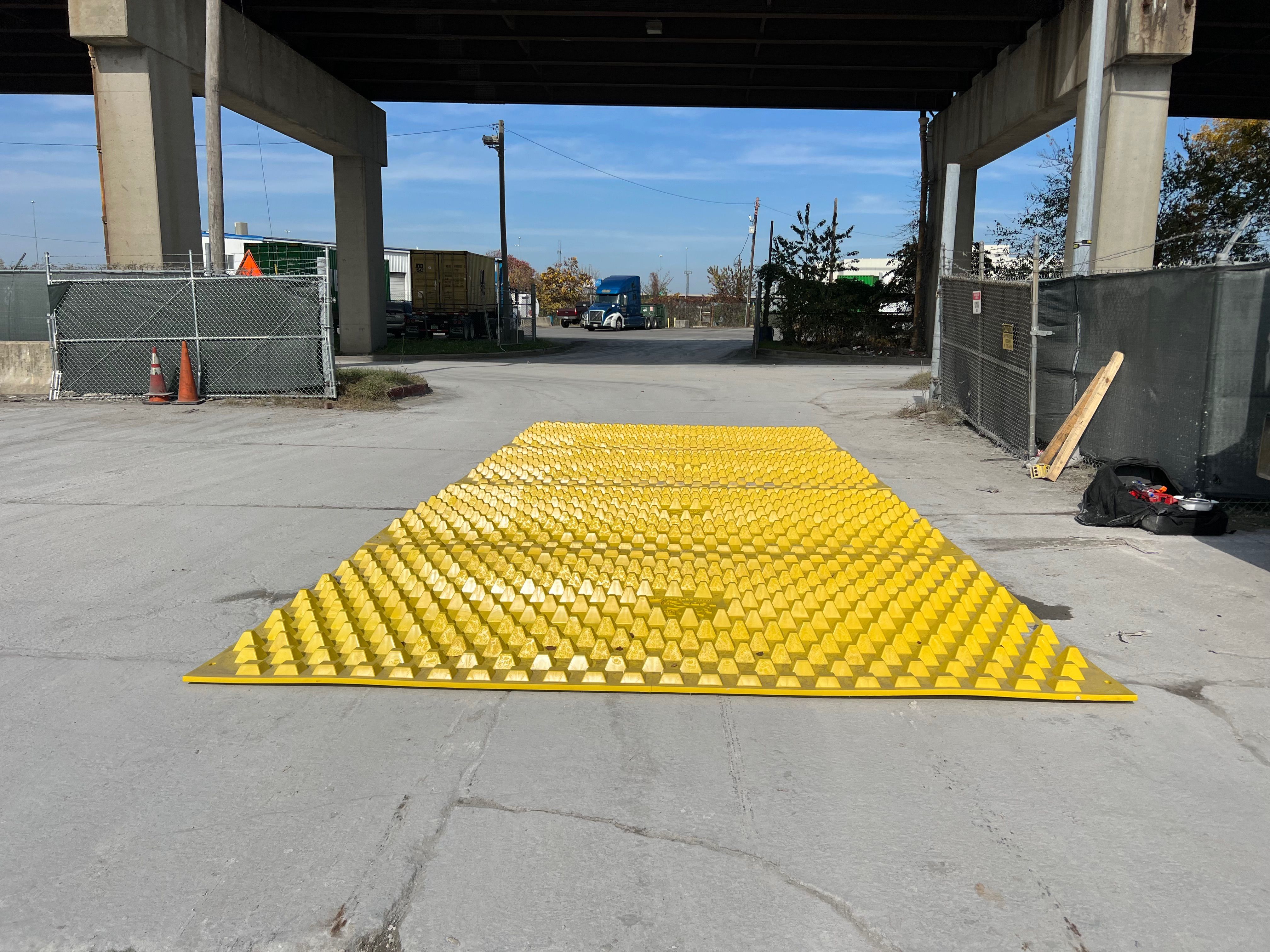

Maryland-Approved Stabilized Construction Entrance BMP
From the Port of Baltimore and the I-95 corridor to the Washington suburbs in Montgomery and Prince George's Counties, Maryland construction runs through some of the most sensitive watersheds in the country. Every job site from Ocean City on the Eastern Shore to Hagerstown in the Appalachian foothills eventually drains to the Chesapeake Bay, which is why Maryland takes trackout and sediment control seriously. The state's Piedmont, Coastal Plain, and Blue Ridge regions each present their own site challenges for stabilized construction entrances, whether you are building along the Capital Beltway, laying utilities in downtown Annapolis, grading new subdivisions in Howard County, or working on the Purple Line light rail, the rebuilt Francis Scott Key Bridge, or BWI Airport expansions.
Whatever corner of the Old Line State you are working in, any project that disturbs earth needs a Stabilized Construction Entrance (SCE) at every point of ingress and egress. This page walks through what Maryland requires, how the traditional gravel pad is specified, and why the Maryland Department of the Environment has approved the FODS Trackout Control System as a formal substitute.
What Is a Stabilized Construction Entrance?
A Stabilized Construction Entrance is the Best Management Practice (BMP) that keeps mud, sediment, and debris from leaving a construction site on truck and equipment tires. Without one, material tracks onto public roads, washes into storm drains during the next rain, and eventually ends up in the Chesapeake Bay, the Potomac, the Patapsco, or one of Maryland's many tidal tributaries.
In Maryland, the SCE is defined as Standard and Specification B-1 in the 2011 Maryland Standards and Specifications for Soil Erosion and Sediment Control, the statewide manual adopted under COMAR 26.17.01. Every county, city, and Soil Conservation District in the state references this same B-1 detail.
Maryland's B-1 Gravel Pad Requirements
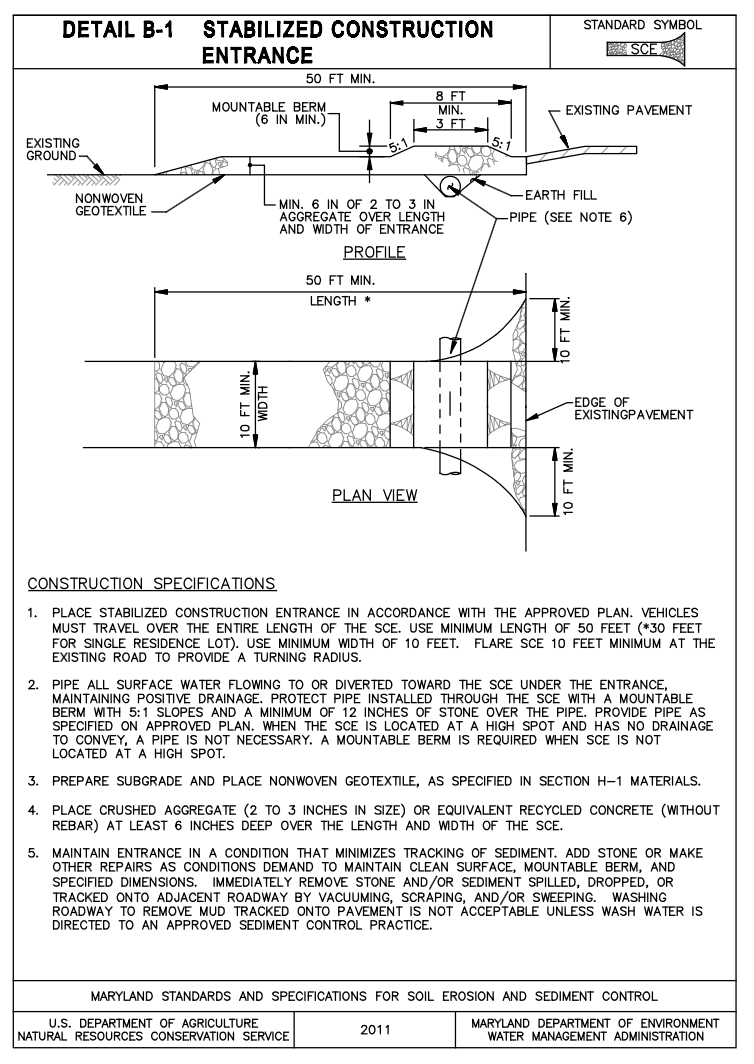
Specification B-1 describes a stone entrance pad at each construction exit. The standard detail calls for:
- Length: a minimum of 50 feet from the existing pavement
- Width: a minimum of 10 feet, with a 10-foot flare at the public road end for turning radius
- Aggregate: 2 to 3 inch coarse stone, 6 inches deep
- Underlayment: non-woven geotextile fabric beneath the aggregate
- Location: the entrance should egress on the high side of the site so runoff does not cross it
- Maintenance: regular top-dressing with fresh stone when the pad clogs with sediment, and prompt cleanup of any trackout that reaches the road
FODS Is Approved by MDE as a B-1 Substitute
In October 2022, the Maryland Department of the Environment issued a formal approval letter naming the FODS Trackout Control System as a substitute for Specification B-1. The letter is signed by Stewart R. Comstock, P.E., Chief, of the Sediment, Stormwater, and Dam Safety Program inside MDE's Water and Science Administration.
MDE reached that decision after reviewing the performance of FODS on two active Maryland sites over the course of a year. The finding was straightforward: FODS performs under the same conditions specified for a gravel SCE, and it does so with less maintenance, less hauling, and less waste.
"FODS has been presented as a lower-cost, longer-lasting alternative to the current Maryland specification B-1, 'Stabilized Construction Entrance' (SCE). The Department approves the use of FODS as a substitute for SCE in conditions where SCE would typically be specified. The FODS product has demonstrated the ability to perform under the same conditions specified for SCE, provided that the manufacturer's installation and maintenance guidelines are followed." Stewart R. Comstock, P.E., Chief Sediment, Stormwater, and Dam Safety Program Maryland Department of the Environment
Maryland's Construction Stormwater Permit (20-CP)
Any project in Maryland that disturbs 1 acre or more of earth, or a smaller site that is part of a larger common plan of development, needs coverage under the state's NPDES construction general permit. The current permit is 20-CP (NPDES No. MDRC), effective April 1, 2023. It replaced the older 14-GP that expired at the end of 2019.
What 20-CP requires you to have on site:
- An approved Erosion and Sediment Control plan from your local SCD or delegated county program
- A Notice of Intent submitted through MDE's ePermits portal
- A stabilized construction entrance (the B-1 gravel pad or an MDE-approved substitute such as FODS) at every ingress and egress point
- Inspections weekly, plus after every rain event of 0.25 inches or more. Twice weekly if you discharge to Tier II waters
- A written SWPPP on site if you discharge to Tier II waters, use chemical additives, or hit any of the other Part III.F triggers
Worth knowing: Maryland also has a separate state ESC plan review threshold under COMAR 26.17.01 that kicks in at 5,000 square feet or 100 cubic yards of disturbance. That is a different (lower) threshold than the NPDES 1-acre trigger, and it is a common source of confusion on smaller sites.
MDOT SHA Projects
If you are bidding work for the Maryland Department of Transportation State Highway Administration, trackout control lives in the Standard Specifications for Construction and Materials, 2025 Edition, specifically Section 308.03.15, Stabilized Construction Entrance, with payment language in Section 308.04.08.
FODS is not listed on the MDOT SHA Qualified Products List, and that is expected: the SHA QPL (MPEL 2.0) does not have a category for construction entrances, trackout mats, or prefabricated entrance mats. Acceptance on SHA projects therefore flows from the MDE substitute approval plus the Section 308.03.15 performance intent, not from QPL listing. Reference the MDE Comstock approval letter when you substitute FODS on an SHA contract, and loop in the project engineer early.
With this approval, contractors, engineers, and specifiers now have an additional BMP solution for managing construction site track out that is both cost-effective and reusable.
Additional Resources:
General Permit for Stormwater Associated with Construction Activity
General Permit for Stormwater Associated with Industrial Activity
Maryland Wastewater Permits Program (WWPP)
2011 Maryland Standards and Specifications for Erosion and Sediment Control