
Canadian Trackout Control and Sediment Compliance for Construction
Federal Fisheries Act, Provincial Regulation, and Municipal Erosion and Sediment Control
Canada holds roughly a fifth of the world's fresh water, from the Great Lakes and the St. Lawrence to the salmon rivers of the Pacific coast, the prairie watersheds, and the countless lakes of the boreal shield. Protecting that water is a shared responsibility across three levels of government, and construction sediment is one of the pollutants they watch most closely. Sediment tracked off a job site travels down storm drains and into the rivers and lakes that fish depend on, so keeping mud on the site and off public roads is a core compliance duty on Canadian projects, and a stabilized construction entrance is one of the first controls installed and inspected.
Federal Regulation: The Fisheries Act
Canada does not use a single national construction stormwater permit the way the United States does. Instead, the unifying federal rule is the Fisheries Act. Subsection 36(3) prohibits the deposit of any deleterious substance into water frequented by fish unless it is specifically authorized, and naturally occurring soil sediment is treated as a deleterious substance because it degrades water quality and harms fish and fish habitat. Enforcement of the pollution provisions is shared by Environment and Climate Change Canada and Fisheries and Oceans Canada (DFO).
Under the modernized Fisheries Act, DFO publishes Standards for routine projects near water, along with Codes of Practice, that describe the measures a proponent must implement to proceed without an individual authorization. As of 2026 these include a national interim standard, Planning for land-based erosion and sediment control, issued in March 2026, which applies to soil-disturbing work near watercourses and water bodies and calls for a full erosion and sediment control plan across every phase of a project. The standard sets out a risk assessment of erodible soils and discharge pathways, a hierarchy of drainage, erosion, and sediment controls, and an adaptive management program of mapping, monitoring, and maintenance. It also ties directly to the duty to notify under sections 38(4) and 38(7) when an unauthorized impact to fish or fish habitat occurs. Larger or more complex works may still require a Fisheries Act authorization. The Species at Risk Act adds further protection for aquatic species, and the Canadian Environmental Protection Act and the Canada Water Act round out the federal framework. In practical terms, allowing construction sediment to reach a fish-bearing water is a federal offence, so effective trackout control functions as a compliance measure rather than an optional site amenity.

Provincial Regulation
The provinces hold primary authority over land and water management, and each regulates construction sediment through its own statutes, transportation ministry standards, and erosion and sediment control guidance. FODS now maintains a dedicated page for every province, and the provincial frameworks are as follows.
Ontario regulates water and pollution through the Ontario Water Resources Act and the Ministry of the Environment, Conservation and Parks, adds a layer of Conservation Authority permits, and specifies erosion and sediment control on public works through the Ontario Provincial Standard Specifications.
British Columbia controls activity affecting water bodies under the Environmental Management Act and the Water Sustainability Act, with strict municipal erosion and sediment control bylaws across Metro Vancouver and a strong focus on salmon habitat.
Alberta manages construction runoff under the Environmental Protection and Enhancement Act and the Water Act, administered by Alberta Environment and Protected Areas and supported by Alberta Transportation's Erosion and Sediment Control Manual, with heavy demand from the energy sector.
Quebec regulates construction discharges through the Environment Quality Act, administered by the Ministère de l'Environnement, de la Lutte contre les changements climatiques, de la Faune et des Parcs (MELCCFP).
Manitoba works under The Environment Act and The Water Protection Act, administered by Manitoba Environment and Climate Change, where sediment and nutrient loading into Lake Winnipeg keeps erosion control under close watch.
Saskatchewan applies The Environmental Management and Protection Act, with the Water Security Agency overseeing works that affect water bodies and aquatic habitat.
Nova Scotia regulates under the Environment Act, administered by the Department of Environment and Climate Change, and publishes the Erosion and Sedimentation Control Handbook for Construction Sites alongside its 2025 Guide to Developing Erosion and Sediment Control Plans.
New Brunswick works under the Clean Water Act and the Clean Environment Act, administered by the Department of Environment and Local Government, and requires a Watercourse and Wetland Alteration permit for work near water.
Prince Edward Island regulates under the Environmental Protection Act, administered by the Department of Environment, Energy and Climate Action, where the island's fine red soils erode readily into rivers and shellfish waters.
Newfoundland and Labrador applies the Environmental Protection Act and the Water Resources Act, administered by the Department of Environment and Climate Change.
Across the territories, the Yukon, Northwest Territories, and Nunavut regulate works affecting water through territorial land and water boards alongside the federal Fisheries Act.
Municipal Programs and Conservation Authorities
Much of the day-to-day enforcement happens locally. Municipalities administer erosion and sediment control bylaws and require an erosion and sediment control plan before construction begins. In Toronto, developers submit stormwater management and sediment control plans for approval, and municipalities across Metro Vancouver, including Surrey, Coquitlam, and the District of North Vancouver, enforce detailed erosion and sediment control bylaws with monitoring and penalties. In Ontario, Conservation Authorities add another approval, regulating development in and near watercourses, wetlands, and floodplains under the Conservation Authorities Act and the consolidated provincial permitting regulation now in force. Across all of these programs, the construction entrance is a required and closely inspected control.
The Aggregate Construction Entrance and Its Limits
Canadian guidance manuals describe the traditional construction entrance under names such as Access Road, Stabilized Construction Access, Gravel Access Approach, and Stone Construction Access. In each case the design is a pad of coarse aggregate placed over a geotextile fabric at every site exit, built long and thick enough to knock sediment loose from tires, with runoff directed to a sediment control.
The weakness of the aggregate pad is maintenance. As the stone compacts and fills with sediment, it stops cleaning tires and must be topped up with fresh rock, and any material tracked onto the road has to be removed promptly. When the stone pad alone is not enough, a wheel wash sprays tires with pressurized water and drains to a sediment trap, which adds water handling and cleanout and can leave ice on the road through a Canadian winter. Each option carries a recurring cost and a maintenance cycle that a durable manufactured entrance can avoid.
FODS Modern Stabilized Construction Entrance
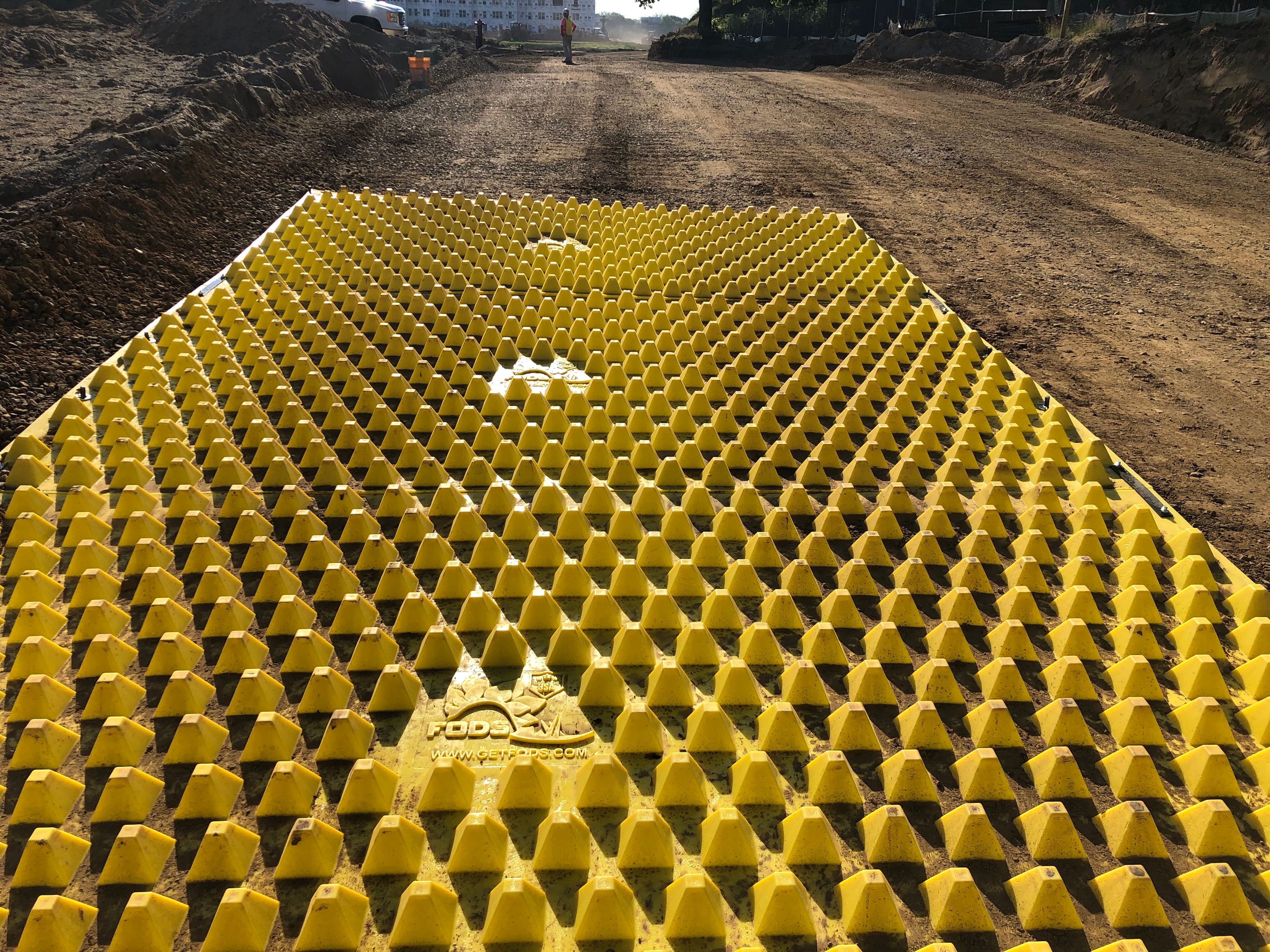
The FODS Trackout Control System is a reusable, manufactured construction entrance made of high-density polyethylene mats formed into a pyramid-shaped surface that works like the rough edges of crushed stone. As vehicles pass, the pyramids deform the tires and open the tread so sediment breaks loose and collects in the voids between the pyramids, clear of the tires. The system has been shown to reduce street sweeping by 59 percent on high-traffic projects, and it replaces the aggregate entrance described in the manuals without introducing loose rock to the site.
Each mat measures about 3.7 metres by 2.1 metres (12 feet by 7 feet), and the modular design lets contractors build the entrance to fit the site. The mats hold roughly 65 millimetres of sediment between the pyramids before tires contact the buildup, and maintenance is a quick pass with a skid steer broom, a powered sweeper, or a FODS shovel. Because the system uses no aggregate, it removes the risk of stone lodging in dual tires or migrating onto active roadways, which suits both highway and dense urban work. The mats install over any substrate without excavation, are portable and reusable across phases and projects, and carry a service life of more than ten years, which shifts the cost of a construction entrance from a recurring expense to a one-time investment. FODS is available across Canada through its network of distribution partners.
Explore Trackout Control by Province
FODS maintains province-specific guidance for construction markets across Canada. Pages for Ontario, British Columbia, Alberta, Quebec, Manitoba, Saskatchewan, Nova Scotia, New Brunswick, Prince Edward Island, and Newfoundland and Labrador cover each province's regulations, transportation standards, municipal programs, and the way FODS is specified locally.
Additional Resources
Fisheries Act, Section 36 (Justice Laws)
DFO Standards for Routine Projects Near Water
DFO Standard: Planning for Land-Based Erosion and Sediment Control
Species at Risk Act - Aquatic Species