The former headquarters of Arrow Electronics in Centennial, Colorado, is now being redeveloped into Alora at Dry Creek, a new multifamily community featuring over 320 apartments. Before vertical construction could begin, the nine-acre site required extensive demolition, earthwork, and preparation. The project also uses modular construction to streamline the building process and more efficiently provide new housing for the Denver metropolitan area.
For over two decades, the office building at 9201 East Dry Creek Road was part of the commercial area near the Denver Tech Center. Built in 2001, it was previously the head office of Arrow Electronics, a Fortune 500 company. Just west of Interstate 25, the site is being converted into a residential community with new apartments, shared facilities, and outdoor gathering areas.

Consolidated Investment Group bought the property in December 2024 for $12.25 million. At first, the developer considered keeping the existing office building, converting its interior into apartments, and then building more residential buildings around it. This approach would have preserved the building while giving the entire campus a new use.
However, converting an office building into housing requires more than dividing existing floors into individual units. The building’s footprint, interior layout, and design must accommodate practical residential spaces, and the finished development must support the cost of those changes. After evaluating the property, the team determined that demolition and new construction would better meet its goals for apartment quality, construction efficiency, and attainable rents.
By November 2025, the former headquarters had been demolished, clearing the site for the new development. Starting from the ground up allowed the project team to plan the community around residential use from the beginning, with purpose-built apartment layouts and a coordinated arrangement of buildings, amenities, and outdoor spaces.
The development, expected to cost about $100 million, will cover 360,000 square feet and consist of five four-story residential buildings and a central clubhouse. The complex will offer a variety of housing types, including studio, one-bedroom, and two-bedroom apartments. Planned facilities include a pool, a fitness center, lounges, conference rooms, and areas where residents can work and meet. The residential buildings will be arranged around a common outdoor area, creating a shared community space within the former office property.
Symmetry Builders, the general contracting team within The Symmetry Companies, is leading construction at Alora at Dry Creek. Symmetry has been building across the Rocky Mountain West since 2011 and has expanded its portfolio across multifamily, commercial, modular, industrial, and residential construction. The company takes an integrated approach to construction and development, bringing together teams and expertise across multiple project types.

That experience has also given Symmetry significant modular construction experience in Colorado, combining traditional construction management with newer building methods designed to improve efficiency, coordination, and predictability. Alora at Dry Creek builds on that experience, bringing the team’s construction and modular capabilities together on one of its largest multifamily projects to date.
For the development, Consolidated Investment Group brought together Symmetry, Lowney Architecture, and RISE Modular to coordinate an approach that integrates architectural design, factory production, and on-site construction. Each partner contributes to a process in which manufacturing requirements and construction sequencing help shape the project before individual building components arrive.
Alora at Dry Creek will use factory-built residential modules combined with precast foundations and elevated decks. RISE Modular will manufacture, transport, and set the modules, while Symmetry will coordinate construction at the Centennial jobsite. This lets portions of building production advance alongside site preparation, rather than requiring every stage to occur sequentially on site.
Standardized apartment layouts are central to that approach. Repeating studio, one-bedroom, and two-bedroom designs across the buildings allows the team to refine manufacturing and assembly while maintaining a consistent residential product. The developer and design team also intend for those layouts to inform future communities, creating a repeatable construction model that can be adapted to different sites and housing needs.
Construction is expected to continue through 2027, with buildings completed in phases as the development progresses. Before the modular units can be delivered and installed, significant site work must take place, including earthwork, foundation construction, utility installation, and preparation of access routes throughout the property. With multiple phases of construction across the nine-acre site, maintaining reliable access for crews, equipment, and deliveries is key to keeping the project moving.

That preparation creates its own jobsite challenges. Following demolition, earthwork exposes soil and creates heavily traveled routes for construction vehicles and equipment. September 2026 site conditions included muddy work areas, rutted ground, and large wheeled earthmoving equipment operating near existing pavement. As vehicles move between disturbed soil and paved surfaces, mud and sediment can become trapped in tire treads, carried toward construction exits, and tracked onto public streets.
For a redevelopment surrounded by established commercial properties and roadways, construction trackout control is an important part of managing the site beyond the work zone. Sediment tracked onto pavement can increase cleanup requirements and be carried farther along surrounding roads by passing traffic. The transition from disturbed ground to paved access therefore becomes a key point for controlling mud, sediment, and construction debris before vehicles leave the site.
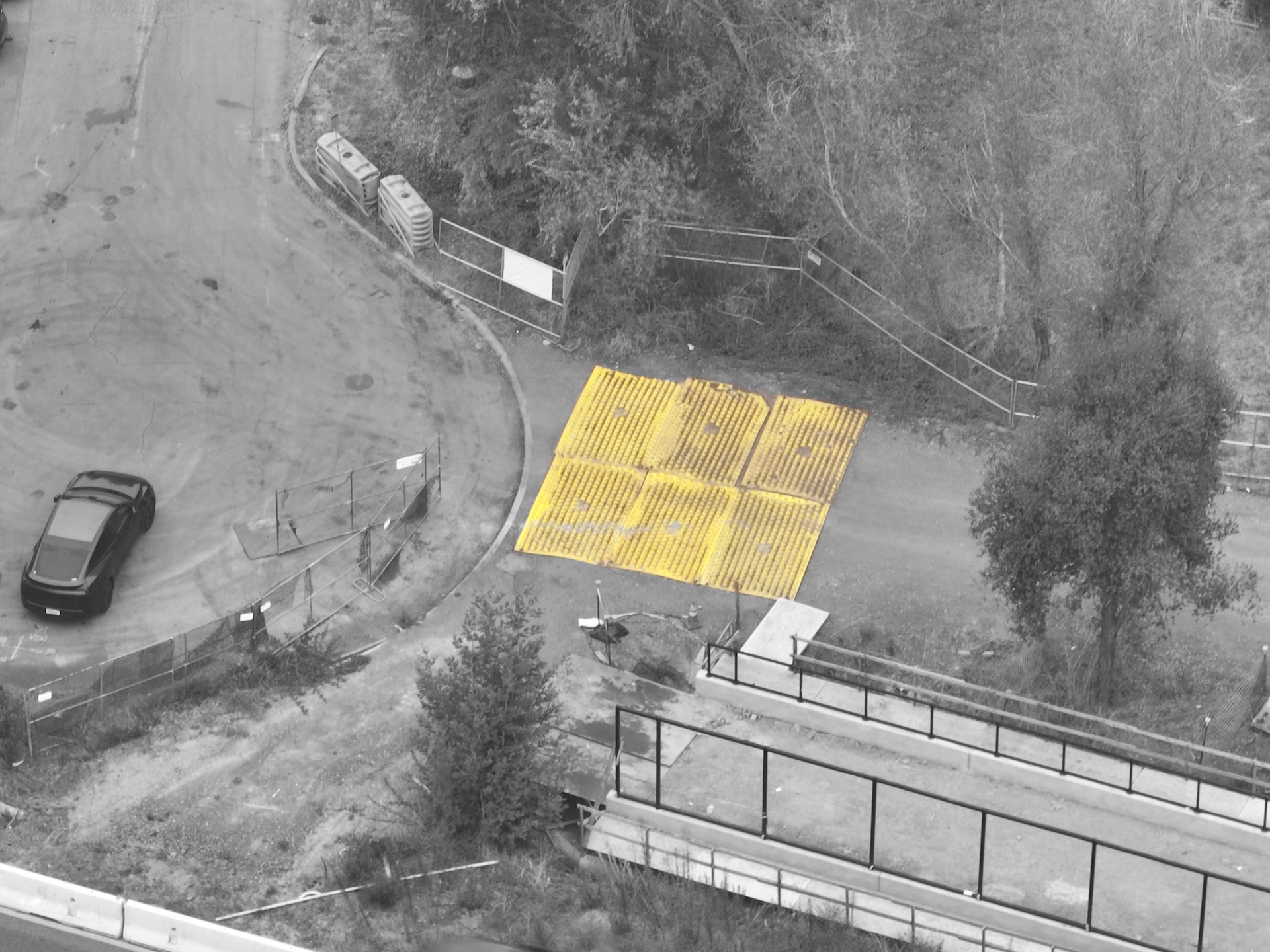
To help manage trackout at Alora at Dry Creek, Symmetry Builders was already using FODS Trackout Control Mats at two construction site exits. In late September 2026, the team installed additional FODS mats to expand the existing system. The added sections extended the trackout control surfaces at established access points, building on the measures already in place as earthwork and site preparation continued.
FODS Trackout Control Mats use rows of raised pyramids to flex vehicle tires and dislodge trapped mud, dirt, and debris as vehicles drive across the system. Released sediment collects between the pyramids, where crews can remove it during routine maintenance. At the Alora at Dry Creek construction site, heavy wheeled equipment traveled across the installed mats, with captured soil and debris visible between the pyramids during active operations.
The September installation also shows how a modular construction entrance system can adapt as site conditions change. The team incorporated additional FODS mats into the existing layouts without replacing the mats already in service. Crews can expand or reconfigure the system as construction entrances, traffic patterns, and access requirements change throughout the project.

The reusable design also suits the extended timeline of a large multifamily construction project. FODS mats can remain in service through multiple phases of work and be relocated when site access changes. Unlike traditional aggregate construction entrances, the system does not rely on recurring stone replacement to maintain the entrance. Routine cleaning removes captured sediment from between the pyramids, allowing the mats to keep engaging vehicle tires and remain available throughout the project or on future jobsites.
As work progresses at Alora at Dry Creek, a former corporate office campus is becoming a new residential community in Centennial, Colorado. Behind that transformation is the daily work of demolition, earthwork, construction access, and equipment movement required to prepare the property for its next use. With expanded FODS Trackout Control Mat installations at two site exits, Symmetry Builders is managing construction trackout where active earthwork meets pavement, helping keep mud and sediment contained as development work moves forward.