Ontario Stabilized Construction Entrances and Trackout Control
Ontario Water Resources Act, Conservation Authorities, and the OPSS Mud Mat
Ontario borders four of the five Great Lakes, and its water drains through the St. Lawrence, Ottawa, and Grand rivers, Georgian Bay, Lake Simcoe, and thousands of inland lakes that support fisheries, drinking water, and recreation. The Greater Golden Horseshoe around Toronto is one of the fastest-growing regions in North America, with highways, transit, and housing under construction across the Greater Toronto Area, Ottawa, and Hamilton. On all of it, keeping sediment on the job site and off public roads is a core compliance duty, and a stabilized construction entrance is one of the first controls installed and inspected.
Ontario Water Resources and Environmental Regulation
The Ministry of the Environment, Conservation and Parks (MECP) administers Ontario's water protection under the Ontario Water Resources Act, which governs the taking and discharge of water and prohibits the discharge of materials that may impair water quality. Stormwater works are approved through an Environmental Compliance Approval or, for eligible activities, the Environmental Activity and Sector Registry. Ontario projects also sit under the federal Fisheries Act, so letting construction sediment reach a fish-bearing water can trigger federal liability in addition to provincial and municipal enforcement.
Conservation Authorities
Ontario is distinctive in that Conservation Authorities add a further layer of approval. Under the Conservation Authorities Act and the current unified permitting regulation, an authority such as the Toronto and Region Conservation Authority regulates development in and near watercourses, wetlands, floodplains, and Great Lakes shorelines. A permit from the local Conservation Authority is often required before construction begins, and it comes with erosion and sediment control expectations that the project must meet on the ground.
Municipal Erosion and Sediment Control
Most day-to-day enforcement is municipal. Cities and towns across Ontario require an erosion and sediment control plan before issuing permits, and developers in Toronto and across the Greater Golden Horseshoe submit sediment and stormwater controls for review. Municipal design standards, such as those used across the region, require the controls to conform to the province's erosion and sediment control specifications and to be inspected and maintained throughout construction.
The Mud Mat and Its Limits
Ontario's technical standard for the construction entrance is the mud mat, specified in the Ontario Provincial Standard Specifications for temporary erosion and sediment control, OPSS 577, and its standard drawings, which are referenced across Ontario municipal design manuals. A mud mat is an aggregate pad installed where an access road meets a municipal right-of-way, built a minimum of 6.0 metres wide and 30 metres long, using 50 to 100 millimetre crushed stone placed over a geotextile fabric, with all site traffic directed across it.
The weakness of the aggregate mud mat is maintenance. As the stone compacts and fills with sediment, it stops cleaning tires and must be topped up with fresh crushed stone, and any material tracked onto the road has to be swept up promptly. When the mud mat alone is not enough, a wheel wash sprays tires with pressurized water and drains to a sediment trap, which adds water handling and cleanout and can leave ice on the road through an Ontario winter. Each traditional option carries a recurring cost and a maintenance cycle that a durable manufactured entrance can avoid.
FODS as a Compliant Construction Entrance in Ontario
Ontario evaluates a construction entrance on whether it performs the function the mud mat standard describes, removing sediment from tires before vehicles reach the road, and the operator specifies the chosen practice in the project erosion and sediment control plan. FODS Trackout Control Mats can be named directly in that plan as the site's stabilized construction entrance, satisfying the same purpose as the mud mat while removing the loose stone and the heavy maintenance the aggregate design depends on. Because FODS controls trackout so effectively, it also helps a project meet the Conservation Authority and Fisheries Act expectation that sediment stays out of nearby watercourses.
FODS Trackout Control System
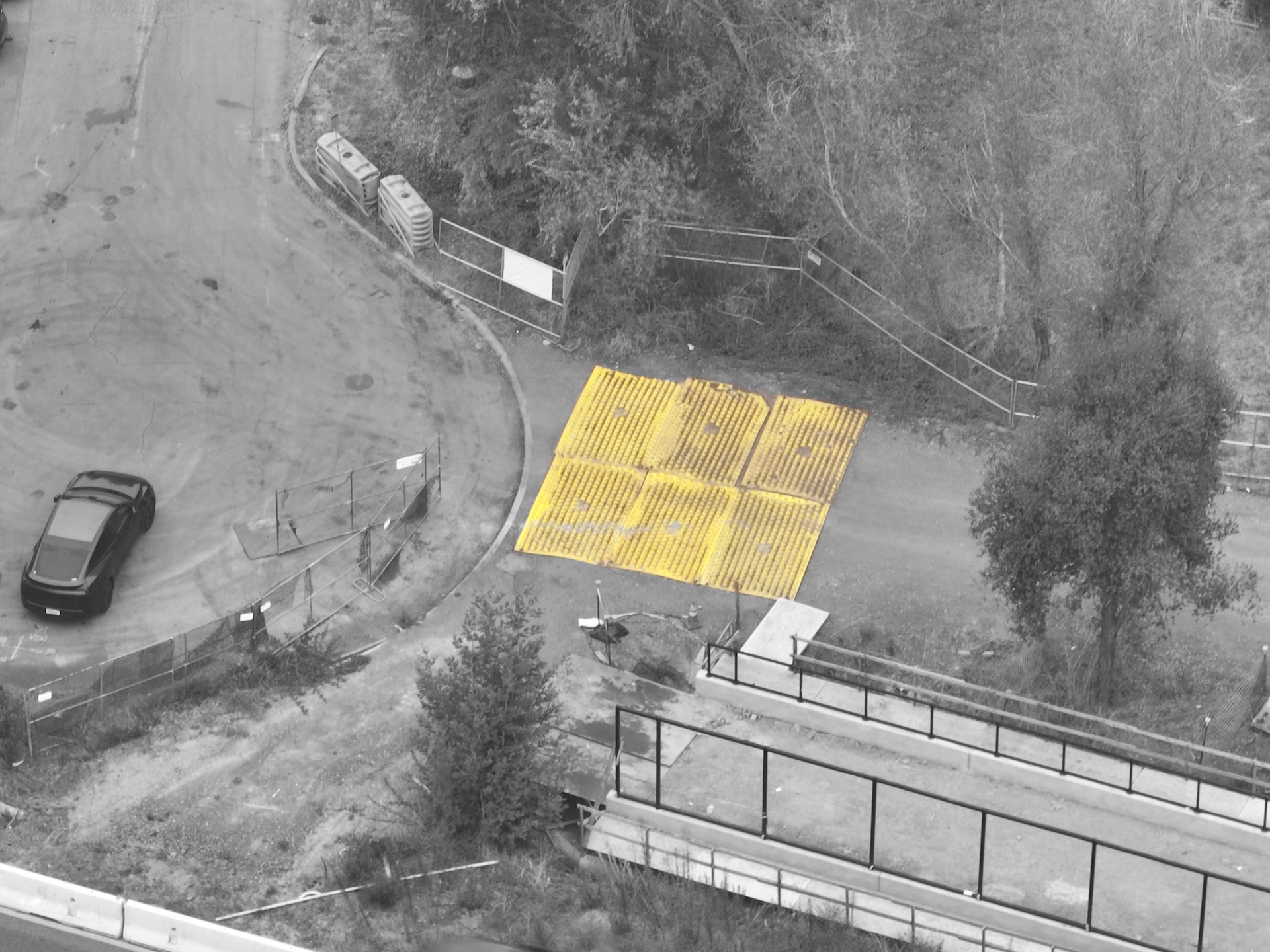
The FODS Trackout Control System is a reusable, manufactured construction entrance made of high-density polyethylene mats with a pyramid-shaped surface that works like the rough edges of crushed stone. As vehicles pass, the pyramids deform the tires and open the tread so sediment breaks loose and collects in the voids between the pyramids, clear of the tires. Each mat measures about 3.7 metres by 2.1 metres, and the modular design lets contractors build the entrance to fit the site. On high-traffic projects the system has reduced street sweeping by 59 percent compared with aggregate.
The mats install over any substrate, including bare grade, gravel, or pavement, without excavation, and a configuration can be deployed or relocated quickly as work advances, which suits the phased highway, transit, and subdivision work common across the Greater Golden Horseshoe. Because FODS uses no loose stone, there is nothing to lodge in dual tires or migrate onto active roadways, and maintenance is a quick pass with a skid steer broom, a powered sweeper, or a FODS shovel when sediment builds up between the pyramids. With a service life of more than ten years, the same mats can be reused across projects, which shifts the cost of a construction entrance from a recurring expense to a one-time investment.
Risks of Vehicle Trackout on Roadways
Safety is a primary concern wherever construction traffic meets a public road. Aggregate exits deposit stone and debris onto pavement, creating hazards for drivers and workers, and loose rock can lodge between dual tires and be thrown at speed. Wheel washes add the burden of supplying and containing water, and in cold weather dripping vehicles can build ice on Ontario roadways. FODS uses a rockless, water-free technique to clean tires and does not carry the same risk of injury or liability as aggregate entrances. The mats are durable and reusable across many projects, which reduces the environmental impact tied to aggregate production, hauling, and disposal. On Ontario sites that drain to the Great Lakes, the St. Lawrence, or the region's rivers and streams, keeping stone and sediment off the road also helps keep it out of the water and out of fish habitat protected under the Fisheries Act.
Additional Resources
Ontario Ministry of the Environment, Conservation and Parks
Conservation Ontario - Permits and Approvals
Ontario Provincial Standards (OPSS and OPSD)
Toronto Erosion and Sediment Control Guideline