Highway 1 is one of Santa Cruz County’s most important transportation corridors, connecting communities along the coast while carrying commuters, residents, visitors, and commercial traffic through an area with limited alternate north-south routes. In Capitola, California, a major transportation project is reshaping a section of the highway between Bay Avenue/Porter Street and State Park Drive with improvements designed to address traffic operations, transit, bicycle and pedestrian connectivity.

Granite Construction is the contractor for the Highway 1 Auxiliary Lanes and Bus-on-Shoulder Project between Bay Avenue/Porter Street and State Park Drive. The work represents Phase II of a larger three-phase Highway 1 improvement program. It is part of the Santa Cruz County Regional Transportation Commission’s broader Watsonville to Santa Cruz Multimodal Corridor Program.
The project brings together Caltrans, the Santa Cruz County Regional Transportation Commission, the County of Santa Cruz, the City of Capitola, and other regional partners. Caltrans awarded Contract 05-0C7334 to Granite Construction Company for approximately $72.4 million, while public project updates describe the overall construction project at approximately $78 million.
The scope extends for nearly three miles of Highway 1, from the State Park Drive overcrossing to just north of the Bay Avenue undercrossing. Northbound and southbound auxiliary lanes are being constructed to connect successive highway ramps, giving vehicles more room to merge and exit without disrupting through traffic. The project also supports bus-on-shoulder operations, which allow authorized transit buses to use designated sections of the highway shoulder to move around congestion when regular traffic slows. By giving buses a way to bypass some of the corridor’s heaviest traffic, the system is intended to improve transit travel times and reliability without requiring a separate dedicated bus lane.
These improvements are particularly significant along this section of Highway 1. The corridor serves Capitola, Soquel, Aptos, and Cabrillo College, and the RTC describes it as one of the busiest sections of highway in Santa Cruz County. In addition to improving highway operations, the auxiliary lanes are intended to help reduce traffic diverting onto surrounding neighborhood streets.

The existing Capitola Avenue overcrossing was replaced with a new bridge designed around a more multimodal transportation network. The former bridge closed in March 2024 and was subsequently demolished, beginning a nearly two-year period in which crews reconstructed the crossing while work continued around active Highway 1 traffic below.
The new Capitola Avenue Overcrossing opened to the public at the end of January 2026. The replacement provides improved bicycle and pedestrian facilities while maintaining vehicle access across Highway 1, reconnecting Capitola Avenue between Soquel Drive to the north and destinations south of the highway.
Elsewhere within the project limits, crews are constructing a dedicated bicycle and pedestrian overcrossing at Mar Vista Drive. Retaining walls, drainage improvements, roadway reconstruction and ramp modifications are also part of the broader corridor work. Together, the improvements are intended to strengthen connections between neighborhoods, schools, parks, beaches, commercial areas and transit while improving operations along Highway 1.
Construction has required extensive staging alongside an active highway and within an established community. Work has included temporary traffic configurations, overnight highway closures, and long-term ramp closures as crews build new roadway infrastructure around existing traffic. In 2026, for example, portions of the Park Avenue and Bay Avenue ramps required multi-month closures for reconstruction associated with the new bus-on-shoulder facilities.
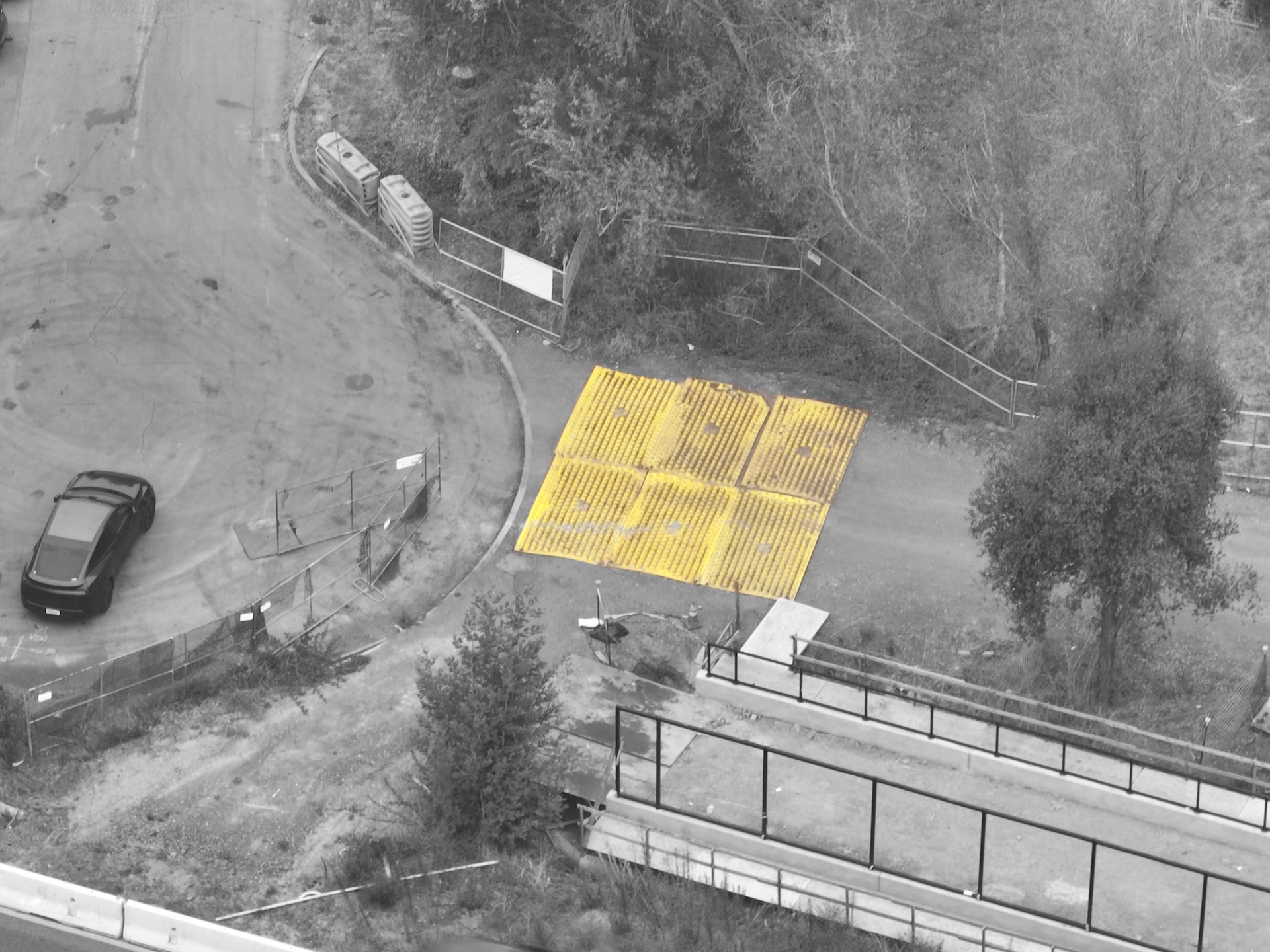
One of the project’s construction entrances presented a particular challenge: space. Located near the Capitola Avenue overcrossing, the entrance connects the unpaved work area directly to a paved public street. With limited room between the roadway and the active construction zone, Granite needed a trackout control solution that could provide full coverage without requiring a large entrance footprint.
There is little room for a large conventional construction entrance. However, the access point still needs to provide a controlled transition for construction and service vehicles moving between the active work zone and the paved public street. Caltrans records also identify the project as operating under a Stormwater Pollution Prevention Plan, making construction-site sediment control an environmental requirement.
To manage trackout within that limited space, six FODS Trackout Control Mats were installed across the gated entrance. The mats were arranged in a compact 3-by-2 configuration, creating continuous coverage across the access point and positioning vehicles to travel over the system before reaching the public roadway. Instead of requiring a long aggregate entrance that extends back into an already constrained site, the modular layout fits within the available footprint.

That flexibility is especially useful on infrastructure projects where the entrance has to adapt to the site rather than the other way around. Each FODS Trackout Control Mat uses a field of raised pyramids designed to flex vehicle tires as they pass over the surface. This tire flex helps dislodge mud, sediment, and debris, allowing material to collect between the pyramids before vehicles transition onto the roadway.
Photos captured at the Capitola site show that process in action. Sediment is visible throughout the channels between the pyramids, while the mats create a defined transition from the unpaved construction area to the paved street. For a construction entrance positioned so close to an active highway corridor and surrounding community, keeping that material contained within the access point is an important part of maintaining the site.
The installation also demonstrates one of the advantages of a modular trackout control system. Rather than designing the site around a fixed aggregate entrance, individual mats can be configured around available space and existing infrastructure. If access requirements change as construction advances, the mats can be disconnected, relocated, and configured again.
That matters on a multi-year transportation project. Highway construction is rarely static. Work zones shift, staging areas change, ramps are reconstructed, and access points evolve as different phases are completed. FODS Trackout Control Mats are designed to move with those changes instead of becoming a temporary entrance that must be removed and rebuilt.

Maintenance follows the same principle. Captured sediment can be removed from between the pyramids while the mats remain in service, allowing the entrance to be maintained throughout construction without continually importing and replacing aggregate. The bright yellow surface also provides a highly visible transition at the gate, clearly identifying the construction access point against the surrounding gravel, pavement and work-zone environment.
The Highway 1 Auxiliary Lanes and Bus-on-Shoulder Project is a major transportation improvement involving new highway lanes, transit infrastructure, bridge construction, ramp reconstruction and new pedestrian and bicycle connections. Yet within a project of that scale, some of the most practical challenges happen in relatively small spaces.
At the Capitola Avenue construction entrance, six FODS Trackout Control Mats provide a compact solution at the point where an active work zone meets the public roadway. The 3-by-2 configuration covers the available entrance, captures sediment within the system, and gives Granite Construction a reusable installation that can be maintained and relocated as work progresses.
