

California Stabilized Construction Entrance/Exit TC-1
Caltrans-Approved TC-1 Trackout Control Solution
In California, stabilized construction entrances and exits are required to prevent sediment and debris from being tracked onto public roads. Under SWPPP and NPDES permit requirements, contractors must implement approved Best Management Practices (BMPs) to control trackout and maintain compliance.
FODS Trackout Control Mats are a California-approved TC-1 solution, recognized by both Caltrans and the California Stormwater Quality Association (CASQA) as a compliant stabilized construction entrance.
What is TC-1 Trackout Control?
Section 6.1 of the Caltrans Construction Site BMP Manual defines TC-1, or Trackout Control, which outlines requirements for stabilizing temporary construction entrances and exits. These systems are designed to prevent mud, sediment, and debris from being carried onto public roadways by construction vehicles.
Traditional TC-1 solutions rely on aggregate-based entrances or hybrid systems using rock and steel rumble plates. These typically require a minimum 50-foot pad, or four times the circumference of the largest vehicle tire, and must be wide enough to accommodate site traffic.
FODS Trackout Control Mats provide a manufactured alternative to traditional aggregate entrances. Instead of relying on loose rock to dislodge debris, FODS mats use a rigid, textured surface that cleans vehicle tires at the point of exit, reducing trackout without introducing aggregate onto the roadway.


FODS Approvals in California
FODS Trackout Control Mats are approved for use as a TC-1 stabilized construction entrance through two authoritative California sources: the Caltrans Encroachment Permit Stormwater Special Provisions and the CASQA Construction BMP Handbook. Together, these recognitions give contractors clear regulatory authority to specify FODS on any California project requiring a compliant TC-1 entrance.
Caltrans Approval - Encroachment Permit Stormwater Special Provisions (SWSP)
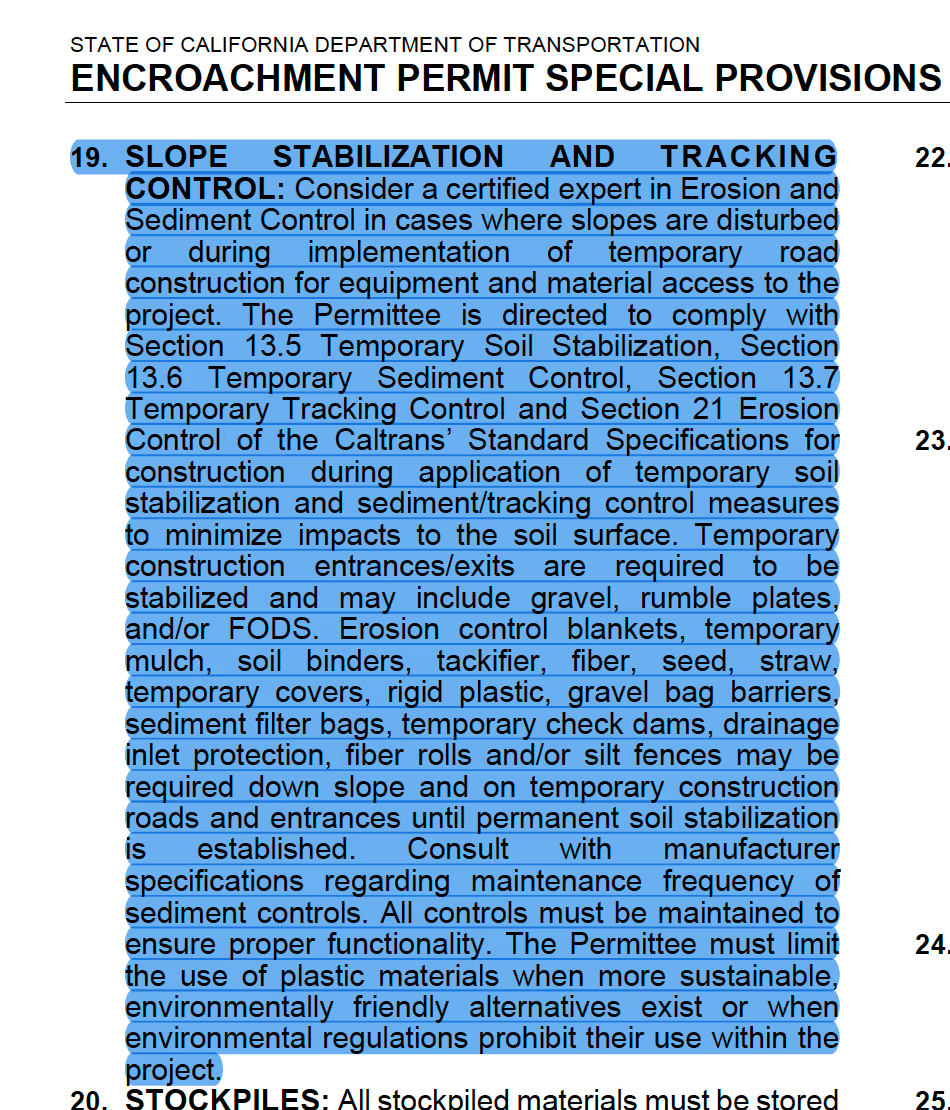
In September 2024, the California Department of Transportation (Caltrans) formally approved FODS Trackout Control Mats through an update to the Encroachment Permit Stormwater Special Provisions (SWSP). FODS is now listed alongside gravel and steel rumble plates as an accepted TC-1 stabilized construction entrance solution across all Caltrans districts.
The SWSP governs all work performed under a Caltrans Encroachment Permit. Section 15, Slope Stabilization and Tracking Control, now explicitly lists FODS manufactured trackout control mats as a compliant TC-1 option for temporary construction entrance and exit stabilization.
For contractors, the approval means FODS can be specified directly in SWPPP documentation without the need for additional justification. It is a pre-approved option within the Caltrans permit framework, carrying the same standing as gravel and steel rumble plates.
FODS mats can be installed over asphalt, concrete, or compacted ground without excavation and reused across multiple project phases. On the Caltrans I-10 Tune Up Project and the LAX LAMP Project, FODS provided consistent TC-1 performance across extended construction timelines, reducing the material and maintenance costs associated with traditional aggregate entrances that require ongoing replenishment.
CASQA BMP Handbook Recognition - TC-1 Stabilized Construction Entrance
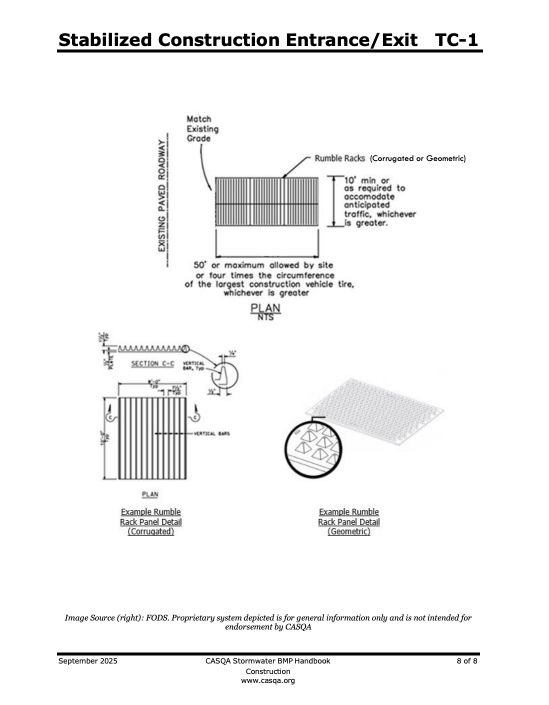
FODS is also recognized in the California Stormwater Quality Association (CASQA) Construction BMP Handbook under the TC-1 stabilized construction entrance specification. The CASQA BMP Handbook is the primary reference used by SWPPP practitioners and inspectors throughout California, making this recognition significant for day-to-day compliance and field inspection.
The handbook provides detailed BMP specifications including dimensional and performance criteria for TC-1 compliant entrances. FODS is identified within the TC-1 section as a valid manufactured system meeting these criteria, appearing alongside the traditional rumble rack configuration in the compliant design diagram.
Because the CASQA handbook is the go-to reference for inspectors, having FODS explicitly listed in the TC-1 specification reduces the risk of compliance challenges on-site. Practitioners can reference the handbook directly when specifying FODS on a project, without needing additional documentation.
FODS mats meet the dimensional and performance criteria shown in the CASQA TC-1 diagram, satisfying the same standard as traditional aggregate or steel plate solutions without the rock debris, replenishment costs, or roadway safety risks.
Risks of Vehicle Trackout on Roadways
Safety is a primary concern with trackout on active roadways. Traditional aggregate solutions create risk by depositing rocks and debris onto public roads, posing hazards to drivers, flaggers, and vehicles. The Caltrans Field Manual identifies this risk specifically and recommends larger vehicles use wheel wash systems or manufactured trackout control solutions.
FODS uses a rockless technique to clean vehicle tires and does not pose the same risk of injury or liability as aggregate-based entrances. Each FODS mat is fully recyclable and reduces the environmental impact from aggregate production, transportation, and disposal.
Caltrans SWPPP and BMP Resources
The California Department of Transportation (Caltrans) provides comprehensive stormwater and water pollution control resources for both Caltrans staff and contractors. These include SWPPP and WPCP templates, the SWPPP/WPCP Preparation Manual, and the Construction Site Best Management Practices (BMP) Handbook.
Key resources for TC-1 compliance:
- Caltrans Stormwater Pollution Control resources
- Caltrans Construction Site BMP Manual - Section 6 (Trackout Control)
- Caltrans BMP Field Manual
- CASQA BMP Handbooks
- EPA California NPDES Permits
The Water Boards issue NPDES Stormwater Permits (also called Waste Discharge Requirements) that regulate discharges to waters of the United States. Construction and industrial stormwater permit coverage generally requires a SWPPP identifying BMPs, while MS4 operators comply through a municipal stormwater program.
Contact us to find out more about FODS Reusable Construction Entrances in California, or download the California State Submittal Package for SWPPP documentation support.
Resources
Caltrans Stormwater Pollution Control
Caltrans Construction Site Best Management Practices (BMP) Manual - Section 6
Caltrans Construction Site Best Management Practices (BMP) Manual
Caltrans Construction Site Best Management Practice (BMP) Field Manual and Troubleshooting Guide