Purdue University Hypersonic Testing Facility Uses FODS to Mitigate Trackout
Purdue University has long been synonymous with research excellence and pioneering innovation. From the Neil Armstrong Hall of Engineering, named for one of its most famous alumni, to the David E. Ross Research Foundation, the West Lafayette, Indiana campus has helped shape American science and engineering for more than 150 years. In 2024, Purdue once again advanced that legacy with the opening of its new $41 million Hypersonics and Applied Research Facility, a landmark project positioning the university at the global forefront of high-speed flight research.
This facility represents far more than a new building. It is a next-generation laboratory designed to unlock the secrets of hypersonic travel, which is flight at speeds exceeding five times the speed of sound. Yet while the science inside the walls captured national attention, the construction of the facility itself demanded equally advanced thinking. Behind every groundbreaking research center lies a construction project with its own environmental, logistical, and community challenges. For Purdue and its construction partner, F.A. Wilhelm Construction, solving one of those challenges meant turning to FODS Trackout Control Mats.


Purdue University at the forefront of hypersonic flight
At the heart of the new facility sits the Hypersonic Pulse, or HYPULSE, shock tunnel, a one-of-a-kind piece of research infrastructure that generates high-temperature shock waves capable of replicating the extreme conditions encountered during hypersonic flight. Researchers can use the tunnel to simulate atmospheric re-entry, missile interception, and next-generation propulsion environments in remarkable detail. By reproducing flight conditions across an enormous range of Mach numbers, the HYPULSE tunnel provides a testing environment that very few facilities in the world can match.
Complementing the HYPULSE tunnel is the world's only Mach 8 quiet wind tunnel, housed within the same complex. While conventional hypersonic tunnels introduce significant acoustic noise that can mask subtle aerodynamic phenomena, the Mach 8 quiet tunnel delivers a low-disturbance flow environment that mirrors the conditions of actual flight at high altitude. This distinction is critical. Quiet-flow data allows engineers to study boundary-layer transition, heat transfer, and aerothermodynamic effects with a precision that noisy tunnels simply cannot provide. Together, these two systems form an unmatched combination of capabilities, cementing Purdue's reputation as a global leader in hypersonic research.
The facility's importance extends well beyond academia. Hypersonic technology is central to United States national defense priorities and to the future of commercial aerospace, including next-generation space-access vehicles and long-range civil aviation. Every test conducted inside the new Purdue laboratory contributes to a body of knowledge that will shape aircraft, spacecraft, and defense systems for decades to come. Purdue's decision to anchor its hypersonics program in a purpose-built research complex reflects years of institutional investment in the field, including close collaborations with the United States Department of Defense, NASA, and leading aerospace primes. That future, however, began with a construction project, and with a series of unglamorous but critical decisions about how to build responsibly.
The High-Tech Construction Entrance Solution
Constructed by renowned Indianapolis based heavy civil and commercial contractor F.A. Wilhelm Construction, the Purdue Applied Research Institute's new facility is not just a hub for cutting-edge research; it's a testament to Purdue's dedication to maintaining a clean and safe environment. Incorporating FODS Trackout Control Mats at the construction site underscores this commitment. These mats are designed to prevent the spread of debris and mud onto public roadways, a common concern during large-scale construction projects.
By employing FODS Trackout Control Mats, Wilhelm and Purdue University ensures its ambitious project does not negatively impact the surrounding community. These mats effectively trap and contain debris, preventing it from being tracked onto streets by vehicles exiting the site. This measure not only keeps the nearby roads clean but also enhances safety by reducing the risk of accidents caused by debris.
The strategic use of these mats at the Hypersonics and Applied Research Facility is a shining example of how technological advancements and environmental stewardship can go hand in hand. Purdue University's approach demonstrates that progress in science and technology can be achieved while respecting and protecting the environment and local community.
The FODS Solution
Traditional trackout control methods, including loose crushed rock pads, wash stations, and rumble strips, come with well-known limitations. Rock pads become saturated and ineffective within weeks, require constant replenishment, and are expensive to remove and restore at project closeout. Wash stations consume large volumes of water and generate sediment-laden runoff that must be managed separately. Neither approach scales well for long-duration projects under heavy traffic.
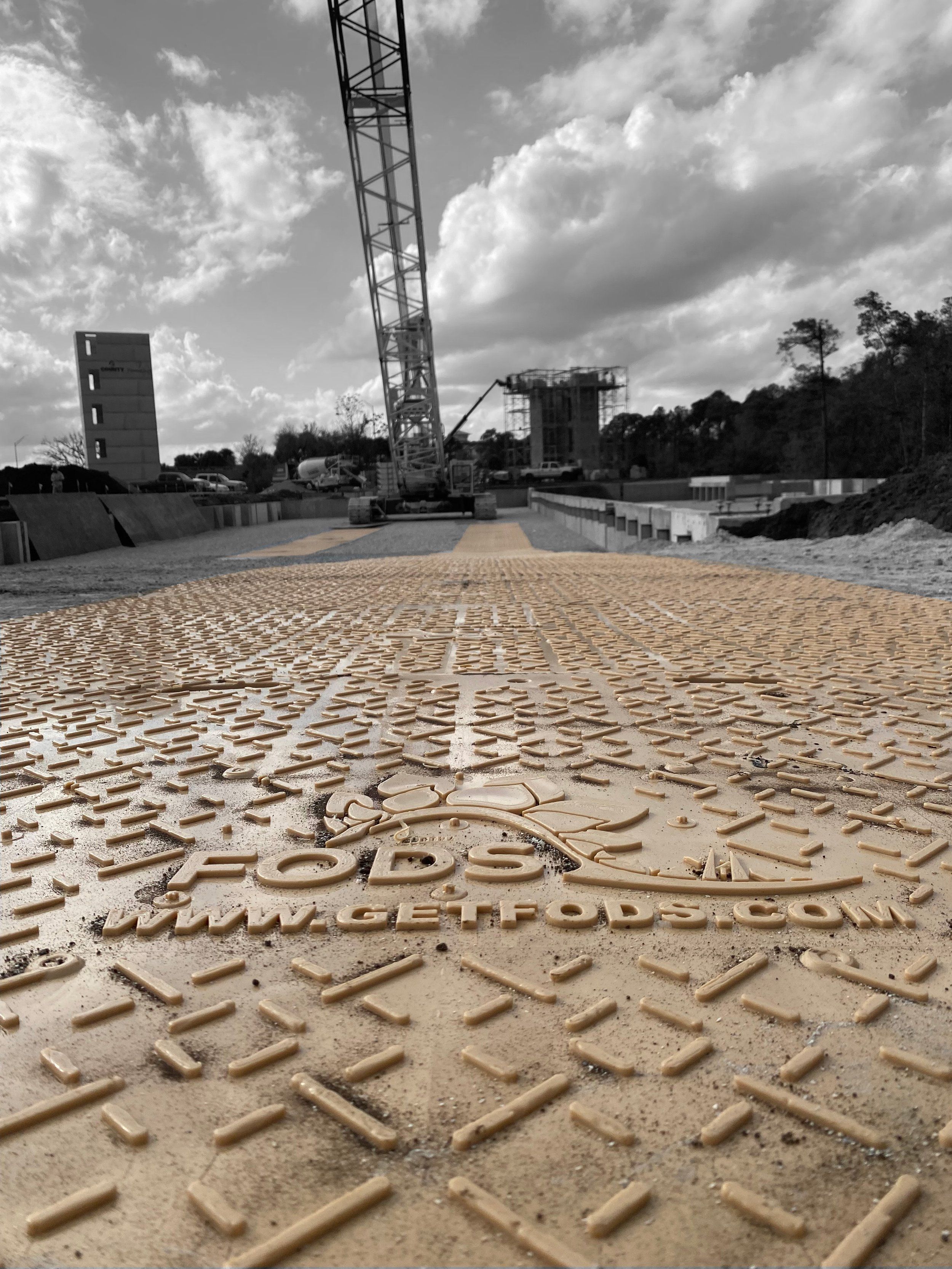
FODS Trackout Control Mats offered Wilhelm Construction a smarter alternative. Engineered from high-density polyethylene with a patented pyramid-based tread pattern, FODS mats are designed to dislodge mud and debris from vehicle tires as they drive across the surface. The interlocking mats form a durable, reusable construction entrance that performs consistently from the first day of installation to the last.
The benefits over conventional methods are substantial. FODS mats install in hours rather than days, requiring no excavation or aggregate delivery. They can be relocated as site conditions change, removed cleanly at project completion, and reused on future projects, eliminating the waste stream associated with traditional rock pads. Because they do not rely on water, they avoid the runoff management burden of wash stations. And because their performance does not degrade with saturation, they deliver consistent trackout control through wet weather, freeze-thaw cycles, and high traffic volumes alike.
Implementation at the HYPULSE Site
F.A. Wilhelm Construction, a renowned Indianapolis-based heavy civil and commercial contractor, deployed FODS mats at the primary construction entrance to the Hypersonics and Applied Research Facility site. Positioned strategically where equipment and delivery trucks exited the active work zone onto Purdue's internal road network, the mats formed the last line of defense between the construction area and the wider campus environment.
From day one, the results were visible. Vehicles exiting the site left behind dramatically less mud and debris. Roads adjacent to the facility remained clean, requiring minimal sweeping and no emergency cleanup responses. Dust complaints, common on projects of this scale, were virtually eliminated. Site personnel reported that the mats held up under the weight of heavy concrete trucks, cranes, and earthmoving equipment without deformation or displacement.
Equally important, the environmental footprint of the construction entrance itself was reduced. Because no aggregate was imported for a rock pad, the project avoided the emissions associated with hauling tens of tons of stone to and from the site. At project closeout, the mats were simply lifted, cleaned, and returned to inventory for use on the next Wilhelm project, an outcome that aligned seamlessly with Purdue's institutional sustainability commitments and with Wilhelm's own reputation for forward-thinking jobsite management.
Project managers also appreciated the operational flexibility the mats provided. When site logistics shifted during the various phases of construction, including the delicate installation of the HYPULSE shock tunnel components, the FODS entrance could be reconfigured or relocated in a single shift. That kind of agility is difficult to achieve with permanent aggregate installations, and it proved especially valuable on a project where the movement of oversized research equipment had to be carefully coordinated with ongoing concrete and steel work.
A Partnership in Excellence
The success of the HYPULSE project speaks to a broader truth about modern construction. World-class research facilities are no longer judged solely on the science they enable; they are also judged on how responsibly they are built. Owners, contractors, and surrounding communities all expect construction activities to respect the environment, protect public safety, and minimize disruption.
By selecting FODS for trackout control, Wilhelm Construction and Purdue University demonstrated that technological advancement and environmental stewardship are not competing priorities. The same spirit of innovation that drives hypersonic research at Purdue animated the practical choices made on the construction site. Every clean tire leaving the project represents a small but meaningful contribution to cleaner roads, safer drivers, and a more sustainable built environment, and it reinforces the university's long-standing promise to be a good neighbor to the West Lafayette community.
Looking Ahead
As Purdue's new Hypersonics and Applied Research Facility begins producing the data that will shape the next generation of flight, the facility itself stands as a model for how high-performance research infrastructure can be delivered in harmony with its surroundings. The HYPULSE tunnel and the Mach 8 quiet wind tunnel will serve researchers for decades to come. The FODS mats that guarded the construction entrance have already moved on to their next assignment, ready to deliver the same clean, efficient, and reusable trackout control wherever heavy construction demands a better solution.
For general contractors, developers, and institutional owners evaluating trackout control options on their own projects, the Purdue case study offers a compelling template. When the standard of excellence is high, whether measured in Mach numbers or in community impact, FODS delivers the performance, sustainability, and reliability that today's most ambitious projects demand.

ABOUT FODS, LLC.
Based in Centennial Colorado, FODS is working to replace ineffective and costly traditional rock stabilized construction entrances, saving you time and money. Our proprietary mat design works to effectively remove debris from your vehicle tires without damaging the tire or the ground’s surface. We provide the only durable, reusable, and environmentally friendly trackout control system currently available on the market. FODS Vehicle Trackout Controls BMP mats are 100% Made In the USA and 100% recyclable.
To find out more information on how we can help your project stay on schedule and in compliance contact 844-200-3637 or email us at [email protected].