Lane-Security Paving Joint venture installs FODS Reusable Construction Entrance BMP on CalTrans Landmark $1.5 Billion Dollar, 33 mile Interstate 10 Corridor Project
Background
When the California Department of Transportation (CALTrans) and the San Bernardino County Transportation Authority put the I-10 Corridor Project out to contract, they handed the winning bidder one of the most constrained heavy civil jobsites on any U.S. interstate: 33 miles of live freeway carrying 265,000 vehicles a day, a $1.5-billion program of ramps, structures and electronic tolling, and an environmental compliance regime that treats every shovel of dirt as a potential permit issue. The joint venture of Lane Construction and Security Paving Co. won the work, then had to solve a quieter but equally demanding problem: how to keep construction equipment moving on and off a linear work zone, while maintaining compliance with California Stormwater Quality Association (CASQA) BMP requirements to prevent the dragging of mud, rock and sediment onto a high-speed freeway.
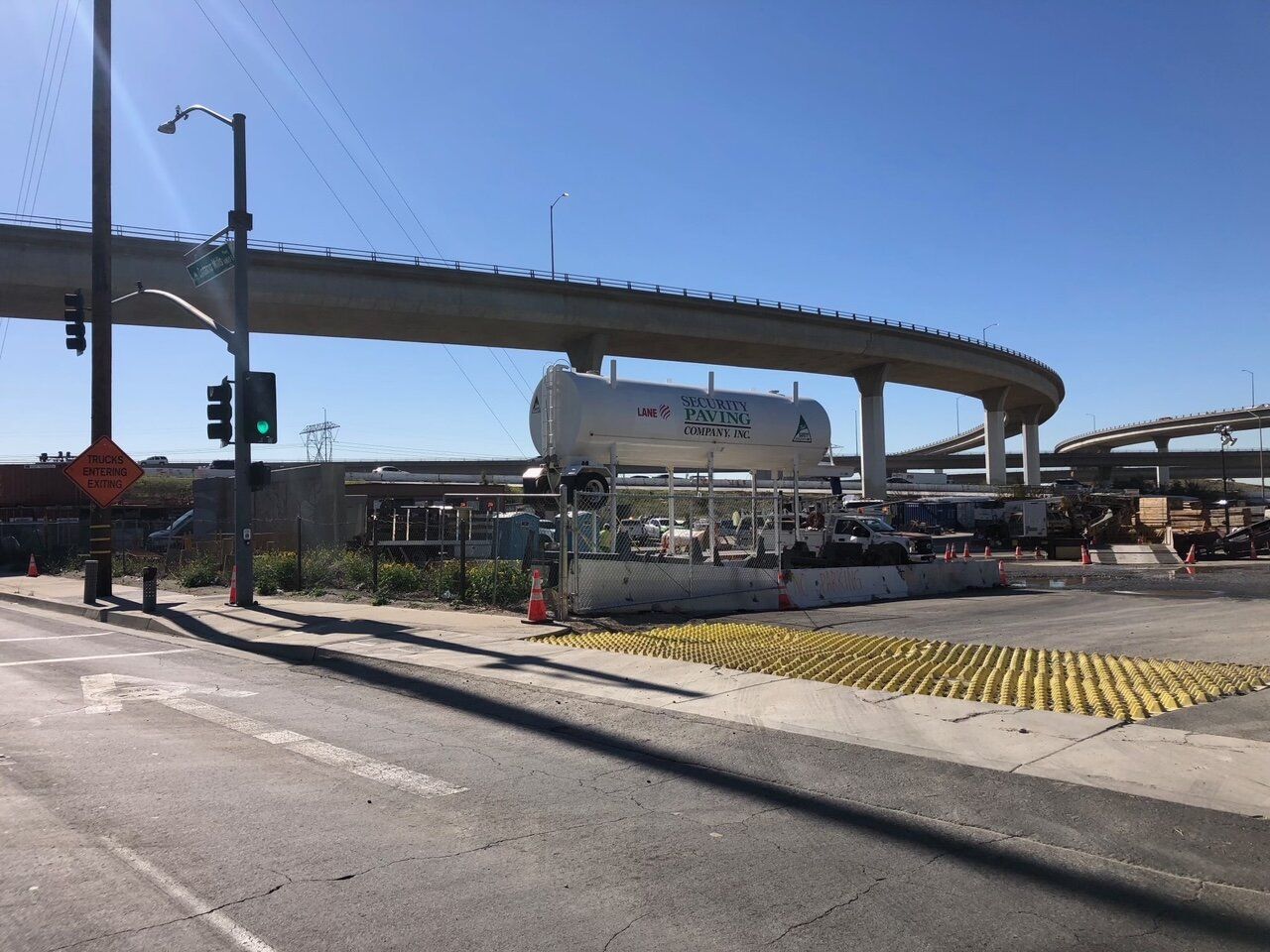
Their answer was a shift away from rock-based construction entrances / TC-1 and toward a reusable composite trackout-control mat system. Over the course of the project, Lane–Security Paving deployed more than 100 FODS TC-1 compliant mats at staging yards, structure sites and haul-road tie-ins along the corridor — a BMP decision that reshaped the logistics of site access on a job where the work zone itself moved almost daily.
The Corridor: A Truck Route Under Pressure.
Interstate 10 is the fourth-largest east–west interstate in the national highway system and the primary freight artery linking Southern California ports and warehouses with the rest of the United States. In the segment crossing San Bernardino and Los Angeles counties, I-10 also functions as the main commuting spine between the Inland Empire and the Los Angeles Central Business District. Demographic forecasts used by Caltrans and SBCTA project a 30% population increase in the service area by 2035, layered on top of peak-hour operation already saturating the existing HOV lanes at their theoretical capacity of 1,850 vehicles per lane per hour.
The agencies’ response was the I-10 Corridor Project, a multi-phase widening and modernization package that extends from the Los Angeles–San Bernardino county line east to the I-10/I-15 interchange. The final phase, now under construction, converts 11 miles of HOV lanes in each direction into High-Occupancy Toll (HOT) express lanes, installs gantry-mounted tolling and enforcement infrastructure and adds pedestrian bridges across the mainline.
Scope Of Work:
The design package Lane–Security Paving inherited is typical of a late-2010s Caltrans corridor rebuild in scale, less typical in linearity. The contract called for realignment of ramps at 10 interchanges, modifications at 7 local arterial crossings and work on 26 structures, box culverts and retaining/sound walls. Bridge work included 18 new bridges and 18 bridge widenings. Drainage called for 78,601 lin ft of new pipe and inlet structures. Overlaid on the civil work is a major ITS (intelligent-transportation-systems) package built around the Regional Integration of Intelligent Transportation Systems (RIITS) program managed by LA Metro, including new fiber-optic communications, CCTV, changeable message signs, updated loop detectors and ramp metering tied into the region’s Transportation Management Centers. Every major highway and local road in the corridor is signal-synchronized and networked into that control hierarchy.
Because the program is effectively a rolling linear construction zone along an active interstate, staging and haul-road geometry change segment by segment. So does the location of every construction entrance that ties the work zone to the public road network.
The Trackout Problem On A Linear, Live Traffic Project:
Lane–Security Paving moved more than 2 million tons of earth over the course of the project. That volume, combined with the adjacency of the work zone to mainline travel lanes, produced a textbook set of trackout, fugitive-dust and stormwater-sediment exposures. Every construction vehicle leaving the jobsite with mud or aggregate in its tread had the potential to deposit that material in a 70-mph travel lane, create a windshield-strike or loss-of-traction hazard, contribute to an exceedance under the South Coast Air Quality Management District’s fugitive-dust rules, or carry sediment into the stormwater conveyance network regulated under California’s Construction General Permit and the statewide NPDES program.
Caltrans’ own Construction Site Best Management Practices Manual identifies the construction entrance/exit, designated TC-1, as the primary BMP for trackout control. The specification sets performance rather than prescriptive requirements: the entrance must effectively remove sediment from vehicle tires before they reach the public right-of-way, must be maintained throughout construction and must not itself become a source of tracked material or a hazard to public traffic.
For Lane–Security Paving, three operational constraints shaped the BMP decision. First, the accelerated schedule offered no tolerance for extended maintenance outages at access points; an entrance that had to be rebuilt or refreshed on a weekly cycle would show up on the critical path. Second, entrances had to be mobile. Within a single quarter, the primary work front could shift miles along the corridor, dragging the optimal entrance location with it. Third, many of the logical access points sat on existing asphalt or concrete — Caltrans right-of-way that could not be trenched to accommodate a traditional rock pad without triggering additional pavement restoration.
Why Rock Pads Were Not The Default:
The historical default for a TC-1 entrance on California highway work is a stabilized-construction-entrance rock pad: typically 50 ft or longer, 12–15 ft wide, 12 in. deep, built from 3- to 6-in. angular aggregate placed over non-woven geotextile.
On the I-10 program, the lifecycle math was unfavorable. Rock entrances are static, consumable and substrate-dependent. The aggregate clogs with fines as tires deposit mud into the voids, which eliminates the mechanical cleaning action and eventually produces a tracking source rather than a tracking solution. Refreshment requires new aggregate to be hauled in and spent material hauled out, both of which add truck trips in a corridor where every additional truck movement has to be scheduled around live traffic. Relocating a rock pad as the work front advances is effectively a demolition-and-rebuild cycle: the pad is excavated, the geotextile is removed, the subgrade is repaired and a new pad is constructed at the next access point. Multiplied across 33 miles and a multi-year schedule, the cumulative labor, equipment and disposal cost of chasing the work front with rock pads would have been material.
FODS System Selected: FODS TC-1 Reusable Entrance Mats
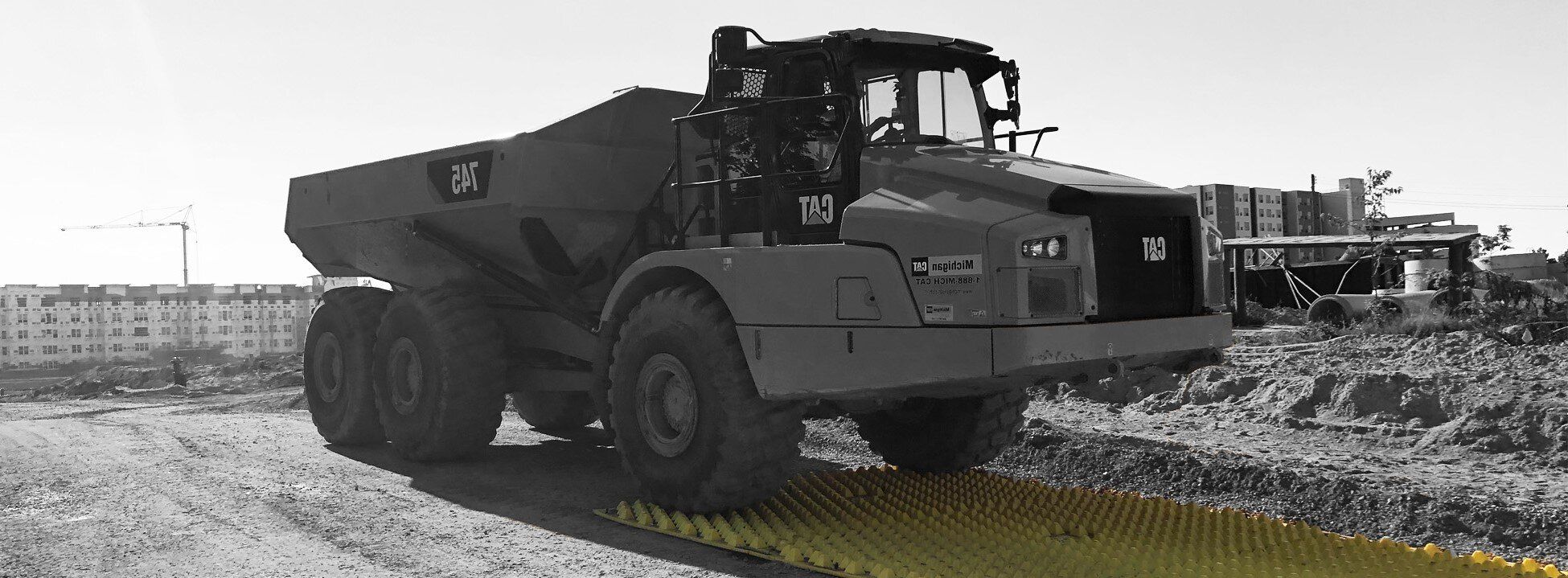
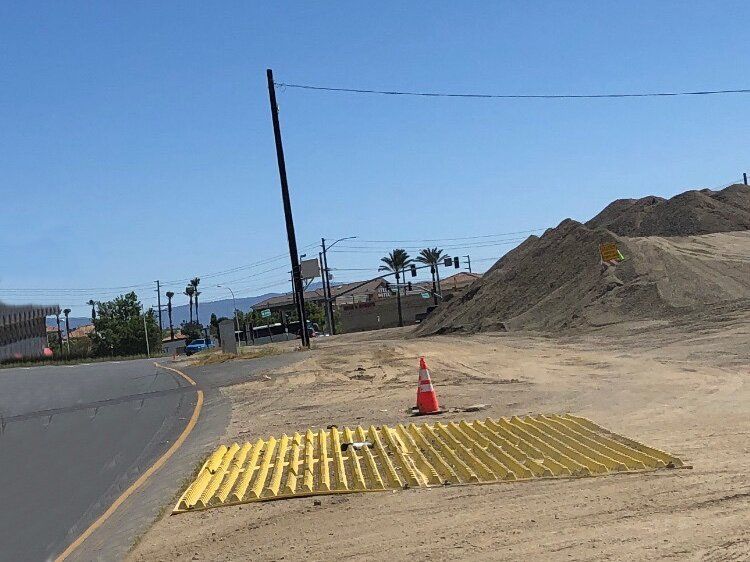
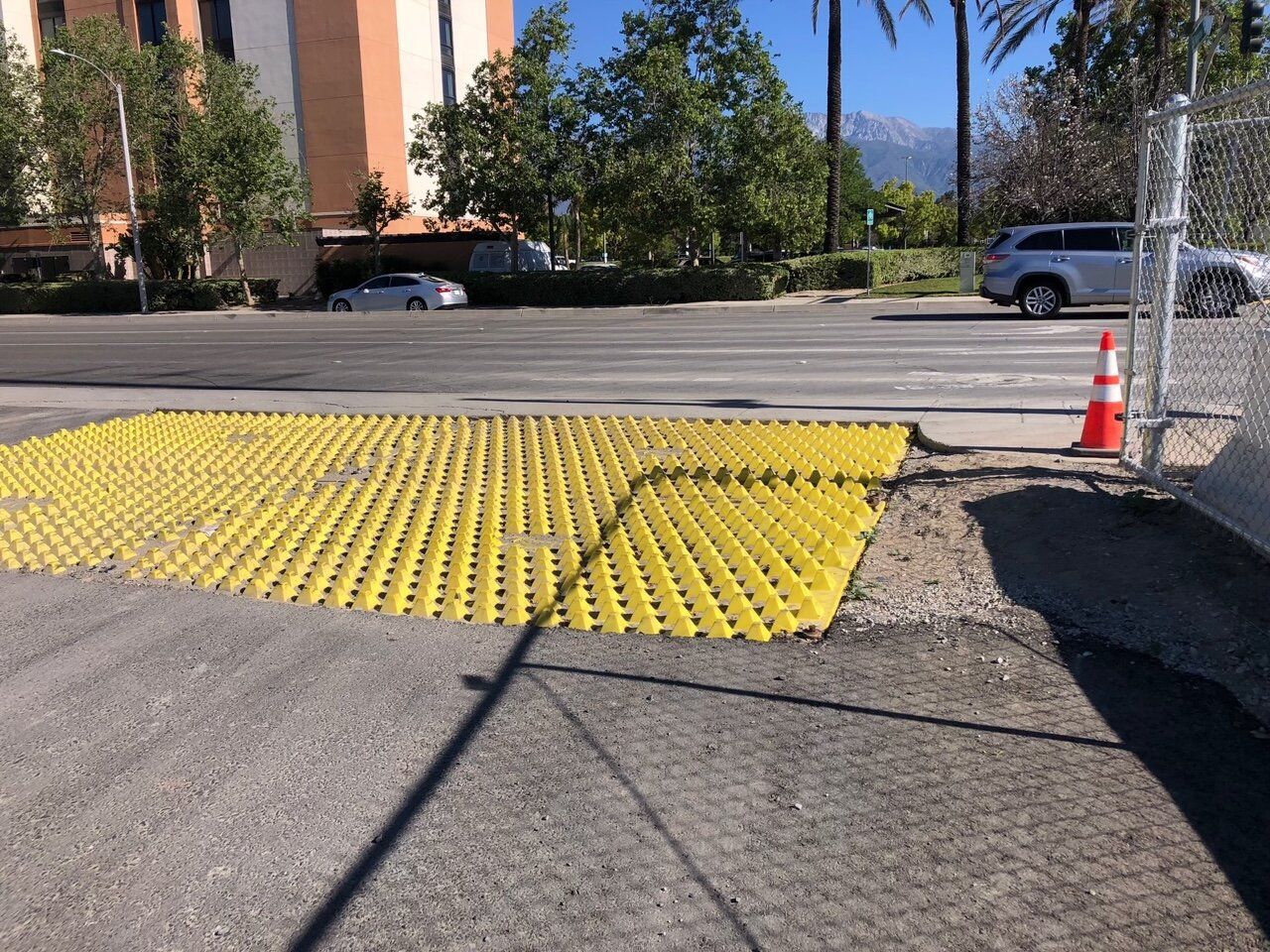
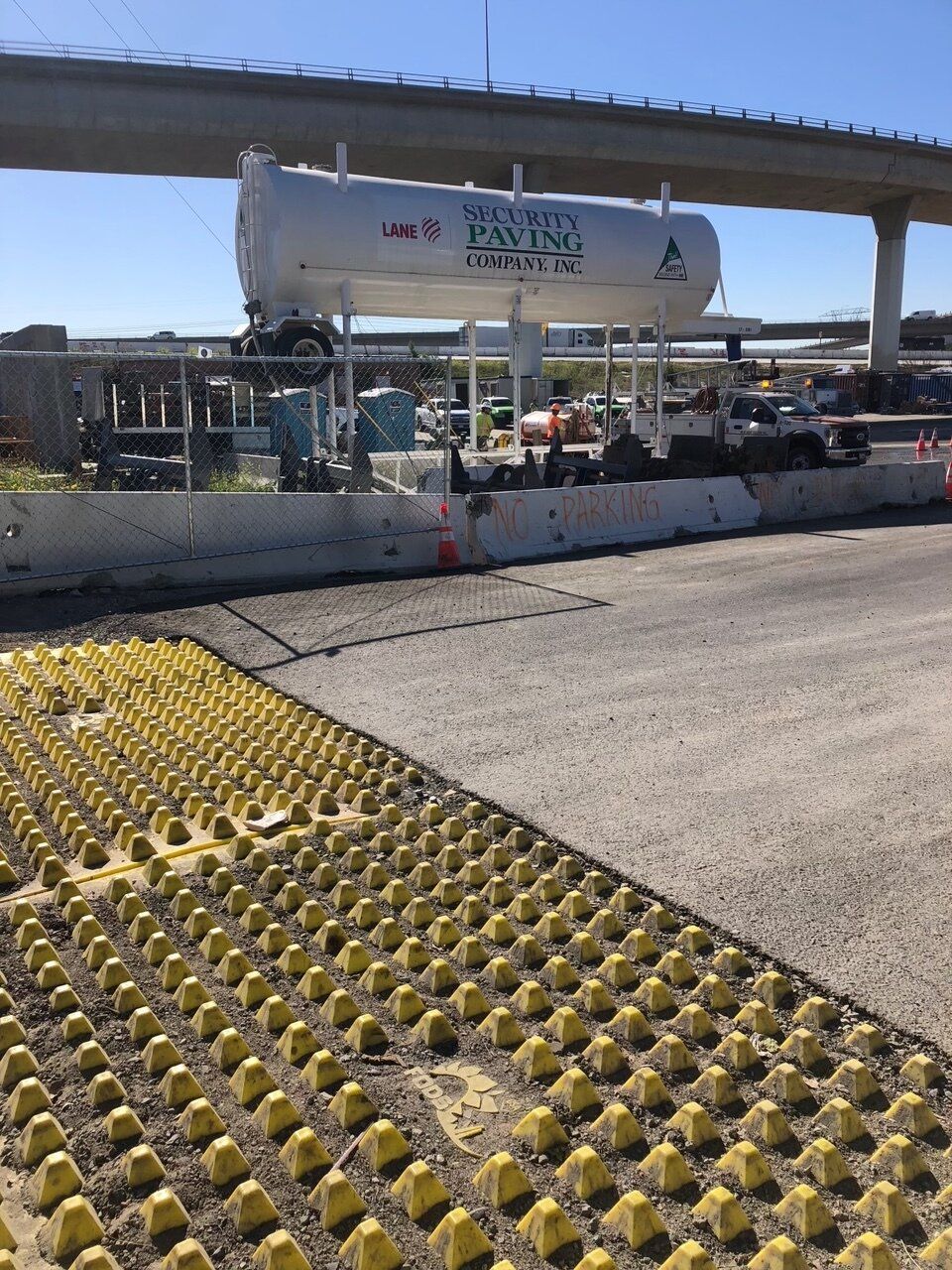
Lane–Security Paving standardized on the FODS Trackout Control System as the project’s primary TC-1 BMP. The product is an engineered, highly durable, composite mat with an designed pyramid surface geometry; individual mats are installed to form continuous entrance to meet the required size to allow for any vehicle to exit the site. Due to proven superior performance, FODS Trackout Control Mats are able to be used at roughly half the distance of travel versus tradition rock pads.
The installation process is extremely simple and designed to save time and reduce labor. As there is no need for aggregate placement, no geotextile subgrade or excavation when installing a FODS system, typical installations take less than 20 minutes and do not require heavy equipment. The same installation time governs relocation: when a segment closes out, the mats are quickly removed and redeployed at the next access point. On the I-10 corridor, that specification translated directly into an ability to keep the trackout BMP on the same weekly move schedule as the earthwork and paving crews.
Deployed on The Corridor:
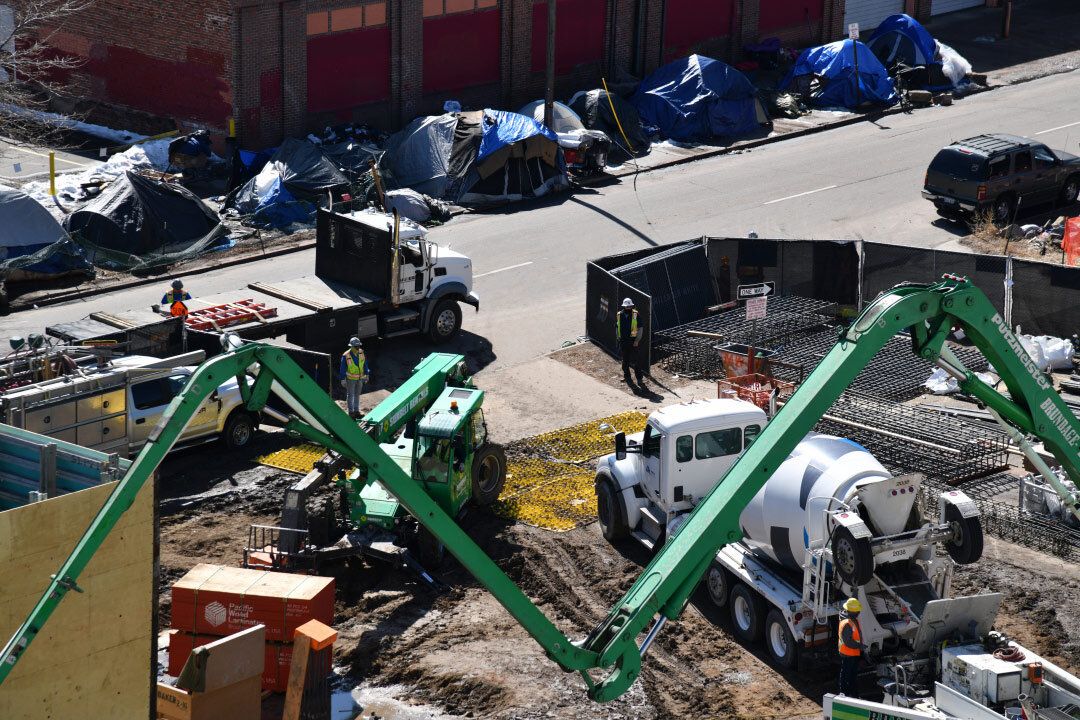
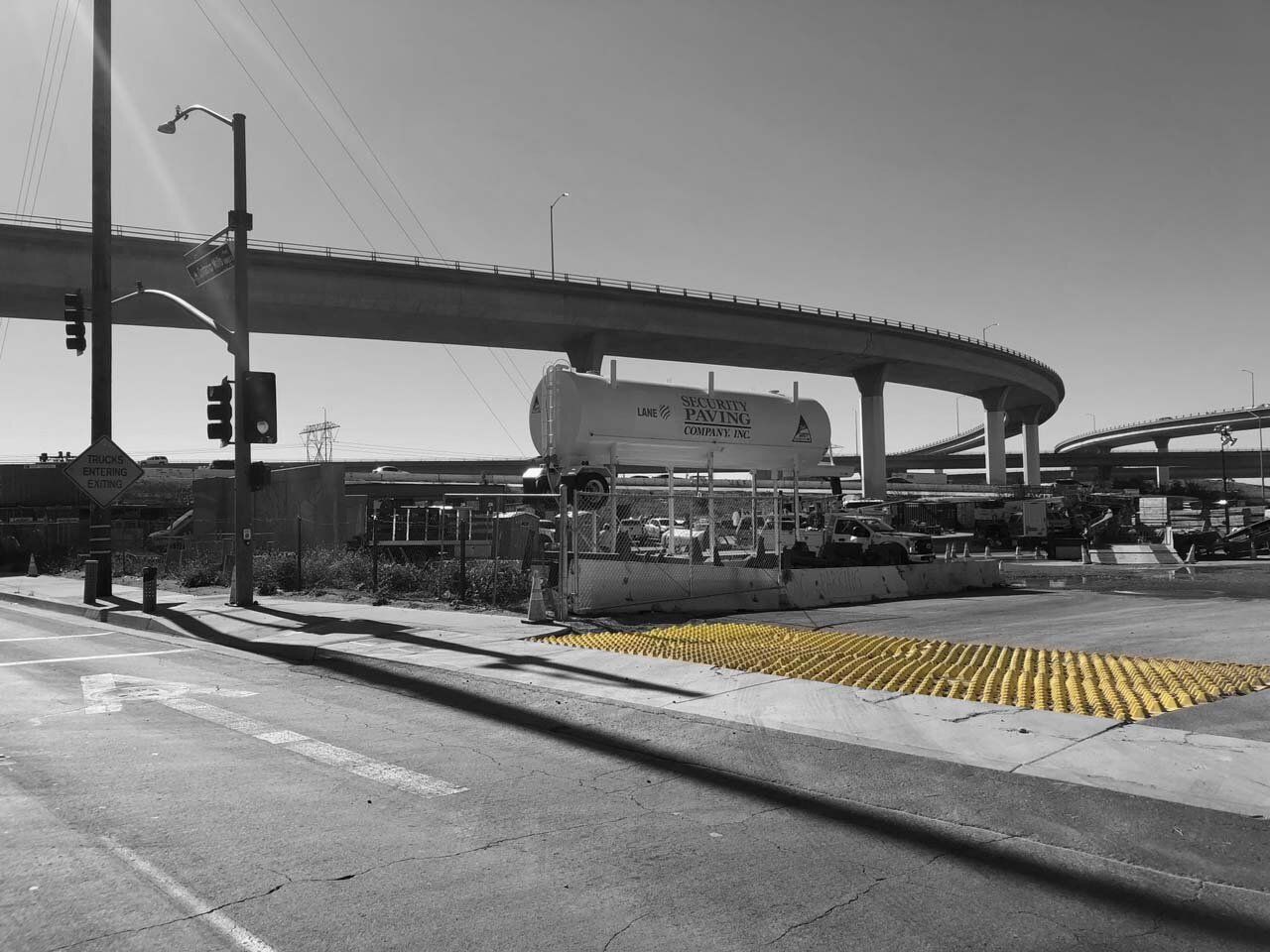
Over the course of the project, Lane–Security Paving installed more than 100 FODS mats across the 33-mile alignment. Entrances were established at active staging yards, soil-import locations, structure sites and paving pull-offs; configurations ranged from straight single-lane runs to double-wide, two-way truck entrances and stepped layouts that accommodated grade transitions between the work zone and adjacent public roads.
The mobility of the system changed day-to-day operations as much as it changed compliance posture. Superintendents were able to select entrance locations based on the current traffic-control plan, the sequencing of the day’s pours and pulls and adjacent-community impacts, rather than on where the project had previously invested in a rock pad. When a crew demobilized from one interchange to the next, the trackout BMP moved with them on the same shift. Mats originally placed during early earthwork remained in rotation through structure and paving phases, then followed the work east into the final HOV-to-HOT conversion.
Performance and Compliance:
The contractor’s reported outcomes on the I-10 program align with the four key categories where a FODS Reusable Entrance System outperforms a conventional Stabilized Construction Entrance on a linear highway job.
• Regulatory compliance. TC-1 compliant entrances kept construction access aligned with Caltrans’ BMP manual and the Construction General Permit, reducing the exposure to notices of violation that typically drive project-level delay and administrative cost.
• Freeway safety. Reduced trackout onto I-10 mainline lanes lowered the risk of windshield strikes and loss-of-traction incidents attributable to construction access, a recurring source of secondary crashes on urban interstate work.
• Schedule protection. Sub-30-minute installation and relocation kept entrance BMPs off the critical path. As earthwork advanced, entrances advanced with it within the same shift rather than requiring a separate subcontractor mobilization.
• Lifecycle cost. Reusable mats eliminated the recurring procurement, hauling, placement, refreshment and disposal of aggregate at each access point, costs that compound on a multi-year, linear program.
Final Phase:
The I-10 Corridor Project is now in its final construction phase. Lane–Security Paving is converting 11 miles of HOV lanes in each direction to HOT express lanes, installing toll-collection and enforcement infrastructure and completing a series of new pedestrian bridges spanning the freeway. Once open, the express-lane system is designed to restore meaningful travel-time advantages for carpool and transit users, reduce stop-and-go operation and its associated emissions and provide a durable congestion-management tool as the Inland Empire grows into its 2035 demographic projections.
The FODS mat inventory remains in rotation through that final phase, serving as the project’s standard TC-1 BMP across the remaining structure and tolling work.
About The Joint-Venture:
Lane–Security Paving, a Joint Venture pairs one of the oldest heavy-civil contractors in the country with one of the most active urban-freeway specialists on the West Coast — a structure Caltrans and SBCTA have used repeatedly to marry national-program experience with local Caltrans-delivery depth on complex Southern California corridors.
The Lane Construction Corporation. Lane traces its roots to 1890, when John S. Lane founded a stone-crushing operation in Meriden, Conn. serving railroads and municipal streets; the business was formally incorporated as The Lane Construction Corporation in 1902. Headquartered today in Charlotte, N.C., Lane is one of the largest heavy-civil contractors in the United States, with delivery experience across highways, bridges, tunnels, mass transit, dams, levees, reservoirs and airport systems. In 2016, Lane was acquired by Webuild (formerly Salini Impregilo), an Italian multinational and one of the largest global contractors in sustainable mobility, hydro energy, water and complex civil infrastructure. The transaction made Lane a wholly owned U.S. subsidiary of Webuild and expanded the firm’s access to the global parent’s tunneling, bridge and mega-project resources — capabilities that show up on programs like the I-10 Corridor Project, where linear heavy-civil scope is layered with major-structure and ITS work.
Security Paving Company, Inc. Security Paving was founded in 1949 as a small, family-owned street-improvement contractor in California’s San Fernando Valley. Over the intervening decades it grew into one of the largest regional heavy-civil contractors in the western United States, with corporate headquarters in Westlake Village, Calif. and regional offices across California and Nevada. Security Paving is best known as a Caltrans specialist — it has been cited as the largest contractor by volume for Caltrans over a multi-year span — and its portfolio is weighted toward urban freeway, interchange, bridge and airport work delivered across bid-build, design-build, CM/GC and emergency-response contracts. That Caltrans-specific experience is a meaningful contribution to the joint venture on I-10: the specification language, BMP requirements, traffic-control protocols and inspection cadence used on the corridor are the same playbooks Security Paving’s field staff has run on dozens of prior Caltrans jobs.
Combining Lane’s national heavy-civil bench and Webuild-backed mega-project resources with Security Paving’s Southern California Caltrans-delivery experience gave the I-10 Corridor Project a contracting team sized to the job in both directions — program scale and local execution.
About FODS:
FODS, a division of Exchange Income Corporation is headquartered in Centennial, CO and is the leading manufacturer of composite reusable trackout-control mat used on the I-10 Corridor Project and construction projects around the world. The mats are TC-1 compliant as construction entrance/exit BMPs, are 100% manufactured in the United States, and are fully reusable and recyclable at end of service life.
About FODS:
FODS, a division of Exchange Income Corporation is headquartered in Centennial, CO and is the leading manufacturer of composite reusable trackout-control mat used on the I-10 Corridor Project and construction projects around the world. The mats are TC-1 compliant as construction entrance/exit BMPs, are 100% manufactured in the United States, and are fully reusable and recyclable at end of service life.