
Texas Stabilized Construction Exits and Trackout Control
TPDES Construction General Permit TXR150000 and TxDOT Compliance
Texas is the largest state in the continental United States, and its construction reaches every kind of landscape and watershed, from the Gulf Coast bays and Houston bayous to the Trinity, Brazos, and Colorado rivers, the Edwards Aquifer and Hill Country springs around Austin and San Antonio, the Rio Grande along the Mexico border, and the Permian Basin oil and gas fields of West Texas. With building booming across Houston, Dallas and Fort Worth, Austin, and San Antonio, and with major energy, semiconductor, and aerospace projects underway, keeping sediment on the job site and off public roads is a core compliance duty, and a stabilized construction exit is one of the first controls installed and inspected.
Texas TPDES Construction General Permit TXR150000
In 1998, Texas assumed responsibility for administering the National Pollutant Discharge Elimination System, and the Texas Commission on Environmental Quality (TCEQ) now implements the program through the Texas Pollutant Discharge Elimination System (TPDES). TPDES oversees most stormwater and other pollutant discharges to Texas surface waters, and in 2021 the EPA granted TCEQ authority to regulate certain discharges associated with oil and gas operations as well.
Construction that disturbs one acre or more, or that is part of a larger common plan of development of that size, must obtain coverage under the TPDES Construction General Permit, TXR150000, and prepare a Stormwater Pollution Prevention Plan, which Texas calls an SWP3. The current permit took effect on March 5, 2023 and runs through March 5, 2028, and TCEQ has begun the renewal process, holding a stakeholder meeting in June 2026, so operators should confirm the current version when preparing an application.
Texas scales the requirements by size. Large construction sites that disturb five acres or more file a Notice of Intent with TCEQ, pay a fee, and post a site notice. Small construction sites that disturb at least one but less than five acres generally do not file an NOI but must prepare an SWP3 and post a site notice, and a site that is not part of a larger common plan may qualify for a Low Rainfall Erosivity Waiver if the calculated erosivity, or R-factor, for the construction period is less than five. On multi-operator projects, operators can share a single SWP3, provided each signs it and their responsibilities are clearly defined. In every case the permit requires the SWP3 to describe the controls used to minimize the off-site vehicle tracking of sediment and the generation of dust.

TxDOT Stabilized Construction Exit
The Texas Department of Transportation (TxDOT) maintains a statewide Storm Water Management Plan with minimum control measures to keep its work in compliance with TPDES, and the measure for sediment trackout is the stabilized construction exit. TxDOT specifies these controls under Item 506, Temporary Erosion, Sedimentation, and Environmental Controls, in its Standard Specifications, most recently the 2024 edition, and pays for them as Construction Exits to install and remove.
A standard rock stabilized exit is a layer of angular aggregate, often six to twelve inches thick, placed over a geotextile fabric on a graded surface that directs runoff to sediment controls. The aggregate must be redressed with fresh rock as sediment fills the voids, and it must be removed when the work is complete. Importantly, TxDOT guidance allows alternative systems, such as prefabricated mat-style or timber-based entrances, where approved by the project engineer, provided they offer comparable control of sediment trackout. That allowance opens the door to manufactured entrances like FODS on TxDOT projects.
FODS as a Compliant Construction Exit in Texas
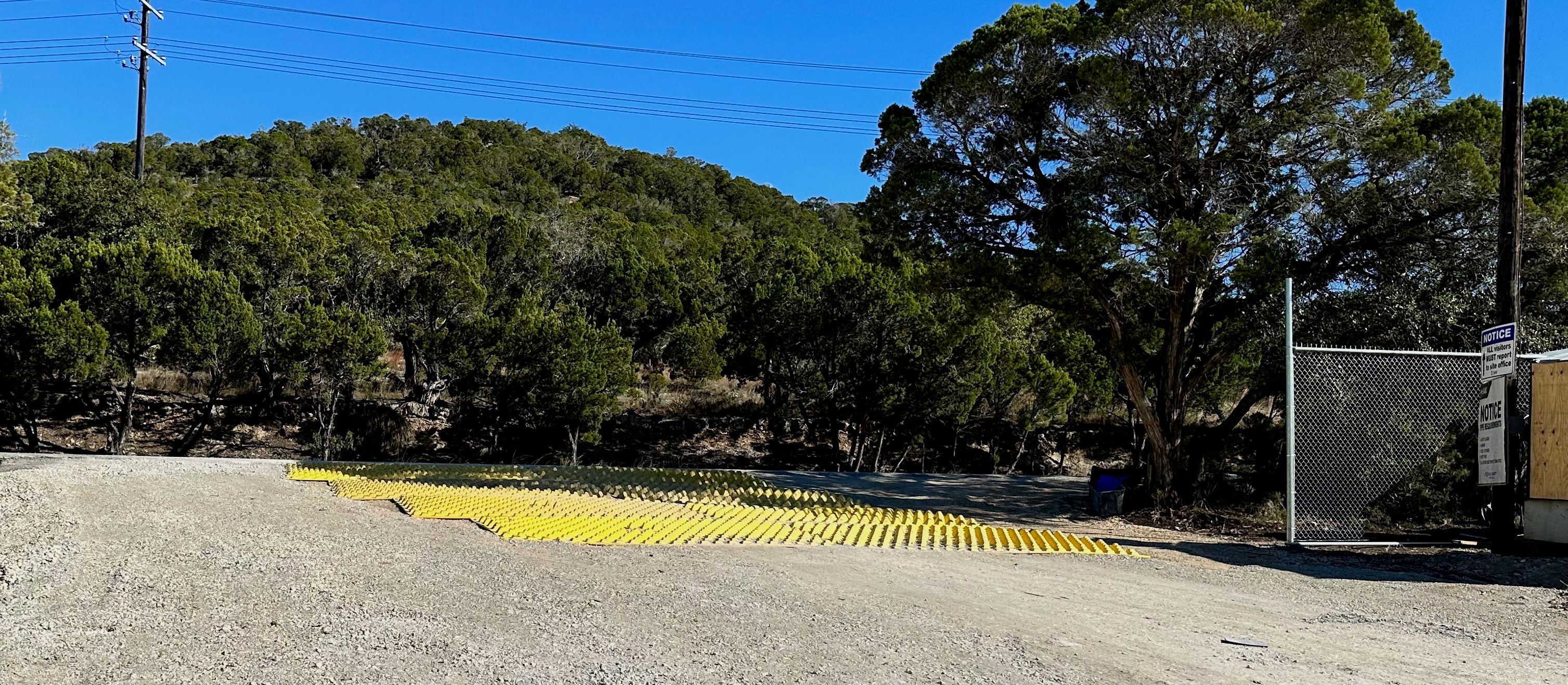
Texas does not maintain a brand-name product approval list for construction exits. TCEQ and TxDOT judge a construction exit on whether it performs the required function, minimizing off-site tracking of sediment, and the operator specifies the chosen control in the SWP3. FODS Trackout Control Mats can be named directly in the SWP3 as the site's stabilized construction exit, and they fit squarely within the TxDOT allowance for prefabricated mat-style alternatives approved by the project engineer. FODS is a rockless and waterless alternative to the traditional TxDOT rock exit, and in testing it has removed more than twice as much sediment from vehicle tires as a traditional rock entrance, while eliminating the loose aggregate and the constant redressing that the rock pad depends on.
FODS Trackout Control System
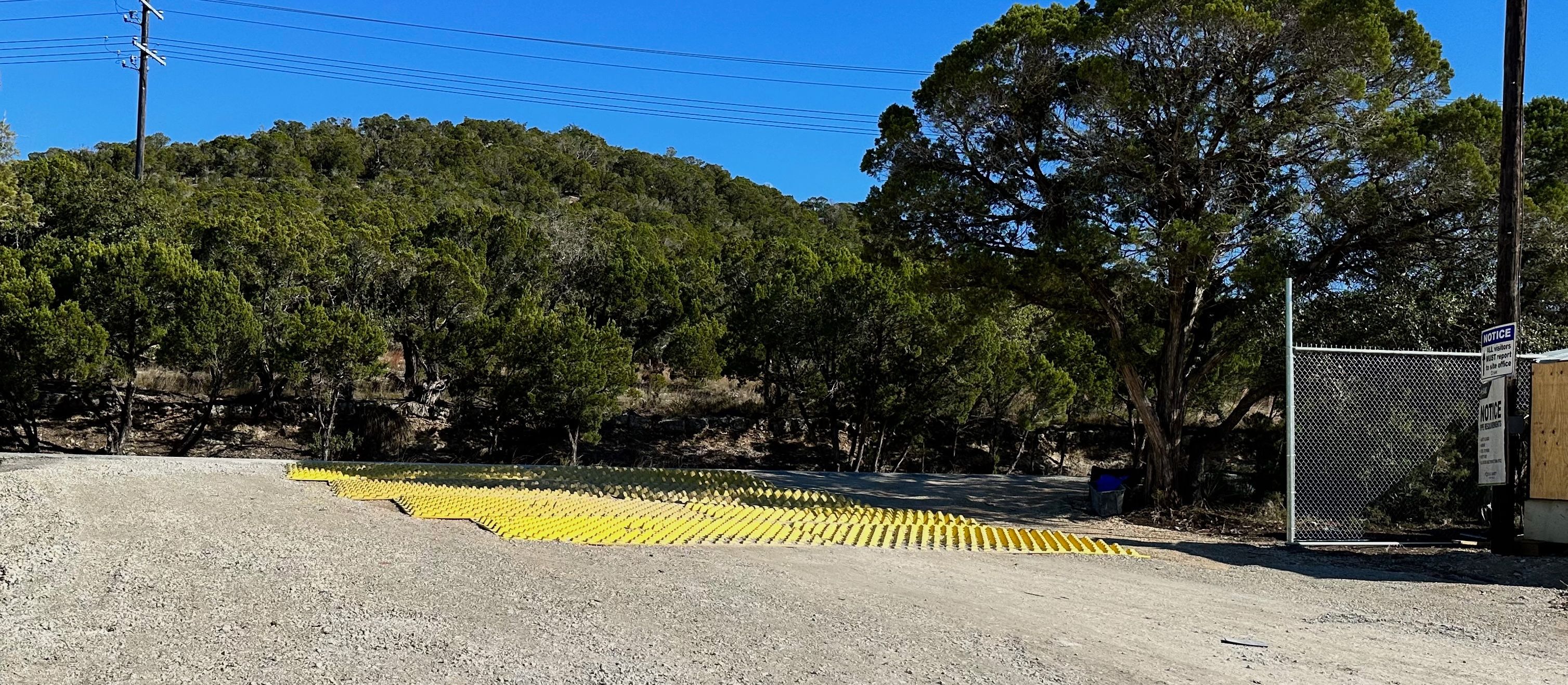
The FODS Trackout Control System is modular, built from a single layer of pre-manufactured mats with pyramid-shaped structures across the surface. As vehicle tires pass over the pyramids, the tread lugs expand and the trapped sediment falls to the base of the mat, clear of the tires. The system installs in single-lane or dual-lane layouts to fit the site, and a standard 1x5T layout provides one lane of travel with a wide turning radius next to the roadway. The mats work well on excavation, grading, and heavy civil projects where high traffic volumes quickly degrade a rock pad, and even after heavy use they can be fully restored by cleaning with a street sweeper or a shovel, which minimizes downtime and keeps the site in compliance with the TPDES permit. Installed over dirt, concrete, or asphalt without excavation and reusable across projects with a service life of more than ten years, FODS shifts the cost of a construction exit from a recurring expense to a one-time investment.
Texas Projects Using FODS
Texas is home to some of the most demanding FODS deployments in the country. At SpaceX Starbase near Brownsville, FODS serves as the stabilized construction entrance BMP at the launch complex, chosen for its consistent, predictable performance under the intense regulatory scrutiny of the FAA and TCEQ, where the company must meet Clean Water Act and TPDES requirements without slowing an aggressive launch schedule.
The performance behind those choices is documented. The Harris County Flood Control District ran a side-by-side comparison of a traditional rock construction entrance and FODS on a large excavation site with up to 800 trucks exiting per day. The district reported that FODS provided equal or greater performance than the stabilized construction access, and its daily records showed roadway cleaning reduced by 59 percent, along with a 94 percent reduction in maintenance and labor compared with the rock entrance. The study confirmed strong performance in both wet and dry conditions.
FODS has supported other marquee Texas work as well. The mats were used on the Brushy Creek Raw Water Delivery System near Austin and on a large new campus just north of the city in the Silicon Hills tech corridor, a project expected to bring up to 15,000 jobs. In Baytown, east of Houston, a two billion dollar chemical plant expansion in the oil and gas sector uses FODS for clean, long-term trackout control. Across launch pads, water infrastructure, semiconductor campuses, and petrochemical plants, the same reusable entrance keeps Texas sites compliant without the recurring cost of hauling and replacing rock.
Risks of Vehicle Trackout on Roadways
Safety is a primary concern wherever construction traffic meets a public road. Rock exits deposit aggregate and debris onto pavement, creating hazards for drivers and workers, and loose stone can lodge between dual tires and be thrown at speed. Wheel washes add the burden of supplying and containing water. FODS uses a rockless, water-free technique to clean tires and does not carry the same risk of injury or liability as aggregate entrances. The mats are durable and reusable across many projects, which reduces the environmental impact tied to aggregate production, hauling, and disposal. On Texas sites that drain to the Gulf, the Trinity, the Brazos, the Colorado, or the springs of the Edwards Aquifer, keeping rock and sediment off the road also helps keep it out of the water.
Additional Resources
TPDES Construction General Permit TXR150000
TCEQ Construction Stormwater Assistance Tools
TxDOT Item 506 - Temporary Erosion, Sedimentation, and Environmental Controls (2024)
TxDOT Storm Water Field Inspector's Guide