
Tennessee Stabilized Construction Exits and Trackout Control
TDOT-Approved Alternative to Standard Drawing EC-STR-25
From the ridgelines of the Great Smoky Mountains and the Cumberland Plateau in the east to the floodplains of the Mississippi Delta in the west, Tennessee drains to a broad and ecologically active network of rivers, including the Tennessee River, the Cumberland River that runs through Nashville, and the many watersheds that feed the Mississippi along the western border. Construction is active in every corner of the state, from the fast-growing Nashville metro around Murfreesboro, Franklin, and Gallatin, to the I-40 and I-75 corridors at Knoxville, the riverfront at Chattanooga, and the logistics and port development around Memphis. On all of it, keeping sediment on the job site and off public roads is a core compliance duty, and a stabilized construction exit is one of the first controls installed and inspected.

Tennessee NPDES Construction Stormwater Permit
The Tennessee Department of Environment and Conservation (TDEC) administers the state's delegated National Pollutant Discharge Elimination System (NPDES) program. Any construction that disturbs one acre or more, or that is part of a larger common plan of development of that size, must obtain coverage under the Construction General Permit, TNR100000, before earth disturbance begins.
Coverage is initiated by submitting a Notice of Intent through TDEC's MyTDEC Forms portal along with a site-specific Stormwater Pollution Prevention Plan (SWPPP) that identifies the site's pollutant sources and the best management practices (BMPs) used to control them. The current TNR100000 permit took effect on October 1, 2021 and expires on September 30, 2026, and TDEC has a successor Construction General Permit planned to take effect October 1, 2026, so operators should confirm the current version and any transition requirements with TDEC's Division of Water Resources. Projects that drain to Impaired or Exceptional Tennessee Waters carry additional requirements, including higher inspection frequencies and personnel trained through the Tennessee Erosion Prevention and Sediment Control (TNEPSC) program.
The EPSC Handbook and the Construction Exit
The technical standards for erosion and sediment control in Tennessee are set out in the Tennessee Erosion and Sediment Control Handbook, published by TDEC. The handbook's Construction Exit practice defines the BMP as a stabilized area that removes mud and soil from the tires of construction vehicles wherever traffic leaves the site and enters a public right-of-way, and it recognizes that while aggregate stone is the most common material, manufactured alternatives are available and permissible. The handbook pairs the exit with a tire washing practice for high-clay soils where a standard exit is not enough, and it requires that sediment tracked onto a public road be cleaned up promptly.

TDOT Standard Drawing EC-STR-25
For projects involving the Tennessee Department of Transportation, the benchmark specification for a temporary construction exit is Standard Drawing EC-STR-25. The drawing prescribes an exit built with Class A-3 machined riprap placed at a 12-inch depth over a Type III geotextile fabric, which separates the aggregate from the subgrade and keeps the stone from sinking into native soil under repeated loads.
The aggregate pad requires ongoing maintenance. As vehicles cycle through, fine sediment fills the spaces between the stones and the pad loses its ability to scrub tires, so the top layer must be scraped and replaced with clean stone, which generates hauling costs, material waste, and downtime. On phased highway or pipeline work, where the exit moves as the job advances, a stone pad has to be rebuilt at each new location.
TDOT Approval of FODS as an Alternative to EC-STR-25
Tennessee is one of the states where the Department of Transportation has formally approved FODS. Following engineering review and a field evaluation on the I-440 widening project near Nashville, TDOT's Research and Product Evaluation Section, within the Division of Materials and Tests and working with the Construction and Design Divisions, approved the FODS Trackout Control System as an alternative to the temporary construction exit in EC-STR-25. The approval letter, dated September 18, 2019, states:
"The FODS Trackout Control System is approved as an alternative to the Temporary Construction Exit described on TDOT Standard Drawing EC-STR-25 (Temporary Culvert Crossing, Construction Exit, Construction Ford). The FODS may replace the Construction Exit that uses machined riprap (Class A-3) 12-inch depth with geotextile fabric (Type III)."
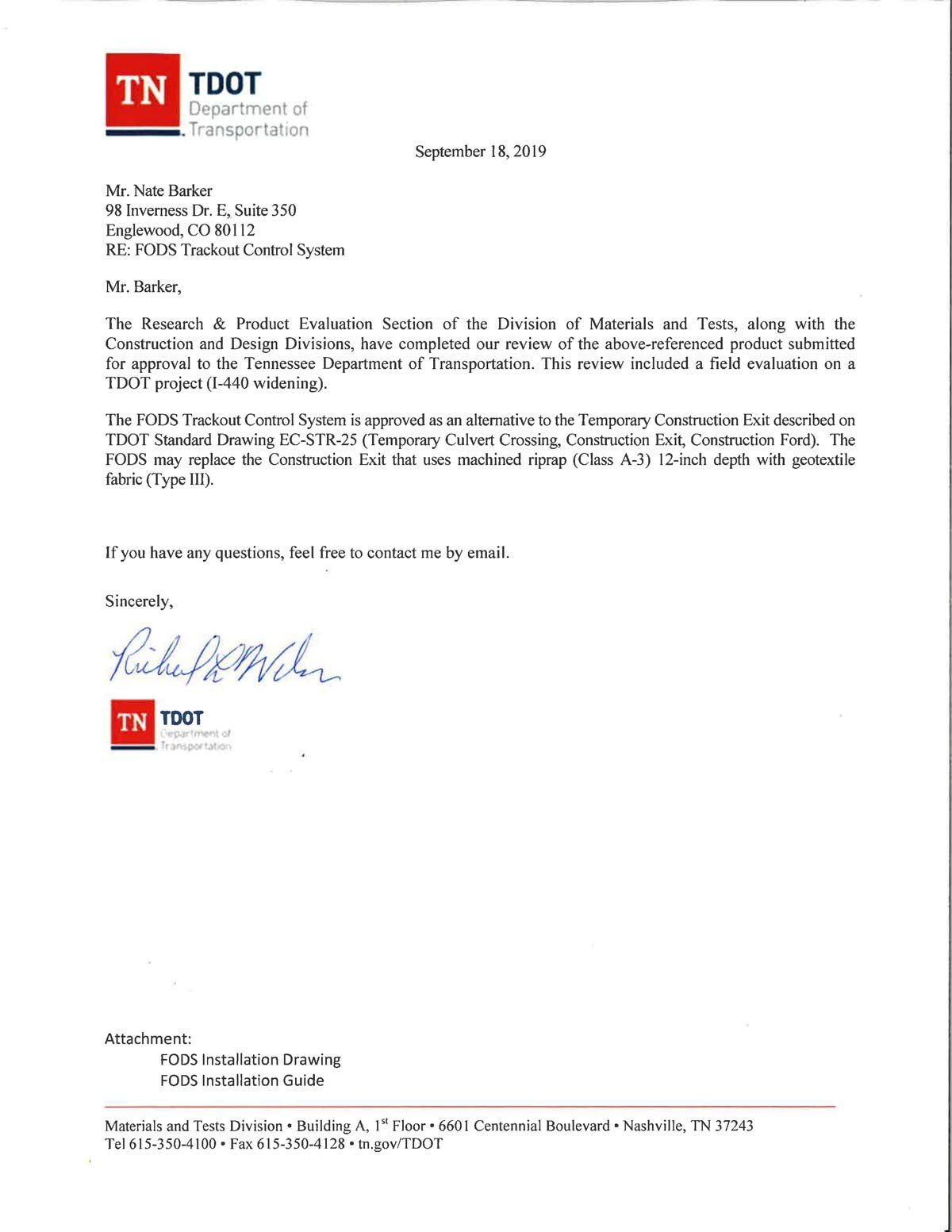
Tennessee Department of Transportation, Division of Materials and Tests, Research and Product Evaluation Section
The Tennessee Department of Transportation formally approved FODS as an alternative to Standard Drawing EC-STR-25 following engineering review and in-field observation on the I-440 widening project near Nashville. For contractors, this means FODS carries a documented statewide TDOT acceptance that most trackout products do not have, and it can be specified on TDOT projects as a direct alternative to the machined-riprap construction exit.
The FODS Trackout Control System
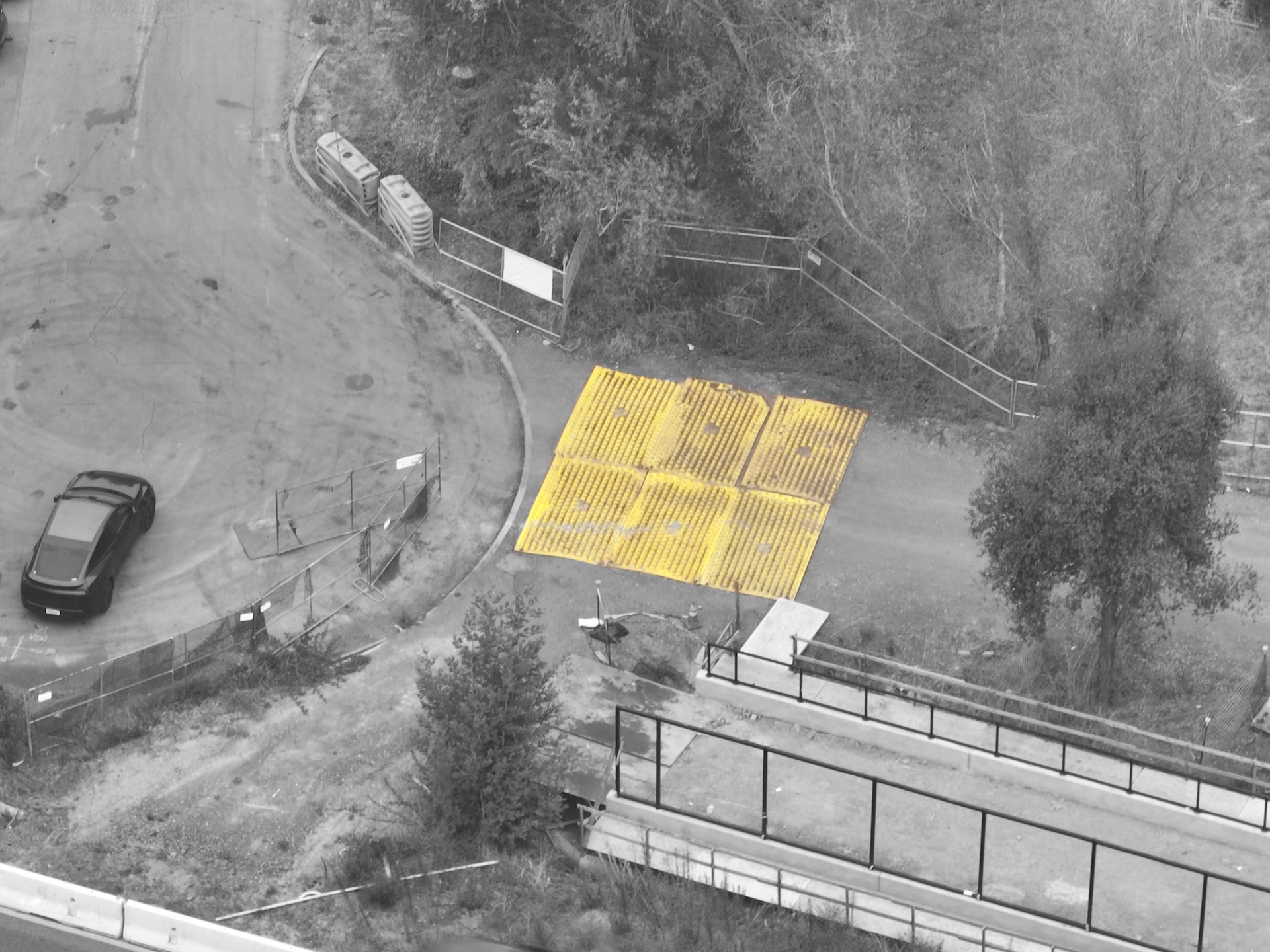
The FODS Trackout Control System is a modular, reusable construction exit made of high-density polyethylene mats with a pyramid-profile surface that contacts vehicle tires and dislodges accumulated sediment as vehicles leave the site. The dislodged material falls between the pyramids and is held in the mat until it is cleaned, rather than being carried onto the road.
A standard 1x5T layout provides about 35 feet of effective tire-scrubbing length with a wide turning radius, and it replaces up to 70 feet of conventional rock construction exit because the mat surface keeps its scrubbing performance without the degradation that affects aggregate over time. The mats do not compact and do not need aggregate replacement, and they are cleaned with a street sweeper or a FODS shovel when sediment builds up to roughly two and a half inches between the pyramids. FODS installs directly on native soil or over existing pavement without excavation, suits the full range of substrates found on Tennessee sites, and is engineered for a service life of ten years or more, so a single set of mats can be reused across projects and relocated from one access point to the next as a phased project advances.

FODS on Tennessee Projects
Since TDOT's approval, FODS construction exits have been deployed across a range of Tennessee projects. The I-440 widening project in Nashville was among the first, where Kiewit used FODS to manage trackout through phased highway work and relocated the system as each phase advanced, avoiding the reconstruction a stone pad would have required at each new access point and keeping loose aggregate out of active travel lanes. DPR Construction later deployed FODS at the data center project in Gallatin during initial sitework, the kind of large commercial grading site, with heavy haul traffic and access points that must stay clean through extended grading and foundation phases, where a reusable, low-maintenance exit is a practical advantage.
Risks of Vehicle Trackout on Roadways
Safety is a primary concern wherever construction traffic meets a public road. Aggregate exits deposit rock and debris onto pavement, creating hazards for drivers and workers, and loose stone can lodge between dual tires and be thrown at speed. Wheel washes add the burden of supplying and containing water, and in cold weather dripping vehicles can build ice on the road. FODS uses a rockless, water-free technique to clean tires and does not carry the same risk of injury or liability as aggregate entrances. The mats are durable and reusable across many projects, which reduces the environmental impact tied to aggregate production, hauling, and disposal. On Tennessee sites that drain to the Tennessee, the Cumberland, or the Mississippi, keeping rock and sediment off the road also helps keep it out of the water.
Additional Resources
TDEC NPDES Construction Stormwater Permit Program
TNR100000 Construction General Permit
Tennessee Erosion and Sediment Control Handbook