
Oklahoma Stabilized Construction Entrances and Trackout Control
OPDES Construction General Permit OKR10 and Local BMP Manual Compliance
Oklahoma runs from the Great Plains and the Wichita Mountains in the west to the rivers and reservoirs of the east, and its economy leans heavily on activities that put a premium on clean water and clean roads, including oil and natural gas, agriculture and cattle, and aviation and aerospace. The Arkansas, Canadian, and Grand rivers feed reservoirs such as Lake Eufaula, Grand Lake O' the Cherokees, and the Robert S. Kerr Reservoir, and Lake Texoma anchors the southern border with Texas. With construction active across the Oklahoma City and Tulsa metros and the state's energy corridors, keeping sediment on the job site and off public roads is a core compliance duty, and a stabilized construction entrance is one of the first controls installed and inspected.
Oklahoma DEQ Construction Stormwater Permit
The Oklahoma Department of Environmental Quality (DEQ) administers the federal stormwater program through the Oklahoma Pollutant Discharge Elimination System (OPDES). Coverage is required for any construction that disturbs one acre or more, or that is part of a larger common plan of development of that size.
Coverage comes through the OPDES Construction General Permit OKR10. The current OKR10 permit took effect on October 18, 2022, carries a fixed five-year term, and expires on October 17, 2027, replacing the 2017 version. Operators obtain coverage by preparing a Stormwater Pollution Prevention Plan, which Oklahoma calls an SWP3, and filing a Notice of Intent with DEQ. The SWP3 identifies the project's potential pollutant sources and the specific control measures, or best management practices (BMPs), that will minimize sediment and runoff. The permit sets a minimum inspection schedule of once every 14 calendar days, and again within 24 hours of the end of a storm that produces half an inch of rain or more, or within 24 hours of a discharge caused by snowmelt.
The Temporary Rock Construction Entrance and Its Limits
Oklahoma DEQ does not publish its own BMP handbook. Instead, the DEQ SWP3 template points engineers to local guidance, chiefly the Oklahoma Department of Transportation (ODOT) and the Oklahoma City and Tulsa BMP manuals, for construction entrance design. Those manuals describe a traditional aggregate entrance with an optional wheel wash.
The Oklahoma City BMP Manual details a Temporary Rock Construction Entrance and Exit built as a 20 foot wide by 50 foot long pad of coarse aggregate, roughly two to three inches in size and at least six inches thick, placed over a filter fabric, with a diversion ridge parallel to the road and drainage directed to a sediment basin. For steep grades, the manual reduces the width to 12 feet and adds a cattle guard in the middle of the pad, used with a wash station that captures runoff to the sediment basin. Both designs are built with a wide turning radius.
The weakness of the rock pad is maintenance. The aggregate needs regular top dressing and repair, the sediment basin and cattle guard need cleaning, and any rock, sediment, or debris tracked onto the public right-of-way has to be removed immediately before it reaches a storm drain, which means routine street sweeping. When the work is done, the fabric, rock, cattle guard, and wash equipment all have to be removed and replaced with topsoil for final stabilization. Each of these steps carries a recurring cost and a maintenance cycle that a durable manufactured entrance can avoid.
FODS as a Compliant Construction Entrance in Oklahoma
Because Oklahoma DEQ has no brand-name product list and instead judges a construction entrance on performance, a trackout control qualifies when it removes sediment from tires before vehicles reach the road, and the operator specifies the chosen practice in the project SWP3. FODS Trackout Control Mats can be named directly in the SWP3 as the site's stabilized construction entrance, satisfying the same purpose as the rock pad in the Oklahoma City and Tulsa details while removing the loose aggregate and the heavy maintenance those designs depend on.
FODS Vehicle Trackout Control Mats
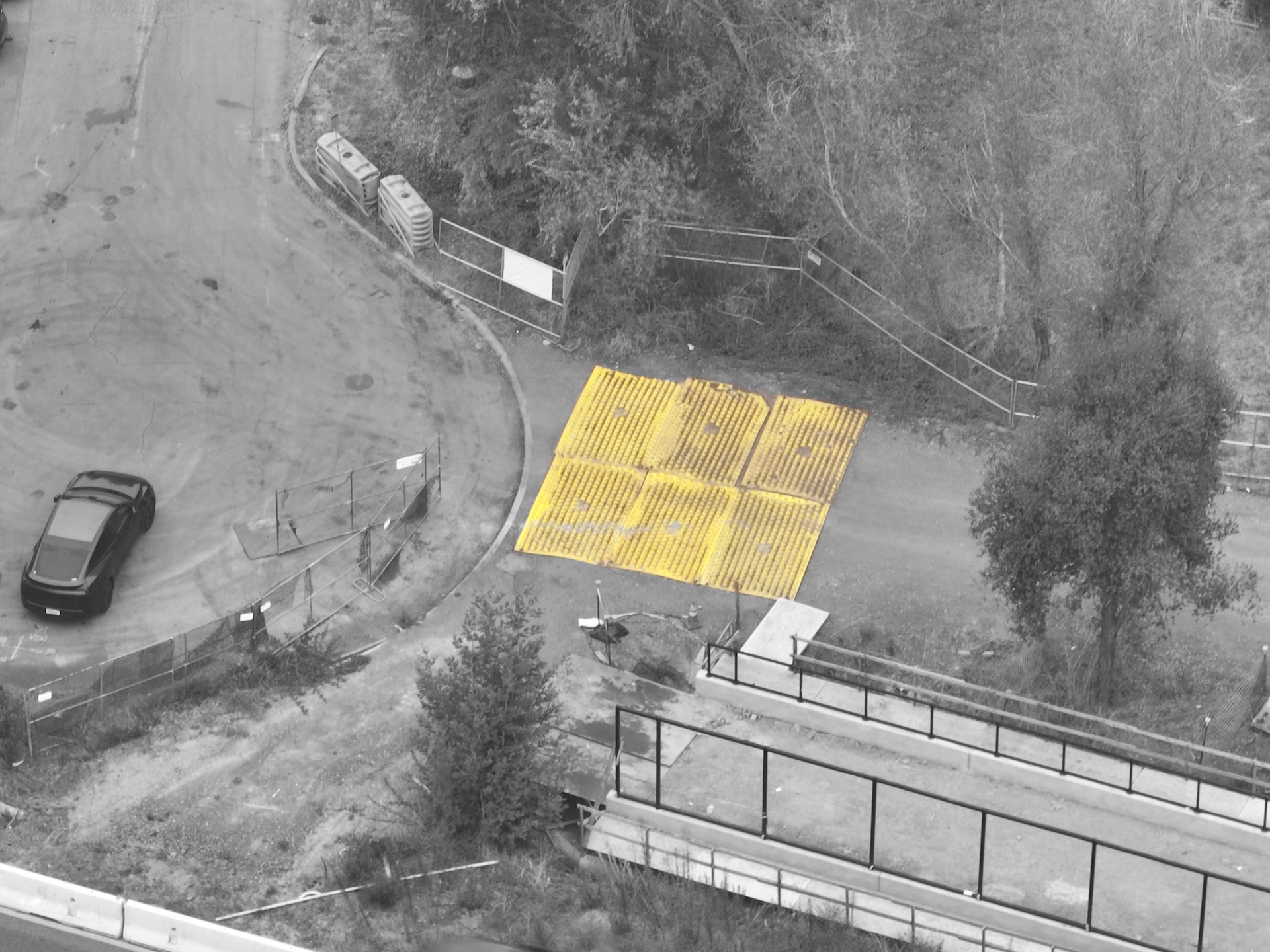
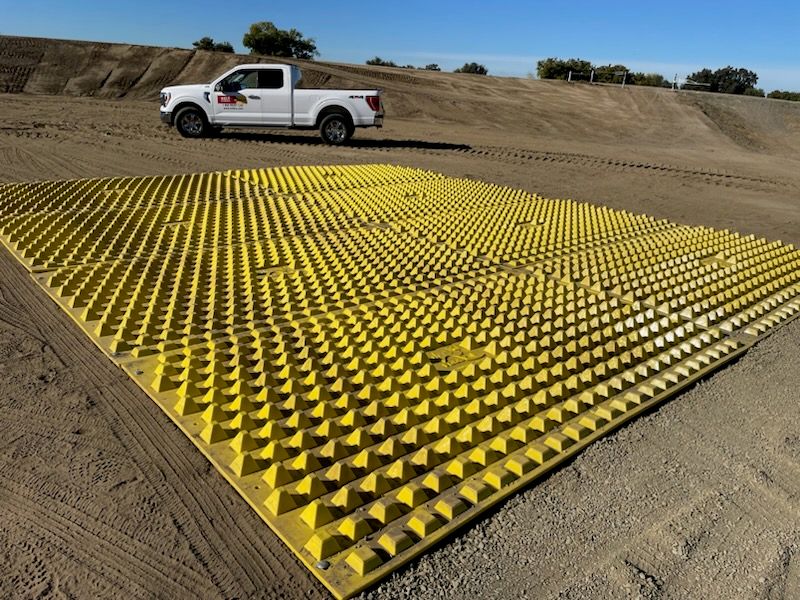
The FODS Trackout Control System is a modular set of single-layer high-density polyethylene mats with a pyramid-shaped surface. As vehicles pass over the mats, the pyramids deform the tires so trapped debris breaks loose and collects at the base of the pyramids, where it stays clear of other tires. Each mat is twelve feet wide and seven feet in the direction of travel, and the modular design lets contractors build the entrance to fit each site.
In side-by-side studies, FODS has been shown to reduce required street sweeping by 59 percent compared with traditional aggregate systems. The mats install over dirt, concrete, or asphalt without excavation, including on the steep grades and ungraded soil where a rock pad struggles, and a standard entrance can be set up in as little as thirty minutes. Maintenance is simple, usually a skid steer with a broom or a FODS shovel to clear sediment from between the pyramids, and it can be folded into a site's routine sweeping. Because the system is portable and reusable, the same mats can be moved across multiple entrances on a linear project and reused on future projects over a service life of ten years or more, which shifts the cost of a construction entrance from a recurring expense to a one-time investment. That flexibility is well matched to Oklahoma's linear and energy-sector work, where access points shift as the job advances.
Risks of Vehicle Trackout on Roadways
Safety is a primary concern wherever construction traffic meets a public road. Aggregate exits deposit rock and debris onto pavement, creating hazards for drivers and workers, and loose stone can lodge between dual tires and be thrown at speed. Wheel washes add the burden of supplying and containing water and, in cold weather, the risk of dripping vehicles building ice on the road. FODS uses a rockless, water-free technique to clean tires and does not carry the same risk of injury or liability as aggregate entrances. The mats are durable and reusable across many projects, which reduces the environmental impact tied to aggregate production, hauling, and disposal. On Oklahoma sites that drain to the Arkansas, Canadian, or Red rivers and the state's reservoirs, keeping rock and sediment off the road also helps keep it out of the water.
Additional Resources
Oklahoma DEQ OKR10 Construction Stormwater Permit
OKR10 Construction General Permit (DEQ)
Oklahoma City Stormwater BMP Manual
City of Tulsa Construction Entrance Detail