

North Carolina Stabilized Construction Entrances and Trackout Control
NCG01 Construction Stormwater, the Sediment Program, and NCDOT Field-Trial Acceptance
North Carolina runs from the Blue Ridge and Great Smoky Mountains in the west, across the Piedmont and the fast-growing Research Triangle and Charlotte metros, to the Coastal Plain, the Outer Banks, and Pamlico Sound. Rivers such as the Cape Fear, the Neuse, the Catawba, and the French Broad, along with the state's lakes, sounds, and coastal waters, supply drinking water and support fisheries and recreation. With construction active from the mountains to the coast, keeping sediment on the job site and off public roads is a core compliance duty, and a stabilized construction entrance is one of the first controls installed and inspected.
NCDEQ Construction Stormwater Program
The North Carolina Department of Environmental Quality (NCDEQ) is the lead agency for protecting the state's waters, and it administers the National Pollutant Discharge Elimination System (NPDES) program across most of the state. On the tribal lands of the Eastern Band of Cherokee Indians, the U.S. Environmental Protection Agency remains the permitting authority.
The construction stormwater program applies to any project that disturbs one acre or more, or that is part of a larger common plan of development of that size. North Carolina uses two general permits. NCG010000, known as NCG01, covers projects that are also subject to the state's Sedimentation Pollution Control Act of 1973 and the Division of Energy, Mineral, and Land Resources (DEMLR) Sediment Program. NCG250000, known as NCG25, covers projects that are not under the Sedimentation Pollution Control Act but still fall under federal Clean Water Act stormwater rules. NCDEQ renewed the NCG01 permit on April 1, 2024, and it runs through March 31, 2029.
North Carolina's approach is distinctive in that, for a project covered by NCG01, the approved Erosion and Sedimentation Control Plan serves as the Stormwater Pollution Prevention Plan. The plan identifies the potential sources of sediment and the best management practices (BMPs) that will control runoff. Permit coverage must be in place before land-disturbing activity begins, and coverage is now requested online, since NCDEQ moved the NCG01 and NCG25 permit applications into its AccessDEQ portal in 2025.
The Temporary Gravel Construction Entrance and Its Limits
North Carolina's Erosion and Sediment Control Planning and Design Manual sets the standard for construction entrances through its Temporary Gravel Construction Entrance and Exit practice. The design is a gravel pad placed where vehicles enter and leave the site and meet the public road. The manual calls for two to three inch washed stone at a minimum thickness of six inches, at least twelve feet wide or the full width of the access point, and at least fifty feet long, sited away from steep grades and off sharp roadway curves.
The weakness of the gravel pad is maintenance. Soil compacts on the surface and the pad loses its ability to scrape tires, so it needs periodic top dressing with fresh stone, and any material tracked onto the road must be swept up promptly. When mud keeps leaving the site, crews add supplemental controls such as a wheel wash draining to a sediment trap, which brings its own needs for water, containment, and cleanout. Each option carries a recurring cost and a maintenance cycle that a durable manufactured entrance can avoid.
FODS as a Compliant Construction Entrance in North Carolina
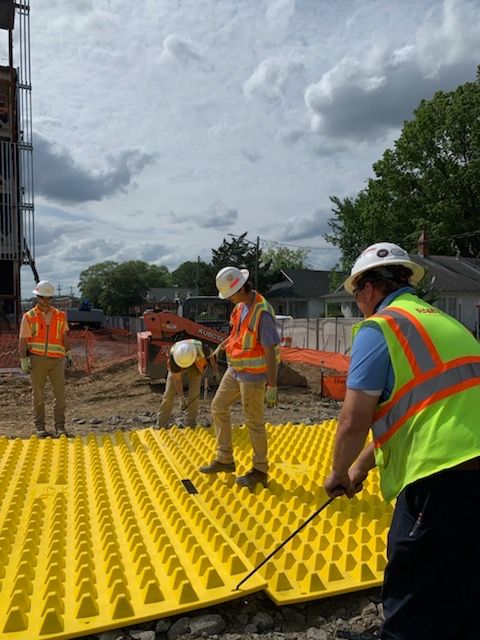
NCDEQ evaluates a construction entrance on whether it performs the function the manual describes, cleaning tires and holding sediment before vehicles reach the road, and the operator specifies the chosen practice in the approved Erosion and Sedimentation Control Plan that serves as the SWPPP. FODS Trackout Control Mats can be named in that plan as the site's stabilized construction entrance, satisfying the same purpose as a gravel pad while removing the loose rock and the heavy maintenance the traditional options depend on. Because FODS controls trackout so effectively, it can also reduce or eliminate the need for a long gravel pad, a wheel wash, or an added sediment trap at the entrance.
NCDOT Evaluation and Field-Trial Acceptance
North Carolina stands out because the state Department of Transportation has evaluated FODS directly. FODS Trackout Control Mats have completed NCDOT's initial product evaluation and are accepted for field-trial use, a designation that reflects NCDOT's review of the product's performance, technical data, and field-evaluation potential. The mats have been and continue to be used successfully on active NCDOT construction projects. For contractors on state transportation work, that evaluation status gives FODS a recognized track record with NCDOT that most trackout products do no

FODS Trackout Control System
The FODS Trackout Control System is a reusable, manufactured construction entrance made of high-density composite mats with a pyramid-shaped surface. As vehicles pass over the mats, the pyramids flex the tires so mud and debris release from the tread and drop to the base of the mat, where they can be cleared with a skid steer broom or hand tools after wet conditions or heavy traffic. The mats install over soil, concrete, or asphalt without excavation or heavy machinery, and they introduce no loose aggregate to the site, so there is no rock to be carried onto active roadways.
A standard 1x5T layout replaces roughly fifty to seventy feet of rock entrance while leaving adequate turning space for exiting vehicles. The system is modular and portable, so entrances can be relocated between phases of work in short order, and with a service life of ten years or more the same mats can be reused across multiple projects. That shifts the cost of a construction entrance from a recurring expense to a one-time investment while keeping the site cleaner and safer.
North Carolina Projects: Coal Ash Closures and Beyond
FODS has proven out on some of the most demanding sites in the state. At Duke Energy's Belews Creek Steam Station, FODS Trackout Control Mats served as the stabilized construction entrance during the excavation of roughly 12 million tons of coal ash into a newly built 100 acre double-lined landfill. On a site where preventing the spread of contaminated material is the entire point, the mats kept sediment and debris contained, supported permit compliance, and reduced cleanup costs, and FODS has been used the same way at several coal ash remediation sites across North Carolina. The system has also supported data center construction and university and campus projects in the state, where fast-moving, phased work benefits from an entrance that can be relocated in under an hour.
Risks of Vehicle Trackout on Roadways
Safety is a primary concern wherever construction traffic meets a public road. Gravel exits deposit rock and debris onto pavement, creating hazards for drivers and workers, and loose stone can lodge between dual tires. Wheel washes add the burden of supplying and containing water, and in cold snaps dripping vehicles can build ice on the pavement. FODS uses a rockless, water-free technique to clean tires and does not carry the same risk of injury or liability as aggregate entrances. The mats are durable and reusable across many projects, which reduces the environmental impact tied to aggregate production, hauling, and disposal. On North Carolina sites that drain to the Cape Fear, the Neuse, the Catawba, or the coastal sounds, keeping rock and sediment off the road also helps keep it out of the water.
Additional Resources
NCDEQ NPDES Construction Program
NCG01 Construction General Permit (NCG010000)
NCG25 Construction General Permit (NCG250000)
NC Erosion and Sediment Control Planning and Design Manual
NC Erosion and Sediment Control Field Manual
AccessDEQ Construction Stormwater Permit Application (NCG01/NCG25)
NCDOT Products and Product Evaluation