
Missouri Vehicle Tracking BMPs and Stabilized Construction Exits
Missouri DNR and MoDOT Compliant Trackout Control for Construction Sites
Missouri sits at the meeting point of two of the largest rivers in North America, where the Missouri River joins the Mississippi just north of St. Louis beneath the Gateway Arch. From the clear streams and springs of the Ozarks and Mark Twain National Forest to Lake of the Ozarks, Table Rock Lake, and the urban watersheds of Kansas City and Springfield, the state holds water resources that construction activity can easily threaten through sediment trackout. Keeping mud and soil on the job site and off public roads is a core compliance obligation on every Missouri project.
The Missouri Department of Natural Resources (DNR) administers the Clean Water Act in Missouri and issues land disturbance permits under the National Pollutant Discharge Elimination System (NPDES) stormwater program. These permits apply to contractors, industrial sites, and municipal separate storm sewer systems, and they require practical, well-maintained best management practices (BMPs) at every point where vehicles leave a site.
Missouri Land Disturbance Permits
A land disturbance permit is required for any construction activity that disturbs one or more acres, and for smaller activities that are part of a larger common plan of development or sale reaching a cumulative total of one acre or more. Most contractors obtain coverage under the Missouri Land Disturbance Stormwater General Permit (MO-RAxxxxx). The current general permit cycle took effect on February 8, 2022 and runs through February 7, 2027, so every permit issued during this cycle shares that expiration date regardless of when coverage begins.
Applications are now handled entirely online. The department no longer processes paper applications for the general permit, and applicants apply through Electronic Permitting (ePermitting) after registering an account in the Missouri Gateway for Environmental Management (MoGEM) portal. A separate Area-Wide Land Disturbance Stormwater General Permit (MO-R100xxx) is available only to cities, counties, and state or federal agencies that operate a DNR-approved local land disturbance program.
The central requirement of any land disturbance permit is a Stormwater Pollution Prevention Plan (SWPPP). The SWPPP names the person responsible for pollution control measures, includes a site map, and identifies the BMPs that will be used to minimize soil exposure, control erosion, and prevent sediment and other pollutants from leaving the site. A stabilized construction exit is one of the most visible BMPs in any Missouri SWPPP.
Construction Entrance BMPs in the Protecting Water Quality Field Guide
The DNR documents recommended practices in its Protecting Water Quality Field Guide, the successor to the agency's earlier field guide. Chapter 6 covers the installation and maintenance of best management practices, including construction entrance stabilization. The guide describes the purpose of a stabilized entrance plainly, as a place where construction vehicles can drop the mud and caked soil from their tires so it is not carried onto public roads, where it would otherwise wash into storm drains and pollute nearby waters.
The guide presents several vehicle tracking techniques, including the temporary rock construction exit pad, wheel wash stations, rumble plates, and bamboo mats. For each, it notes common problems and solutions, and it stresses that traffic must be restricted to stabilized exits so vehicles cannot bypass the controls and leave the site with contaminated soil. Importantly, the guide acknowledges that the rock pad is simply the most commonly used option, noting that superior practices may be available in the construction industry. That recognition is the opening for manufactured systems such as FODS.
FODS as a Compliant Construction Exit in Missouri
Missouri does not maintain a brand-name approval list for construction exits. Like the framework in many states, the DNR evaluates a vehicle tracking BMP on whether it performs the required function, removing mud and soil from tires before vehicles reach the road. A contractor specifies the chosen practice directly in the project SWPPP. Because the Field Guide already invites superior alternatives to the rock pad, FODS Trackout Control Mats can be named in the SWPPP as the site's stabilized construction exit without a separate approval letter.
FODS satisfies the same purpose the DNR assigns to a rock pad, wheel wash, or rumble plate, while removing the loose aggregate that the guide itself flags as a recurring maintenance and roadway problem. For inspectors and engineers, the result is a construction exit that meets the intent of the Field Guide and the permit, holds up under heavy and repeated traffic, and does not need to be rebuilt after every storm.
Site Preparation: The Temporary Rock Construction Exit, and Its Limits
The traditional Missouri construction exit is a temporary rock pad. The Field Guide describes an excavated area roughly 50 feet long and 12 feet wide, lined with geotextile fabric and topped with crushed stone. The stone should be large enough to create a rough, tire-deforming surface but smaller than four inches so it is not caught and thrown from dual tires. As vehicles pass, the rough surface knocks sediment loose, but that same traffic gradually compacts the pad and smooths it out. Under high traffic volumes or during rain events, the pad degrades quickly and must be redressed with additional aggregate to restore the rough surface.
Wheel wash stations clean tires with water that must be recycled or diverted to a sediment basin, and the guide advises discontinuing their use below freezing to avoid ice forming on the road. Rumble plates use vibration to shake sediment loose into a void below, which must be cleaned out with specialized equipment when full. Bamboo mats, lightweight rolls with rigid material set in pockets, suit very small projects such as single-home construction but lack the durability for high-traffic sites. FODS combines the easy handling of a mat system with the durability and performance those lighter options cannot provide.
FODS Reusable Construction Entrance Mats
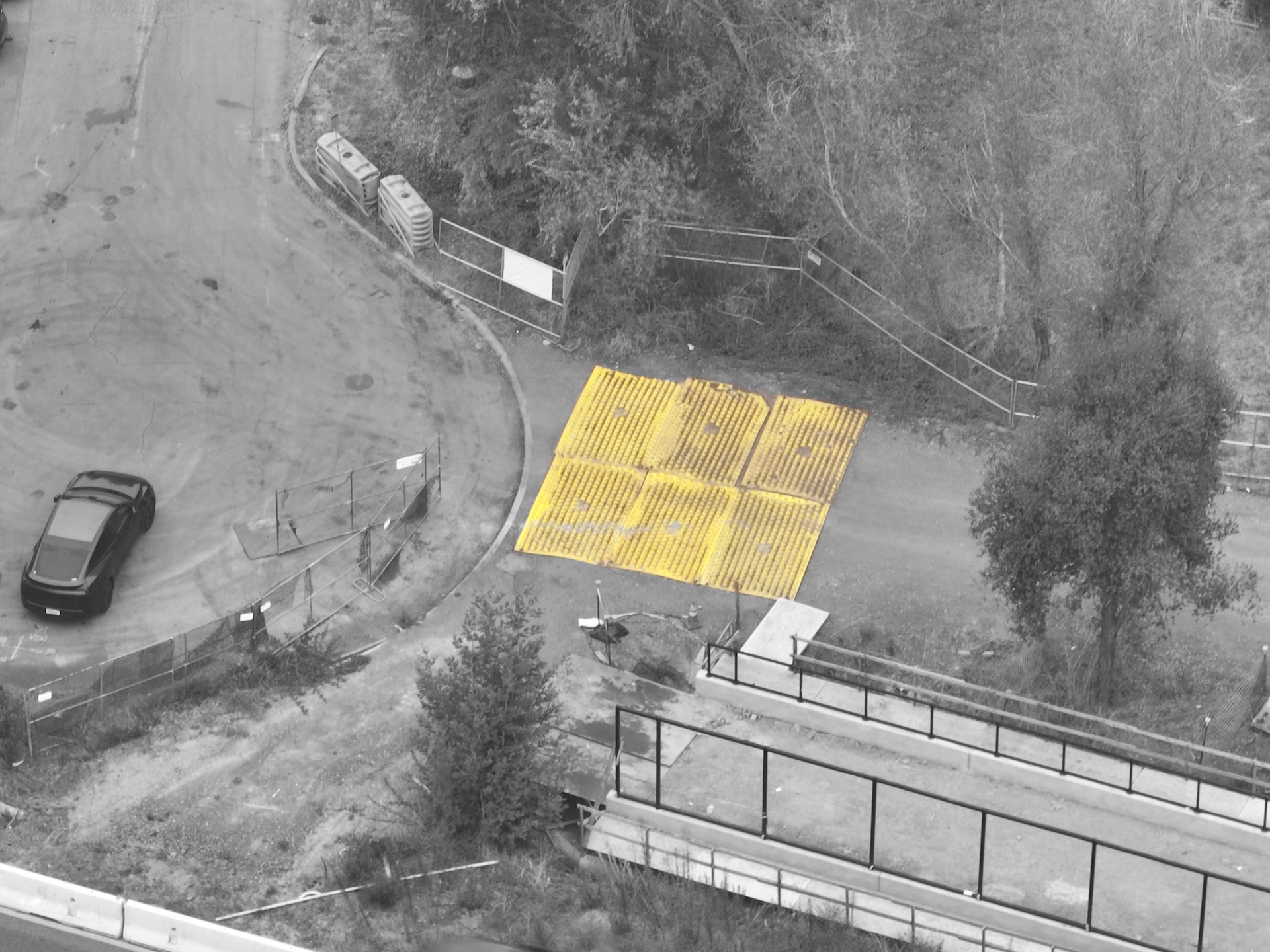
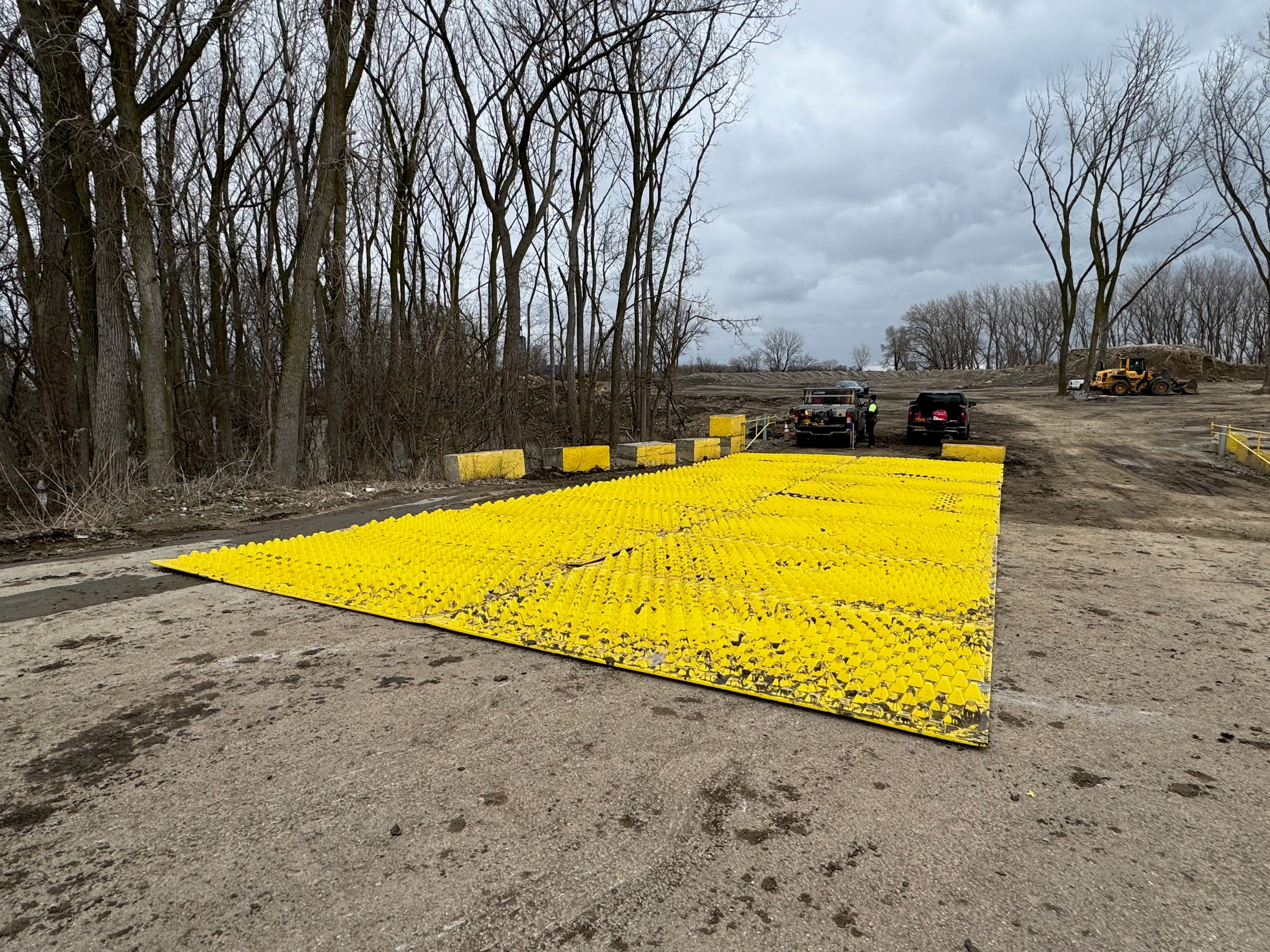
The FODS Trackout Control System is a modular system of 12 foot by 7 foot mats that link together with connecting hardware and anchor to the ground. The mats install without excavation and work over a variety of substrates, including soil and asphalt, and installation, relocation, maintenance, and removal can all be completed without heavy equipment.
The surface of each composite mat is formed into pyramids that deform vehicle tires and pull sediment from the tread, while the base of the pyramids acts as a void that catches debris so it does not transfer to other vehicles. After a rain event, or once sediment builds up to the tops of the pyramids, the mats can be cleaned with a FODS shovel or sweeper to fully restore function. A standard 1x5T layout provides roughly five tire rotations for a semi-truck along with a wide turning radius.
FODS performs in all weather, including below freezing, and because the system uses neither water nor rock, it avoids the ice hazards of wheel washes and the loose-rock hazards of aggregate pads. The mats can be lifted and relocated through each phase of a project, and with an engineered service life of ten years or more they shift stabilized construction exit costs from a recurring expense to a one-time investment.
MoDOT Stormwater and Construction Exit Requirements
On state transportation work, the Missouri Department of Transportation (MoDOT) sets its own stormwater expectations. MoDOT's Engineering Policy Guide addresses the Stormwater Pollution Prevention Plan in Section 806.8, which covers erosion and sediment control practices, including construction entrance and exit stabilization and the control of trackout from roadway work. FODS provides a manufactured, reusable alternative to the aggregate entrances contemplated in these provisions, well suited to phased roadway projects where access points shift as the work advances.