
Minnesota Vehicle Tracking BMPs and Stabilized Construction Exits
MPCA and MnDOT Compliant Trackout Control for Minnesota Construction Sites
Minnesota, the Land of 10,000 Lakes, holds some of the most significant freshwater resources in the country. The state borders Lake Superior to the northeast, gives rise to the Mississippi River at Lake Itasca, and protects treasured waters such as the Boundary Waters Canoe Area Wilderness, Lake Minnetonka, and the chain of lakes within the Twin Cities of Minneapolis and Saint Paul. With water this close to nearly every job site, controlling sediment from construction activity is central to protecting the state's surface waters.
To safeguard these resources, the Minnesota Pollution Control Agency (MPCA) administers the state-delegated National Pollutant Discharge Elimination System (NPDES) program and issues stormwater permits that regulate discharges from construction, industrial, and municipal sources. These permits require contractors to minimize pollution and sedimentation, and the MPCA supports that work with detailed guidance in the Minnesota Stormwater Manual. Among the practices every site must address is vehicle tracking, the movement of mud and sediment from a work zone onto public roads.
Minnesota NPDES/SDS Construction Stormwater General Permit
Any construction project that disturbs one acre or more of soil must obtain coverage under the MPCA Construction Stormwater General Permit (MNR100001), which authorizes the discharge of stormwater associated with construction activity. The current permit was reissued on August 1, 2023, replacing the 2018 version. Coverage requires a Stormwater Pollution Prevention Plan (SWPPP) that identifies potential pollution sources and the best management practices (BMPs) the contractor will use to control erosion and sedimentation throughout the project.
The application also asks contractors to identify whether the project lies within one mile of a Special or Impaired water. Projects with the potential to affect those waters must implement additional control measures to prevent erosion, sedimentation, and pollution from leaving the site.
On vehicle tracking specifically, the permit is direct. Permittees must install a vehicle tracking BMP to minimize the track out of sediment onto paved roads, must use street sweeping when that BMP is not adequate, and must remove sediment from all paved surfaces within one calendar day of discovery, or sooner where it poses a safety hazard. These obligations make a reliable construction exit one of the most visible compliance items on any Minnesota site.
What Counts as a Compliant Vehicle Tracking BMP in Minnesota
The Minnesota Stormwater Manual defines a vehicle tracking BMP as a rock pad, shaker rack, wheel washer, or other BMP designed to remove soil and mud from vehicles leaving the work zone. The manual describes three standard types in detail.
The rock or stone pad consists of coarse aggregate, generally two to six inches, laid over nonwoven geotextile fabric. The manual recommends a pad at least 20 feet wide and 50 feet long, six to twelve inches thick, with a 20-foot turning radius where the pad meets the road. Rock pads rate low to moderate for sediment removal and lose effectiveness as the voids clog with mud, so they require ongoing top dressing, regrading, and replacement.
The shaker rack, also called a rumble rack or rumble plate, removes material through a bouncing and shaking action and is used when a rock pad alone is not enough. The wheel washer or wash rack uses pressurized water to clean tires and can remove more than 75 percent of sediment, though it requires a water source, a containment basin, and special attention in cold weather, since dripping vehicles can build ice on roadways as they leave the site.
The manual's recognition of an "other BMP designed to remove soil and mud" is the key. Minnesota does not maintain a brand-name approval list for construction exits. Instead, a manufactured system qualifies when it meets the performance and dimensional intent the manual sets for vehicle tracking. FODS Trackout Control Mats fall squarely within this category as a manufactured alternative to loose aggregate.

FODS as a Compliant Construction Exit in Minnesota
Because Minnesota evaluates construction exits on performance rather than a product list, FODS is specified directly in the project SWPPP as the vehicle tracking BMP. There is no separate approval letter to obtain. The mats satisfy the same function the MPCA manual assigns to a rock pad or shaker rack, cleaning tires at the point of exit so sediment stays on site, while removing the rock that the manual itself flags as a maintenance and roadway hazard.
This approach is well established across Minnesota's largest projects. FODS has served as the construction entrance on heavily traveled MnDOT interstate work and on utility-scale solar developments, where inspectors and engineers accepted the mats as the site's vehicle tracking BMP under the Construction Stormwater General Permit. For contractors, that track record means FODS can be planned into a SWPPP with confidence that it meets the same standard as the traditional options.
MnDOT Construction Exit Controls
The Minnesota Department of Transportation (MnDOT) sets its own requirements for construction exits on state projects. MnDOT Standard Plan 5-297.405, Construction Exits, details several exit types, including the Rumble Pad Construction Exit, while MnDOT Specification 2573.3.K, Construction Exit Controls, provides guidance for selecting an exit type and ranks the controls from lowest to highest protection. These provisions now appear in the 2025 edition of the MnDOT Standard Specifications for Construction, effective for most projects let on or after October 22, 2025, with the 2020 edition governing earlier lets.
FODS provides a manufactured alternative to the aggregate and rumble configurations described in these standards. Rather than relying on loose rock to dislodge debris, the mats use a rigid, textured surface that cleans tires at the exit, which is well suited to phased highway work where entrances move repeatedly as the project advances.
FODS Reusable Construction Exit
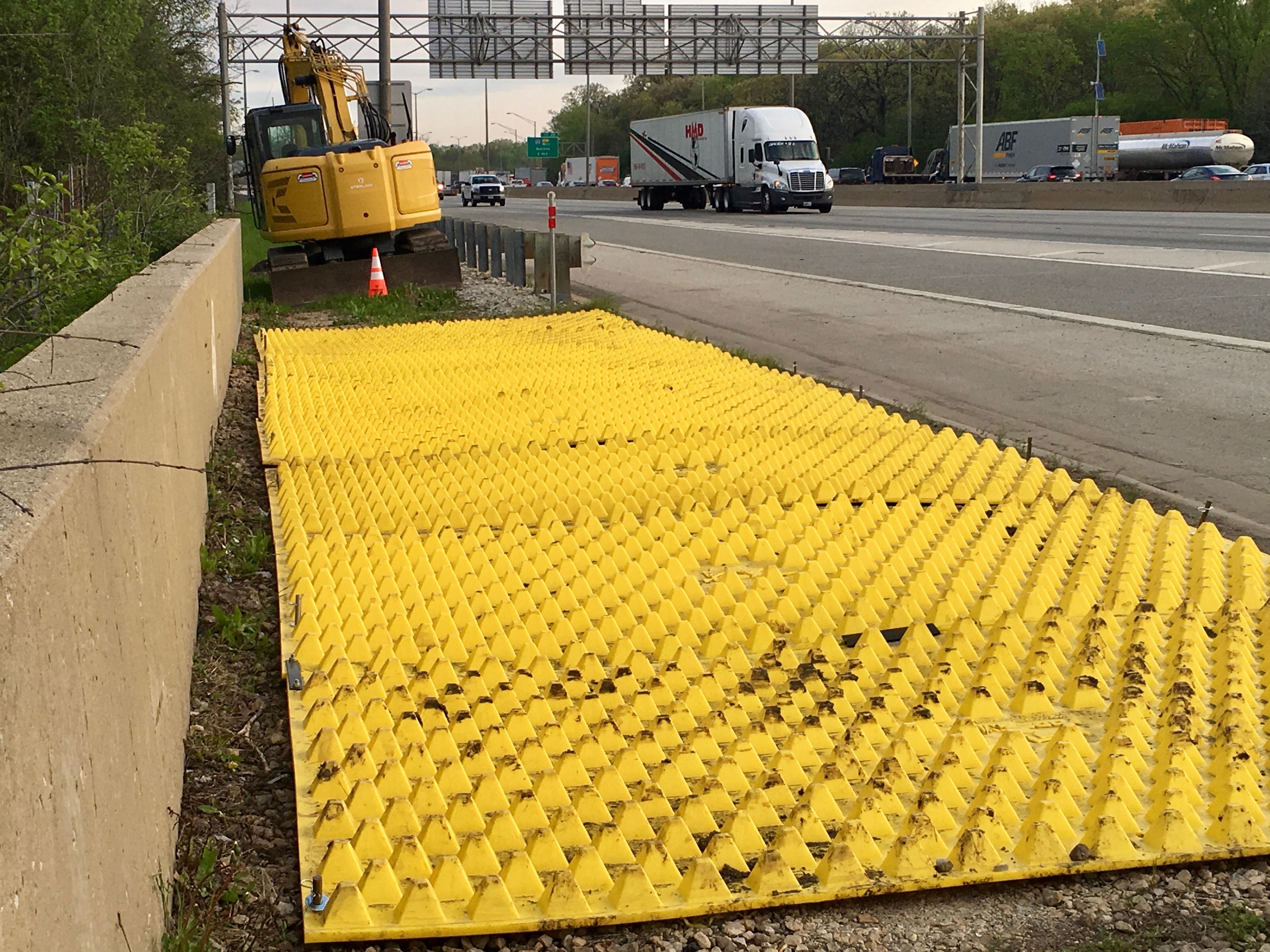
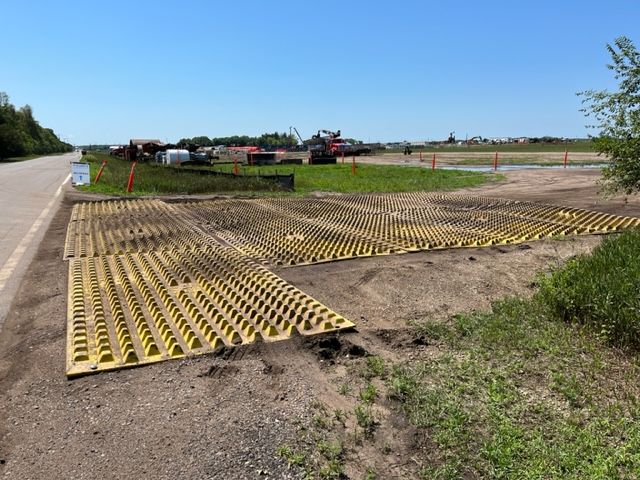
FODS mats offer a durable alternative to traditional soil tracking prevention devices. Each modular mat measures 12 feet by 7 feet and carries a surface of pyramid-shaped structures. As vehicles pass over the mats, the pyramids flex and rock the tires, releasing the sediment lodged between the tire lugs. The system performs in both dry conditions and on muddy sites. A standard 1x5T layout provides roughly five tire rotations for a semi-truck along with a wide turning radius.
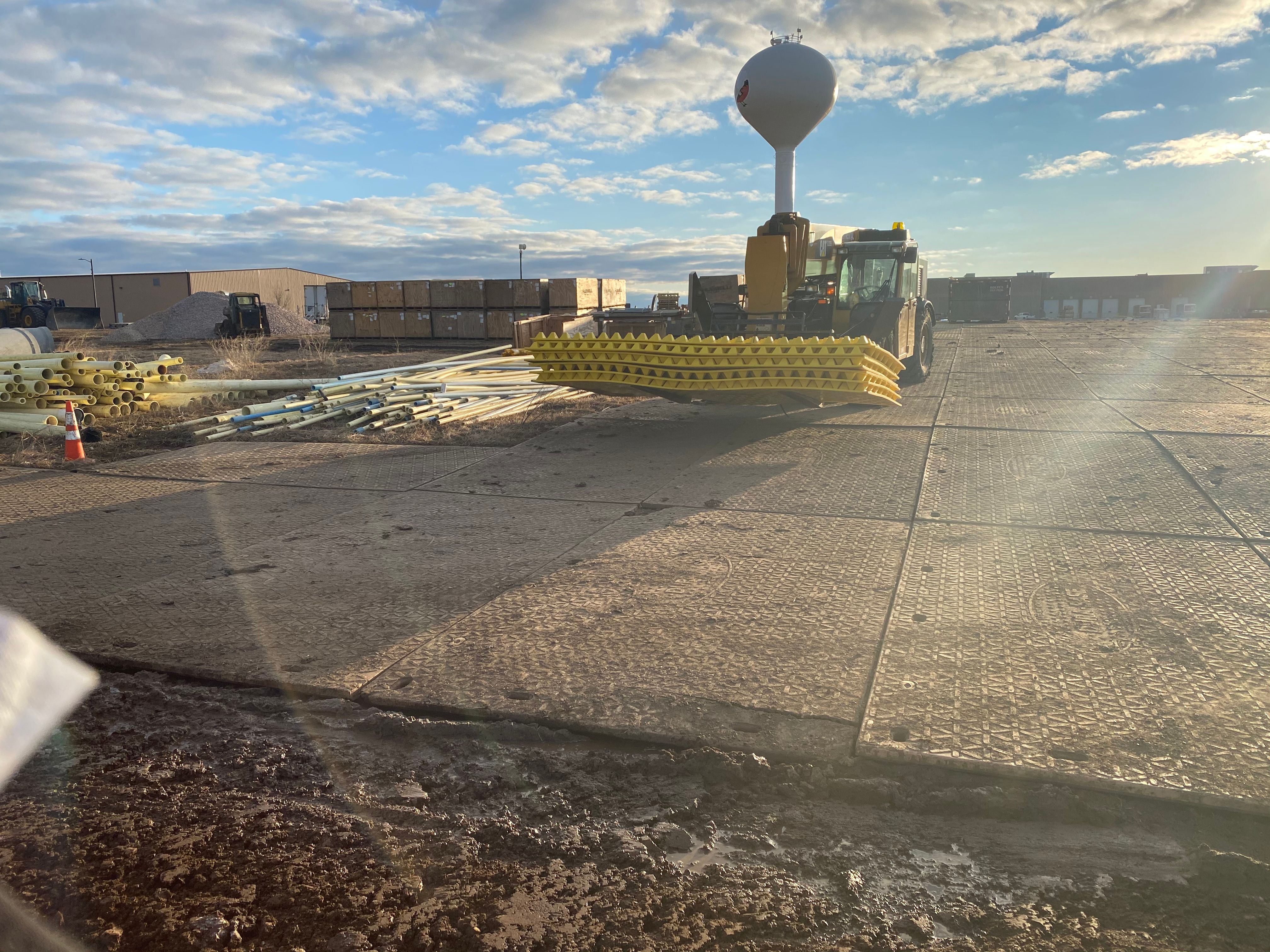
With an expected service life of more than ten years, FODS offers a cost-effective, reusable solution that meets or exceeds EPA standards for minimizing sediment track out. The rockless, water-free, all-weather system installs over asphalt, concrete, or compacted ground without excavation, and it works through every Minnesota season, from spring thaw to deep winter. For highway and energy projects that rely on many entrances over a long schedule, the mats can be lifted and relocated to the next access point as each phase is completed, eliminating the hazard of tracking rock onto active roadways.
Risks of Vehicle Trackout on Roadways
Safety is a primary concern wherever construction traffic meets a public road. Aggregate-based exits deposit rock and debris onto pavement, creating hazards for drivers, flaggers, and equipment, and that loose rock can lodge between dual tires. Wash racks introduce a separate winter risk, since dripping vehicles can build ice on cold roadways, a concern the Minnesota Stormwater Manual calls out directly.
FODS uses a rockless technique to clean tires and does not carry the same risk of injury or liability as aggregate entrances. The mats are fully recyclable and are manufactured with post-consumer recycled content, which reduces the environmental impact tied to aggregate production, hauling, and disposal. On Minnesota sites near lakes, wetlands, and rivers, keeping rock and sediment out of the road also helps keep it out of the water.
Minnesota Projects Using FODS
North of Minneapolis, the 12-mile MnDOT I-35W North MnPASS Project delivered major improvements to the interstate between Roseville and Blaine, including a new MnPASS lane, repaving, six bridge replacements and rehabilitations, and more than four miles of noise walls. Ames Construction used the FODS Reusable Construction Entrance System, which could be transported and deployed at each phase of the work. The rockless system reduced the hazard of rock tracking onto active highway lanes and helped maintain compliance on one of the state's busiest corridors.
In Sherburne County, FODS supported the Sherco Solar III project near Clear Lake, the third phase of Xcel Energy's Sherco Solar program built by Blattner. Covering roughly 1,750 acres and adding up to 250 megawatts to the grid, the site sits between U.S. Highway 10 and the Mississippi River, where protecting surrounding farmland and water was a visible priority. The project began with a single entrance and added more as construction advanced. Using a 1x5T layout, the same four FODS mats were relocated to create two additional access points, shifting stabilized construction exit costs from a recurring expense to a one-time investment while keeping the surrounding roads and waterways clean.
Additional Resources:
MPCA Construction Stormwater Permit
Minnesota Stormwater Manual - Vehicle Tracking BMPs
Minnesota Urban Small Site BMP Manual - Vehicle Tracking Pad
MPCA Stormwater Construction Inspector’s Field Guide
MnDOT Standard Specifications for Construction