
Kansas Construction Entrance And Wheel Wash BMP
KDHE-Compliant Trackout Control for Kansas Construction Sites
Kansas sits at the geographic center of the continental United States, where the tallgrass prairie of the Flint Hills gives way to the High Plains in the west and the Kansas and Arkansas river systems drain toward the Missouri River. Construction activity concentrates along the Interstate 70 and Interstate 35 corridors and in the metropolitan areas of Kansas City, Wichita, Topeka, and Lawrence, much of it on silty and clay-rich soils that erode quickly once disturbed. Any project that breaks ground in the state must keep that soil on-site and off public roads, and Kansas regulates how operators do so.
Stabilized construction entrances and exits are the primary tool for that job. They are required to prevent sediment and debris from being tracked onto public roadways, where deposited material washes into storm drains and degrades surface water. FODS Trackout Control Mats provide a rockless, reusable construction entrance that satisfies these requirements without aggregate, meeting the same performance standard as the traditional rock pad and steel rumble plate options referenced by Kansas jurisdictions.
Kansas Department of Health and Environment (KDHE) Stormwater Permits
The federal Clean Water Act of 1972 established the National Pollutant Discharge Elimination System (NPDES) permit program, which regulates stormwater discharges from construction, industrial, and municipal activities. Construction projects that disturb one acre or more of land, or that are part of a larger common plan of development disturbing one acre or more, must obtain stormwater permit coverage before work begins.
In Kansas, the Department of Health and Environment (KDHE) administers the NPDES program from its Bureau of Water in Topeka. KDHE reviews permit applications, issues coverage to site operators, and enforces permit conditions. Most construction projects obtain coverage under the KDHE Construction Stormwater General Permit, currently General Permit No. S-MCST-2208-1 (Federal Permit No. KSR100000). This permit took effect on August 1, 2022, and runs through July 31, 2027, replacing the prior permit cited on the FODS Kansas page. Operators should confirm they are working from the 2022 permit rather than the expired 2017 version.
To obtain coverage, operators submit a Notice of Intent (NOI) through the Kansas Environmental Information Management System (KEIMS), KDHE's online portal. Paper applications are no longer accepted, and all forms are completed within KEIMS. The operator must also develop and implement a Stormwater Pollution Prevention Plan, which KDHE refers to as an SWP2 Plan. The SWP2 Plan identifies the potential sources of pollution on the site and describes the practices and procedures used to contain them. These practices are known as Best Management Practices (BMPs), and they include structural controls, operational procedures, and pollution prevention measures consistent with the federal Construction and Development Effluent Guidelines at 40 CFR Part 450.
Construction Entrance BMPs
Sediment is the most common construction pollutant. Disturbed soils erode rapidly under rainfall and runoff, and the resulting sedimentation raises water temperatures, lowers dissolved oxygen, and smothers aquatic habitat. Sediment and erosion control BMPs are implemented to keep that sediment within the job site and to stabilize disturbed areas so they erode less.
The construction entrance is one of the first BMPs installed at a site, and it must be in place before grading, clearing, and excavation begin. Its purpose is to reduce off-site tracking of sediment from construction vehicles onto public roads. A properly built entrance removes sediment from vehicle tires and is graded with a ridge or slope that drains runoff back toward the site rather than out to the roadway. Several techniques are available, and they can be combined to improve performance.
For a construction entrance to effectively contain sediment, one should be installed at every point where vehicles exit the site. Street sweeping or vacuuming should follow promptly to recover any material that does reach the public road, and regular inspections keep the entrance in working condition. The KDHE general permit directs that off-site tracking be minimized through wheel washing facilities or an appropriately designed and constructed entrance and exit. Detailed design guidance is generally provided by the local permitting authority. In the Kansas City metropolitan area, for example, several jurisdictions reference the Kansas City Metro Chapter of the American Public Works Association (KC Metro APWA) regional standard details for erosion and sediment control.
Aggregate Construction Entrance
The aggregate construction entrance is the traditional design, using a pad of coarse rock to stabilize the site exit. The KC Metro APWA specifications describe an aggregate entrance built from two to three-inch coarse aggregate placed over a non-woven geotextile filter fabric. The fabric keeps the underlying soil from pumping up into the rock layer. The standard pad is recommended at a minimum length of 50 feet and a minimum width of 20 feet, with a generous turning radius where the aggregate meets the road.
As construction proceeds, the aggregate pad compacts and fills with sediment, which reduces its ability to clean tires. Once the entrance no longer holds the majority of the site's sediment, it has to be restored, either by turning the stone or by top-dressing with fresh rock. Entrances should be inspected on a regular schedule and again after rain events, since they saturate quickly. When an aggregate entrance is no longer sufficient on its own, additional or alternative BMPs should be added.
Steel Rumble Plates
The KC Metro APWA aggregate entrance standards include an optional rumble plate, sometimes called a shaker plate. These are typically steel structures with raised ridges, and some styles are elevated to create a void beneath the plate. The ridges agitate the tires as vehicles pass over them, knocking loose mud and debris. Rumble plates are usually combined with an aggregate pad and set into the center of the rock to supplement the cleaning action. When sediment fills the gaps between the ridges, the plates are cleaned to restore performance, and on raised systems, the plates must be removed to excavate the void below.
Wheel Wash Construction Entrance BMP
Wheel wash systems use pressurized water to spray mud and sediment off vehicle tires. A wheel wash station combines a wash rack, which can be a shaker plate or a concrete slab, with a pressurized water supply that may be operated manually or automatically. All wash water has to be directed to a sediment basin or sediment trap so that sediment-laden water does not reach the roadway. Wheel wash stations are effective but entail the added costs and complexities of water supply, containment, and disposal.
FODS Trackout Control System
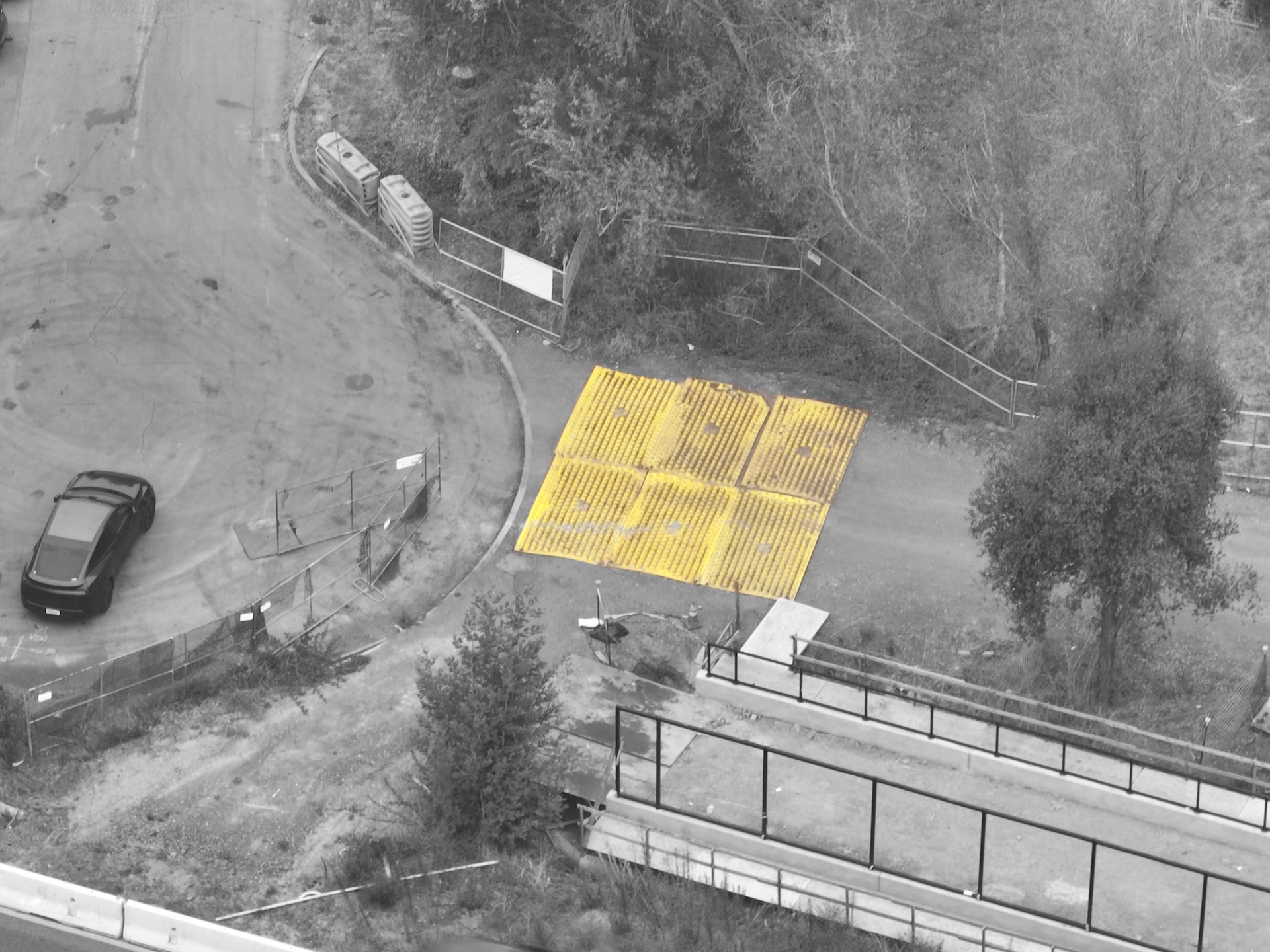
The FODS Trackout Control System is a modern construction entrance BMP designed to remove sediment from vehicle tires and minimize off-site tracking. The system is durable and reusable, allowing contractors to reduce recurring material and maintenance costs associated with rock entrances. It consists of modular HDPE mats, each measuring 12 feet by 7 feet, molded with a pyramidal surface. As a vehicle drives across the mats, the pyramids flex the tires and open the tread lugs, dislodging sediment and debris at the point of exit. Compared with traditional aggregate entrances, FODS has been shown to reduce street sweeping by 59 percent at high-traffic-volume sites.
FODS mats are installed on a range of substrates, including dirt, concrete, and asphalt, without excavation. Because the system is designed to work as a standalone entrance without aggregate, it eliminates the risk of loose rock migrating onto the roadway or lodging in dual-tire vehicles. The mats can hold up to 2.5 inches of sediment between the pyramids before maintenance is required, and maintenance is usually performed with a skid-steer broom attachment or a street sweeper with an adjustable brush. In many cases, the entrance is cleaned as part of the project's regular street sweeping schedule.
Kansas does not maintain a brand-name approval list for trackout control devices through KDHE or the Kansas Department of Transportation (KDOT). Instead, the state and its local jurisdictions take a performance-based approach: a construction entrance is acceptable when it controls trackout in accordance with the SWP2 Plan and the applicable standard details. On KDOT projects, temporary erosion and pollution control is governed by Section 901 of the Standard Specifications and by the KDOT Temporary Erosion-Control Manual, with each project carrying a standard SWPPP that includes special provisions, standard drawings, and inspection forms. FODS qualifies as a stabilized construction entrance under this framework because it meets the function the specifications require, and it can be specified directly in the SWP2 Plan as the construction entrance and wheel wash BMP.
Kansas Project Spotlight: David Booth, Kansas Memorial Stadium
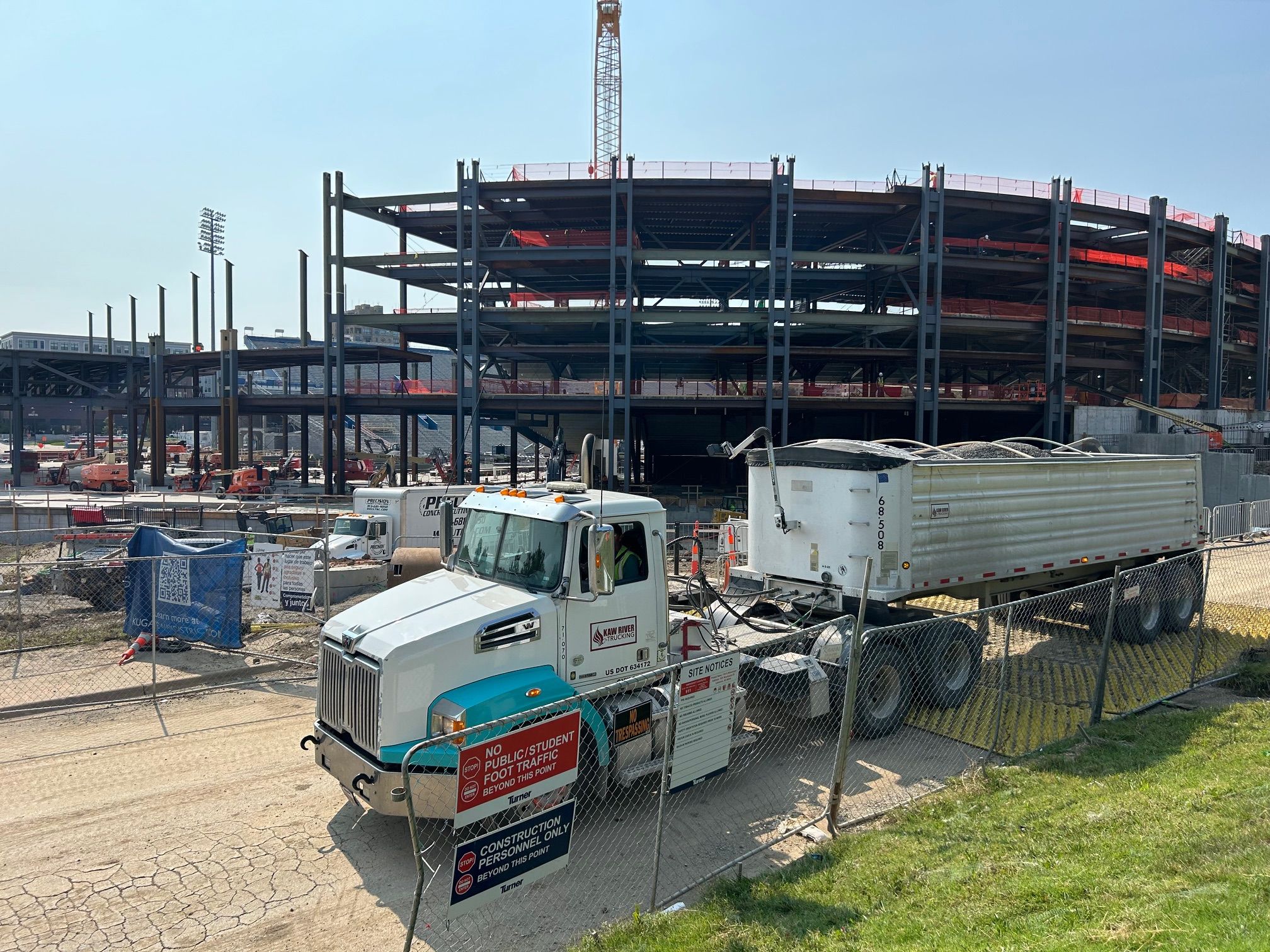
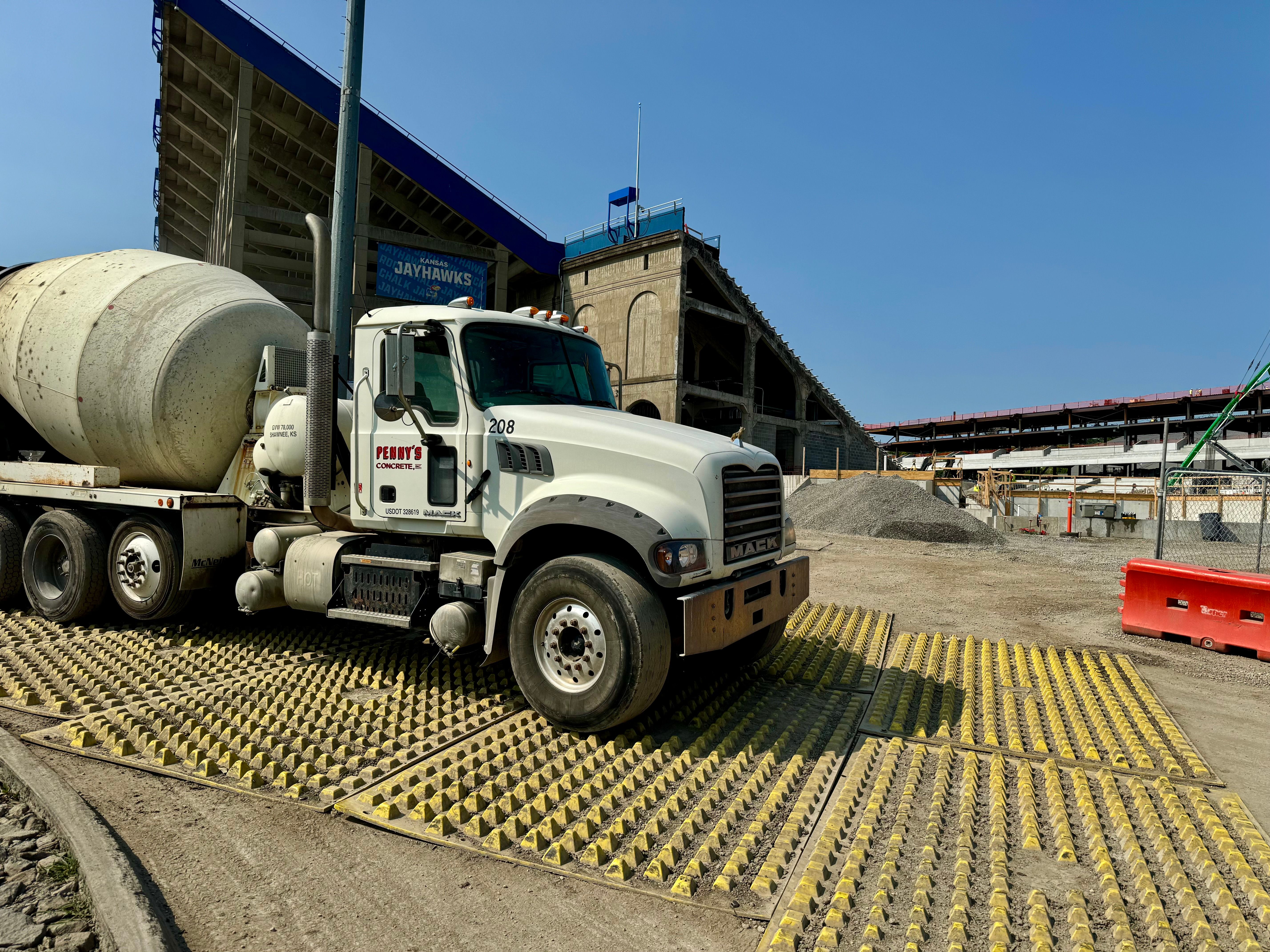
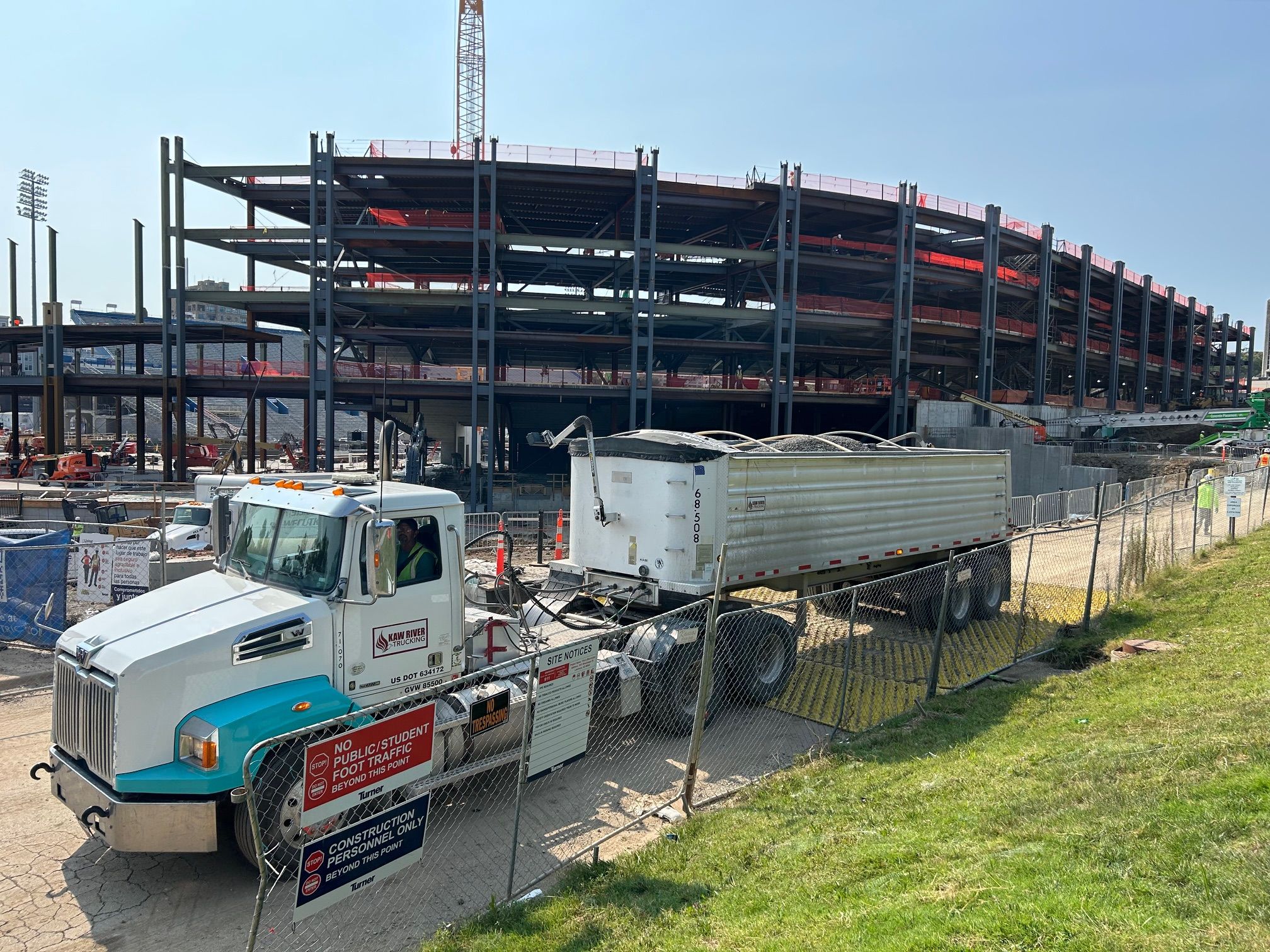
The clearest demonstration of FODS in Kansas is the ongoing renovation of David Booth Kansas Memorial Stadium at the University of Kansas in Lawrence, roughly 40 miles west of Kansas City. The stadium, which first opened in 1921, is the centerpiece of a $448 million renovation within the larger Gateway District redevelopment, with Turner Construction serving as construction manager. A project of this size carries significant erosion and sediment control obligations, and trackout from the constant flow of construction traffic onto Lawrence's public streets had to be controlled to protect local waterways and keep the surrounding neighborhood clean and safe.
Rodriguez Mechanical Contractors of Kansas City, Kansas, selected FODS Trackout Control Mats as the construction entrance and wheel wash BMP for the project, deploying them at key entry and exit points as part of the comprehensive SWPPP. The reusable mats replaced the traditional rock-and-geotextile entrance, and their rapid installation and removal allowed crews to move the entrances as the work shifted between phases without rebuilding a rock pad each time. The result was effective sediment control, cleaner roadways around the stadium, and continued regulatory compliance across a multi-phase schedule.
Additional Resources
Kansas Construction Stormwater Program
Kansas Construction Stormwater Permit Packet
Kansas Stormwater Runoff from Construction Activities General NPDES Permit