
Iowa Stabilized Construction Entrance Detail
Performance-Based BMP Compliant with Iowa DNR NPDES General Permit No. 2
Iowa is defined by its rivers. The Missouri River forms the state's western boundary, the Mississippi River its eastern border, and the Big Sioux River marks much of the northwest. Before western settlement, Iowa contained millions of acres of wetland prairie, the vast majority of which was drained and converted to agricultural use. Today, more than 90 percent of Iowa's land surface is cropland and managed prairie, and the network of drainage tile systems originally built to reclaim that land continues to channel runoff across the state. Surface water collects in natural and constructed lakes throughout Iowa, including the Iowa Great Lakes chain in the northwest near Spirit Lake and Okoboji, as well as impoundments along the Cedar River, the Des Moines River, and Clear Lake.
Those water resources serve critical public and agricultural functions. Groundwater aquifers beneath Iowa's fertile plains supply municipal systems in Des Moines, Cedar Rapids, Iowa City, and Sioux City, as well as rural water districts and agricultural operations across all 99 counties. Construction activity along the I-80 corridor, I-35, I-380, and the expanding network of rural roads supporting Iowa's wind energy and agricultural infrastructure creates ongoing stormwater risk. Sediment leaving construction sites enters that drainage network directly, degrading water quality and threatening the aquifer systems that Iowa's residents and industries depend on.
Iowa's stormwater permit program is the principal regulatory mechanism for managing that risk. Construction operators working at sites that disturb one or more acres are required to obtain permit coverage, develop a Stormwater Pollution Prevention Plan, and implement Best Management Practices before ground is broken.

Iowa DNR NPDES General Permit No. 2
Iowa's Department of Natural Resources (DNR) administers the state's National Pollutant Discharge Elimination System (NPDES) permit program under delegation from the U.S. EPA. For construction activity, the controlling instrument is NPDES General Permit No. 2: Stormwater Discharge Associated with Industrial Activity for Construction Activities, currently effective March 1, 2023 through February 29, 2028.
General Permit No. 2 applies to any construction project that will disturb one or more acres of total land area, including smaller disturbed areas that are part of a larger common plan of development or sale where the overall project will ultimately disturb one or more acres. Prior to commencing ground disturbance, the site operator must submit a Notice of Intent (NOI) through the Iowa DNR Stormwater General Permit Database and receive a formal authorization from the Department. Ground-disturbing activity may not begin until that authorization is issued.
The NOI must be accompanied by the applicable permit fee, proof of public notification published in a newspaper with the largest circulation in the project area, and a certification that the Stormwater Pollution Prevention Plan has already been developed and is ready for implementation. NOIs are submitted online at the Iowa DNR Stormwater General Permit Database at programs.iowadnr.gov/stormwater.
As of April 2026, the Iowa DNR conducted a stakeholder meeting regarding proposed revisions to General Permit No. 2, General Permit No. 1, and General Permit No. 3, all of which expire on February 29, 2028. Formal rulemaking for permit renewal is anticipated to begin in mid-2026. Operators with active project authorizations are not required to take immediate action; General Permit No. 2 provides that if a new permit has not been reissued prior to expiration, the current permit's provisions and coverage remain in force until a new general permit is adopted.
Stormwater Pollution Prevention Plan (SWPPP)
General Permit No. 2 requires that a SWPPP be completed before the NOI is submitted to the Department, and that the SWPPP be implemented from the start of construction activities. The SWPPP must identify the site, describe the nature and scope of construction, document drainage patterns and approximate post-grading slopes, and provide a detailed description of all erosion and sediment control measures that will be installed and maintained throughout the project.
The SWPPP must address the full sequence of construction activity, including initial controls required before land-disturbing activities begin, staging to limit the area of simultaneous disturbance, stabilization of areas where work has temporarily or permanently ceased, and specific measures to minimize off-site vehicle tracking of sediments. Part IV.D.2.c.(2) of General Permit No. 2 states directly that off-site vehicle tracking of sediments shall be minimized. Sediment trackout from vehicle tires onto paved roadways is one of the most frequently cited violations under this permit.
The SWPPP must be kept on-site at any construction trailer, shed, or covered structure for the duration of the project. Where no on-site structure exists, it must be maintained at an alternative location approved by the Department and made available for inspection within three hours of a request. Qualified personnel must inspect all unstabilized disturbed areas at least once every seven calendar days, and immediately following any storm event. Inspection reports must be retained as part of the SWPPP for at least three years after final stabilization and submission of a Notice of Discontinuation (NOD).

Iowa DOT Water Pollution Control: Section 2602
For Iowa Department of Transportation (IDOT) projects, Iowa DOT Standard Specifications Section 2602, Water Pollution Control (Soil Erosion), revised April 21, 2026, governs all temporary erosion and sediment control measures on NPDES-regulated construction projects. Section 2602 supplements General Permit No. 2 and applies to all DOT prime contractors and co-permittee subcontractors working on regulated projects.
Section 2602 requires the contractor to designate a Water Pollution Control Manager (WPCM) before any construction activity begins. The WPCM must hold at minimum an Iowa DOT Erosion and Sediment Control Basics certification (valid for two years) or an Erosion Control Technician (ECT) certification (valid for five years through the Department's Technical Training and Certification Program). The WPCM is responsible for supervising all stormwater-related work, coordinating with the contracting authority, and reviewing and signing inspection reports.
For projects where IDOT is the contracting authority, Section 2602 requires contractors to use Permix, the Department's web-based permit compliance tracking software. Contractors are responsible for managing company users, uploading Erosion Control Implementation Plans (ECIPs), uploading co-permittee certifications, and reviewing signed inspection reports within Permix. The stabilized construction entrance is a pay item under Section 2602 and is measured in linear feet as shown in the contract documents.
Stabilized Construction Entrance Requirements
A stabilized construction entrance is one of the first BMPs required on any Iowa construction site subject to General Permit No. 2. The entrance is placed at all vehicle egress points where construction traffic exits directly onto a paved roadway or public right-of-way. Its purpose is to dislodge and trap soil, debris, and other pollutants from vehicle tires before those materials can be deposited on public roads and enter the stormwater system.
The Iowa DOT Standard Road Plan EC-303 provides design guidance for stabilized construction entrance installations on DOT projects. Temporary construction entrances must be maintained throughout active construction and inspected as part of each scheduled SWPPP inspection. When an entrance becomes embedded with sediment or compacted to the point that it no longer functions effectively, it must be replenished or replaced before the next rain event.
Street sweeping must supplement any entrance BMP to remove any material that bypasses the entrance and reaches the active roadway. At Iowa project sites, particularly those adjacent to high-traffic arterials in the Des Moines metro, along the US-30 and US-20 corridors, or on rural secondary roads through eastern Iowa's river valleys, trackout prevention is not only a permit requirement but an active field enforcement priority.
Traditional Aggregate Entrance
The Iowa Construction Site Erosion Control Manual describes a conventional stabilized entrance design using crushed rock or gravel. A standard aggregate entrance consists of a pad of 2-inch crushed rock placed to a minimum depth of six inches over a minimum pad length of 50 feet. The rough surface texture of the stone is intended to dislodge mud and debris from vehicle tires.
In practice, aggregate entrances require frequent maintenance. The crushed rock becomes compacted and embedded with sediment during active use, progressively reducing its effectiveness. Additional stone must be added whenever the surface is no longer sufficiently rough to perform its function. Aggregate that becomes dislodged from the entrance pad can migrate onto the active roadway, creating hazards for passing vehicles and cyclists. On longer projects or high-traffic phases, the cost of ongoing aggregate replenishment is a significant operational expense.
Wheel Wash
When an aggregate entrance alone is insufficient to prevent trackout from reaching the roadway, wheel wash systems are often installed as a supplement. A wheel wash station uses pressurized water to clean tires more aggressively than passive contact with a crushed rock surface can achieve. Wheel wash systems require a water supply line, power for the wash equipment, and a properly designed sediment basin to collect, filter, and manage the wash water before discharge. These infrastructure requirements add to project cost and complexity, particularly at remote Iowa project sites.
FODS Trackout Control System
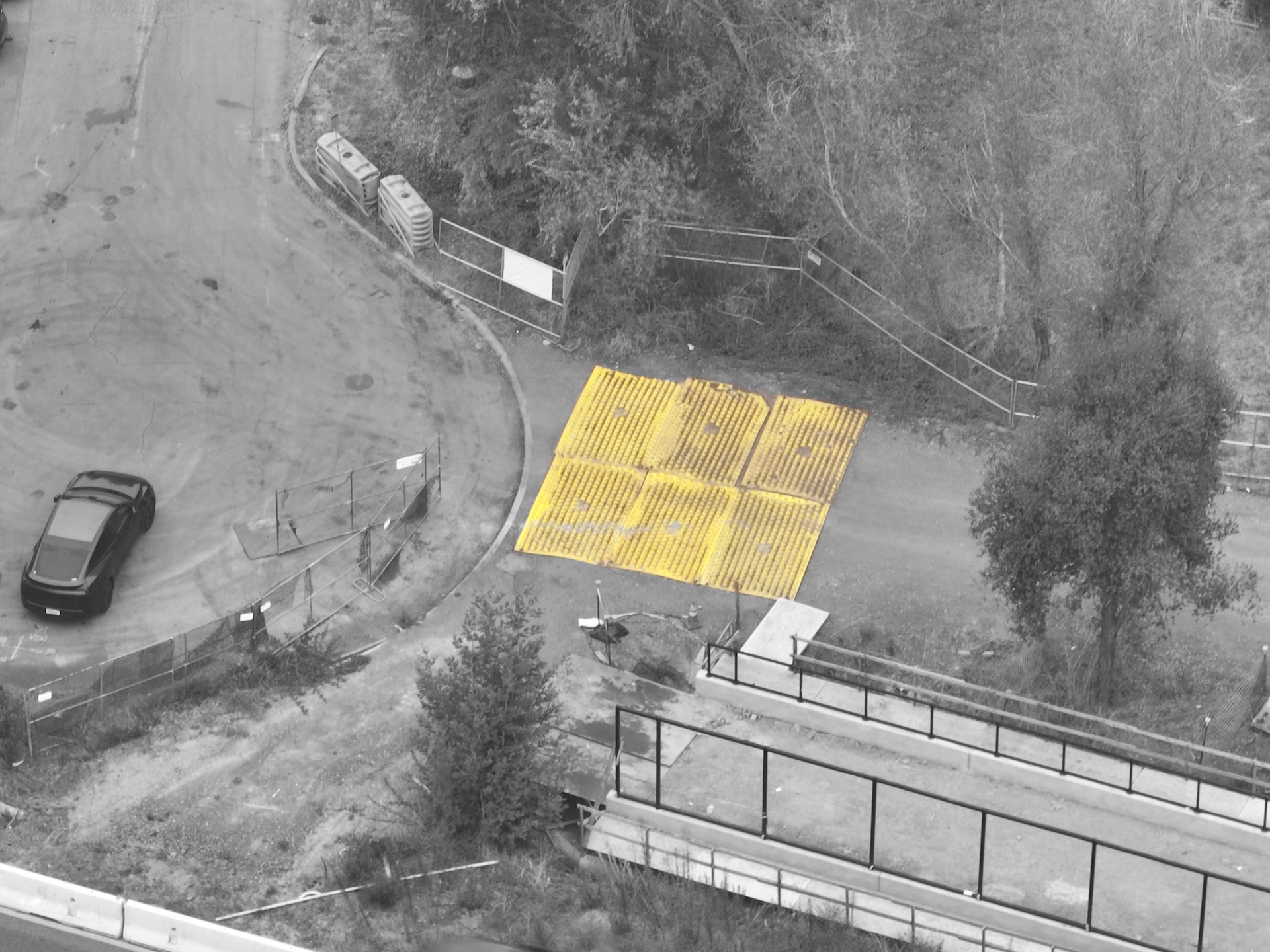
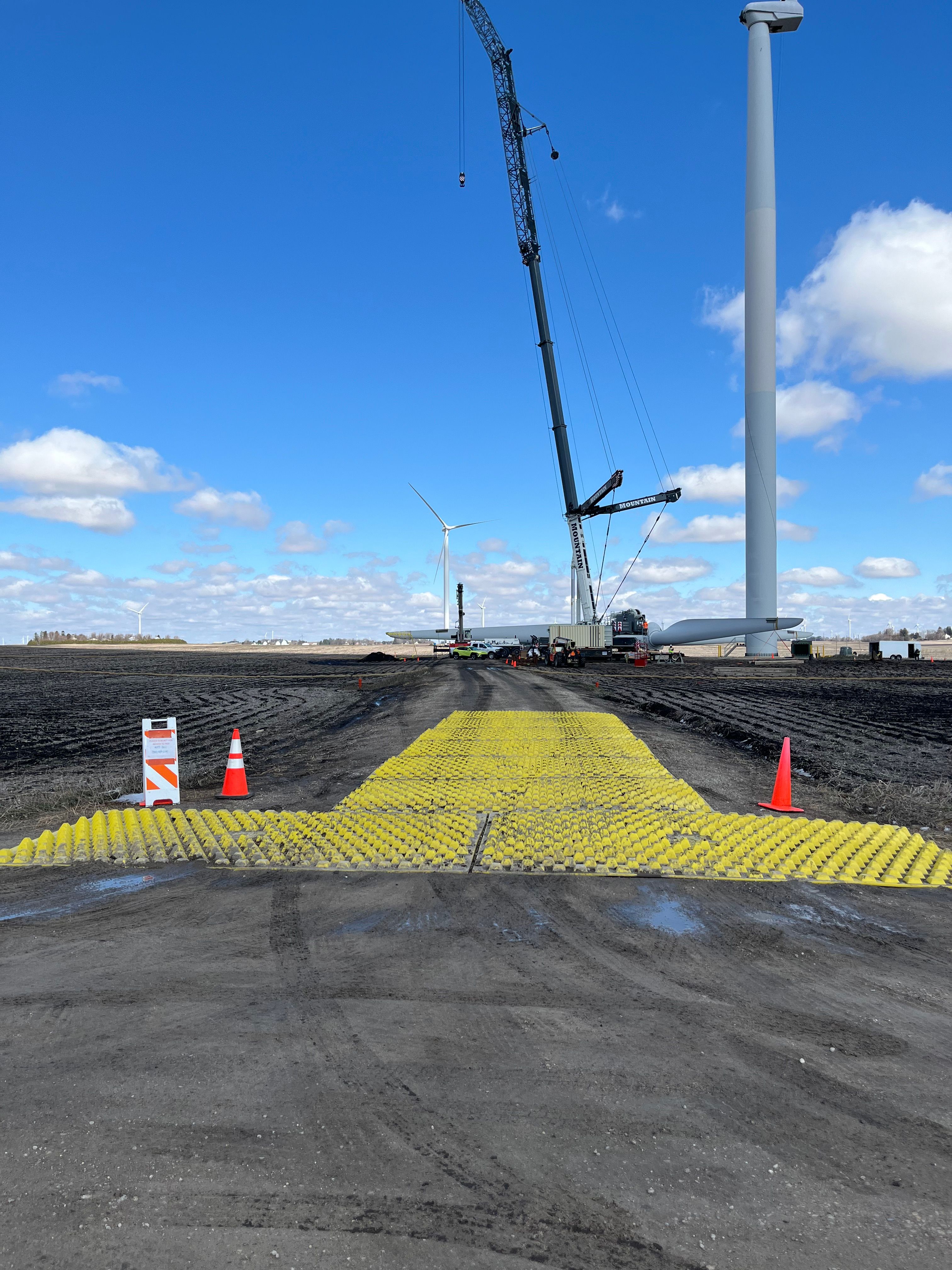
FODS Trackout Control Mats are a manufactured, performance-based alternative to traditional aggregate entrances. Each FODS mat measures 12 feet wide by 7 feet long and is constructed from durable high-density polyethylene (HDPE). The top surface consists of rows of raised pyramids, staggered in the direction of travel, that are engineered to deform vehicle tires as they pass over the surface. This deformation opens the tire tread, releasing embedded mud, sediment, and debris without requiring water or power.
Iowa does not maintain a named-product approval list for stabilized construction entrance BMPs in the same manner as states with DOT-specific Qualified Products Lists. FODS qualifies for use on Iowa projects as a performance-equivalent BMP under the Iowa Construction Site Erosion Control Manual's framework and the performance-based requirements of General Permit No. 2, which defines BMPs to include any management practice designed to prevent or reduce the pollution of waters of the state. Specifiers documenting FODS in a SWPPP can reference the manufacturer's independent performance testing, which demonstrates that FODS is up to 59 percent more effective at sediment removal than aggregate-based systems.
On Iowa projects, FODS has been deployed across a range of construction environments, from commercial developments in the Des Moines metro and Cedar Rapids to rural road construction and utility work supporting the state's wind energy infrastructure in central and northwest Iowa. The mat configuration adapts to site geometry: a standard 1x5T arrangement (five mats in tandem, extending 35 feet) replaces a conventional 70-foot aggregate pad while providing a wide turning radius suited to the large equipment that is common on Iowa agricultural and infrastructure projects.
Because the FODS system does not use loose rock, it eliminates the risk of stone projectiles from dual-tire vehicles, a safety concern specifically identified in Iowa's construction site enforcement guidance. FODS mats can be installed on any substrate, including compacted dirt, asphalt, and concrete, in as little as 30 minutes, with no excavation required. The mats are fully reusable across a lifespan of ten or more years, eliminating the ongoing material replenishment cost of aggregate entrances. At the end of a project phase, the system is removed, cleaned, and redeployed at the next phase or the next project site.
Inspection, Maintenance, and Compliance
Under General Permit No. 2 and Iowa DOT Section 2602, all stabilized construction entrance BMPs require regular maintenance to remain functional. For FODS installations, maintenance consists of inspecting mats at each required inspection interval, removing accumulated debris from the mat surface, and confirming that the perimeter of the installation has not allowed sediment to bypass the entrance. Because the mat surface does not compact or degrade with use, performance remains consistent between maintenance intervals. Removal and reinstallation for phased projects is straightforward, and no additional material is required to restore function between phases.
When construction is complete and final stabilization has been achieved across the disturbed area, the operator must submit a Notice of Discontinuation to the Iowa DNR within 30 days. The stabilized construction entrance may be removed once it is no longer needed to protect an active vehicle egress point.