

Georgia Stabilized Construction Exit
GSWCC-Recognized Construction Exit Alternative
Georgia's landscape is defined by remarkable diversity, from the Blue Ridge Mountains in the north to the barrier islands and coastal marshes along the Atlantic coast. The state's rivers, wetlands, and agricultural lands are protected through a comprehensive framework of erosion, sediment, and stormwater controls that apply to construction activity across all 159 counties.
The Georgia Department of Natural Resources has been delegated by the Environmental Protection Agency (EPA) to issue NPDES permits in the state. State-issued permits can be found through the Georgia Environmental Protection Division (EPD), Watershed Protection Branch. This branch issues permits to local governments and industry for managing wastewater, erosion and sedimentation, drinking water, stormwater, water withdrawal, and other water-related matters.
Georgia Environmental Protection Division (EPD)
The Environmental Protection Division (EPD) of the Georgia Department of Natural Resources is charged with protecting Georgia's air, land, and water resources through the authority of state and federal programs. The Watershed Protection Branch protects, restores, and monitors Georgia's water resources to maintain a sustainable environment. The EPD protects Georgia's many rivers, lakes, swamps, and waterfalls, and offers volunteer programs such as Rivers Alive and Adopt-a-Stream.
The coasts of Georgia contain many different wetlands, ranging from non-tidal wetlands to salt marshes. Under the Georgia Coastal Marshlands Protection Act of 1970, the state recognized that the coastal marshlands of Georgia comprise a vital natural resource system, serving as the habitat of many species of marine life and wildlife. This remains an essential feature under the EPD and underscores the importance of stormwater and sediment controls on construction sites across the state.
Georgia Construction Stormwater Permit
The Federal Clean Water Act (CWA) prohibits the discharge of any pollutant into waters without authorization under a National Pollutant Discharge Elimination System (NPDES) permit. Three general construction permits regulate construction activities that disturb one or more acres in Georgia:
- NPDES Permit No. GAR100001 for stand-alone construction sites
- NPDES Permit No. GAR100002 for infrastructure construction sites
- NPDES Permit No. GAR100003 for common development construction sites
Permit coverage must be obtained by submitting a fully completed Notice of Intent (NOI) along with a Storm Water Pollution Prevention Plan (SWPPP). The NOI must be submitted through the EPD electronic submittal portal at least fourteen days before beginning construction activities. Construction general permits are issued on a 5-year cycle, and coverage remains active for the duration of construction unless terminated or modified.
A SWPPP includes a list of each pollution source along with the measures to mitigate or contain contaminants. Each practice outlined in the SWPPP is called a Best Management Practice (BMP). The Georgia Soil and Water Conservation Commission (GSWCC) publishes the Manual for Erosion and Sediment Control in Georgia, which serves as the primary reference for approved BMPs used on Georgia construction sites.
What Is a Construction Exit in Georgia?
One of the first Best Management Practices installed at a new construction site is the Construction Exit (Co), also called the stabilized construction entrance. The purpose of the stabilized entrance is to prevent or reduce soil tracking from vehicle tires onto roadways and into storm drains.
Georgia Crushed Stone Construction Exit (Co) Specifications
The GSWCC Manual for Erosion and Sediment Control, section on Crushed Stone Construction Exit (Co), calls for a stone-stabilized pad to be located where traffic will be leaving a construction site for a public street, sidewalk, or parking area, or where bare soil transitions to a paved area.
Key specifications include:
- Minimum width of 20 feet
- Minimum thickness of 6 inches
- Minimum length of 50 feet (when construction is less than 50 feet from paved access, the length shall run from the edge of pavement to the structure being built)
- Stone in accordance with R-2 gradation (1.5 to 3.5 inch stone)
- Geotextile underliner required throughout the full length and width, selected per AASHTO M288
Exits must be maintained to prevent mud tracking. This may require periodic top dressing with 1.5 to 3.5 inch stone and removal of rocks from the entrance or adjacent roadway. All materials washed, spilled, dropped, or tracked onto roadways or storm drains must be removed immediately.
Alternate Option: Wheel Wash
If vehicle travel over the construction exit does not sufficiently remove mud, tires should be washed prior to exit. Washing should be done on an area stabilized with crushed stone, with provisions to collect sediment runoff into an approved sediment trap or basin. All materials washed, spilled, dropped, or tracked onto roadways or storm drains must be removed immediately.
FODS Approvals in Georgia
FODS Reusable Construction Entrance is recognized by the Georgia Soil and Water Conservation Commission as an approved Construction Exit alternative (Co-Alt). This listing authorizes contractors and design engineers to specify FODS in their SWPPP as a compliant Construction Exit BMP without additional justification or equivalency review.
GSWCC Construction Exit Co-Alt Listing
The Georgia Soil and Water Conservation Commission has listed FODS LLC as an approved source for a Construction Exit alternative under the Co-Alt designation in the GSWCC Approved Products and Vendors list.
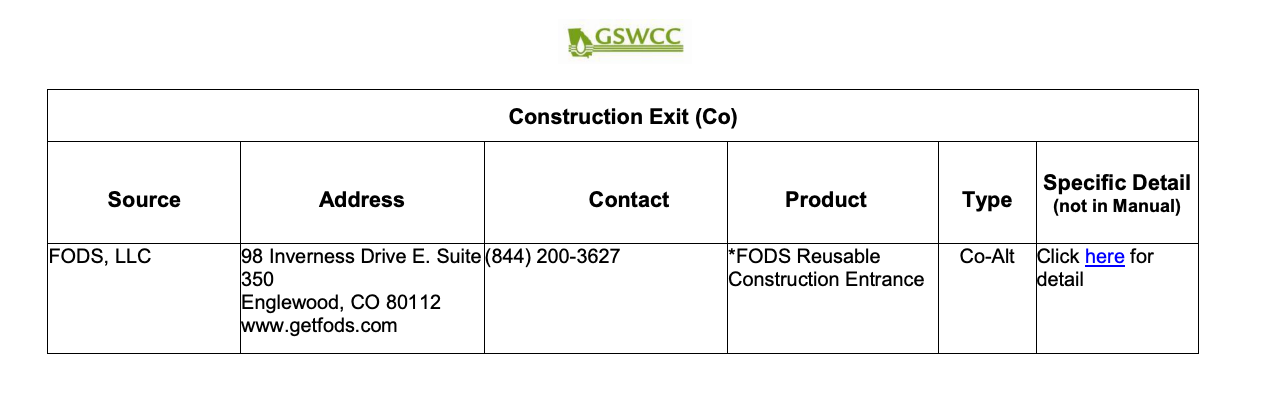
- Approval Body: Georgia Soil and Water Conservation Commission (GSWCC)
- BMP Category: Construction Exit (Co)
- Product: FODS Reusable Construction Entrance
- Designation: Co-Alt (Construction Alternative)
- Manufacturer: FODS, LLC
- Contact: (844) 200-3627
- Website: www.getfods.com
Contractors and inspectors can verify this listing directly through the GSWCC Approved Products and Vendors list.
FODS Trackout Control Mats
The FODS Trackout Control System is a GSWCC-recognized BMP for stabilized construction entrances, a more straightforward, cost-effective alternative to the proposed crushed stone construction exit. The mats are made of a high-density composite material and are specifically designed to remove sediment from vehicle tires. The mat's unique pyramid design manipulates vehicle tires as they drive over the surface to remove mud and dirt, even from inside the tire treads. As debris is removed, it collects at the base of the mat for easy cleanup.
When sediment builds up, the mat can be quickly cleaned and restored to full functionality using the FODS shovel. These durable mats are designed to withstand 10 or more years of service, reducing long-term construction entrance costs.
A standard layout that commonly replaces crushed stone construction entrances is a 1x5T configuration, which provides a wide turning radius and a 35-foot length. FODS can be installed without excavation over a wide range of surfaces, including soil, asphalt, and concrete. The system can be relocated and maintained without heavy equipment or constant upkeep.
A common problem with crushed stone entrances is that dual-tire vehicles often displace and launch rocks into active traffic lanes and the construction site. With FODS's rockless design, contractors get a safer and more manageable way to remove sediment from construction vehicles. The effectiveness of these mats also eliminates the need for an additional wheel wash station and sediment trap, helping contractors cut costs and save time.
Risks of Vehicle Trackout on Georgia Roadways
Sediment and mud tracked onto Georgia roadways creates hazards for drivers and increases the risk of stormwater violations. During Georgia's frequent and heavy rainfall events, trackout deposited on pavement can wash directly into storm drains and reach streams, rivers, and coastal waterways regulated under the state's NPDES program.
Georgia EPD and local issuing authorities conduct site inspections and can issue notices of violation, stop-work orders, and fines for trackout violations and BMP failures. A GSWCC-recognized product like FODS reduces the risk of these outcomes by providing a reliable, well-documented control measure that is already familiar to inspectors trained on the GSWCC Manual.
Georgia SWPPP and BMP Resources
Key resources for Georgia construction exit compliance and stormwater permitting:
- Georgia EPD NPDES Construction General Permits (GAR100001, GAR100002, GAR100003)
- GSWCC Manual for Erosion and Sediment Control in Georgia
- GSWCC Approved Products and Vendors List
- Georgia EPD Watershed Protection Branch
- Georgia EPD Electronic Submittal Portal
- EPA NPDES Construction General Permit
Contact us to find out more about FODS Reusable Construction Entrances in Georgia, or download the Georgia State Submittal Package for SWPPP documentation support.
Additional Resources:
Manual For Erosion and Sediment Control In Georgia
Manual For Erosion and Sediment Control In Georgia - Excerpt
Field Manual for Erosion and Sediment Control in Georgia
GSWCC Guidance Documents for Alternative BMPs [October 2008]
GSWCC Approves FODS as Alternate BMP
Documents List for Georgia Water