

Florida Soil Tracking Prevention Device
NPDES-Compliant Stabilized Construction Entrance for Florida Projects
Florida construction projects that disturb one or more acres of land are required to obtain coverage under the NPDES Stormwater Construction Generic Permit (CGP), administered by the Florida Department of Environmental Protection (DEP). As part of permit compliance, contractors must develop and implement a Stormwater Pollution Prevention Plan (SWPPP) identifying Best Management Practices (BMPs) to prevent sediment and pollutants from leaving the construction site.
One of those required BMPs is a Soil Tracking Prevention Device (STPD), a stabilized construction entrance designed to remove mud and debris from vehicle tires before they reach public roadways. FODS Trackout Control Mats are deployed on construction sites across Florida as a performance-based alternative to traditional aggregate STPDs, providing effective, reusable trackout control that meets the intent of the CGP and Florida's Erosion and Sediment Control requirements.
From the urban corridors of Miami and Orlando to the coastal waterways of Clearwater and Fort Lauderdale, Florida contractors have used FODS on some of the state's most complex and environmentally sensitive construction projects.
What Is a Soil Tracking Prevention Device in Florida?
The Florida Department of Environmental Protection and the Florida Department of Transportation (FDOT) collaborated to produce the Erosion and Sediment Control Designer and Reviewer Manual, which defines standards and specifications for common BMPs used on Florida construction sites. Within that manual, the Soil Tracking Prevention Device is defined as a stabilized entrance point that prevents sediment from being tracked from the construction site onto adjacent paved roads.
Florida's proximity to protected waterways, including Biscayne Bay, Tampa Bay, the Indian River Lagoon, and the watershed that feeds Everglades National Park, makes effective trackout control particularly important. Sediment that reaches public roadways is carried by stormwater runoff into storm drains and ultimately into those surface waters. During the state's frequent heavy rain events and hurricane season, even minor lapses in trackout control can contribute to significant water quality impacts.
Traditional STPD Specifications in Florida
The FDOT Soil Tracking Prevention Device Type A specification calls for a stabilized entrance that is 12 feet wide and 50 feet long, excavated, lined with filter cloth, and topped with a minimum of 6 inches of crushed stone ranging from 2 to 4 inches in diameter. The device must be positioned so that runoff is directed into a sediment basin rather than onto the roadway.
The CGP requires contractors to inspect STPDs every seven days and within 24 hours of any storm event producing 0.5 inches or more of rainfall. In Florida, that inspection requirement carries real weight. The state averages more than 50 inches of rain per year, concentrated heavily in the summer months, meaning STPDs must perform reliably under frequent and heavy loading.
Traditional aggregate entrances face well-documented challenges in wet conditions. Rock pads compact and flatten over time, reducing their effectiveness. Mud infiltrates the aggregate layer and diminishes tire cleaning performance. Additional material must be hauled in to restore the entrance, creating ongoing supply chain, cost, and site logistics challenges. In urban environments like Orlando, Miami, or Fort Lauderdale, limited staging space can make it difficult to achieve the FDOT-recommended 50-foot length with aggregate alone.
FODS as a Stabilized Construction Entrance in Florida
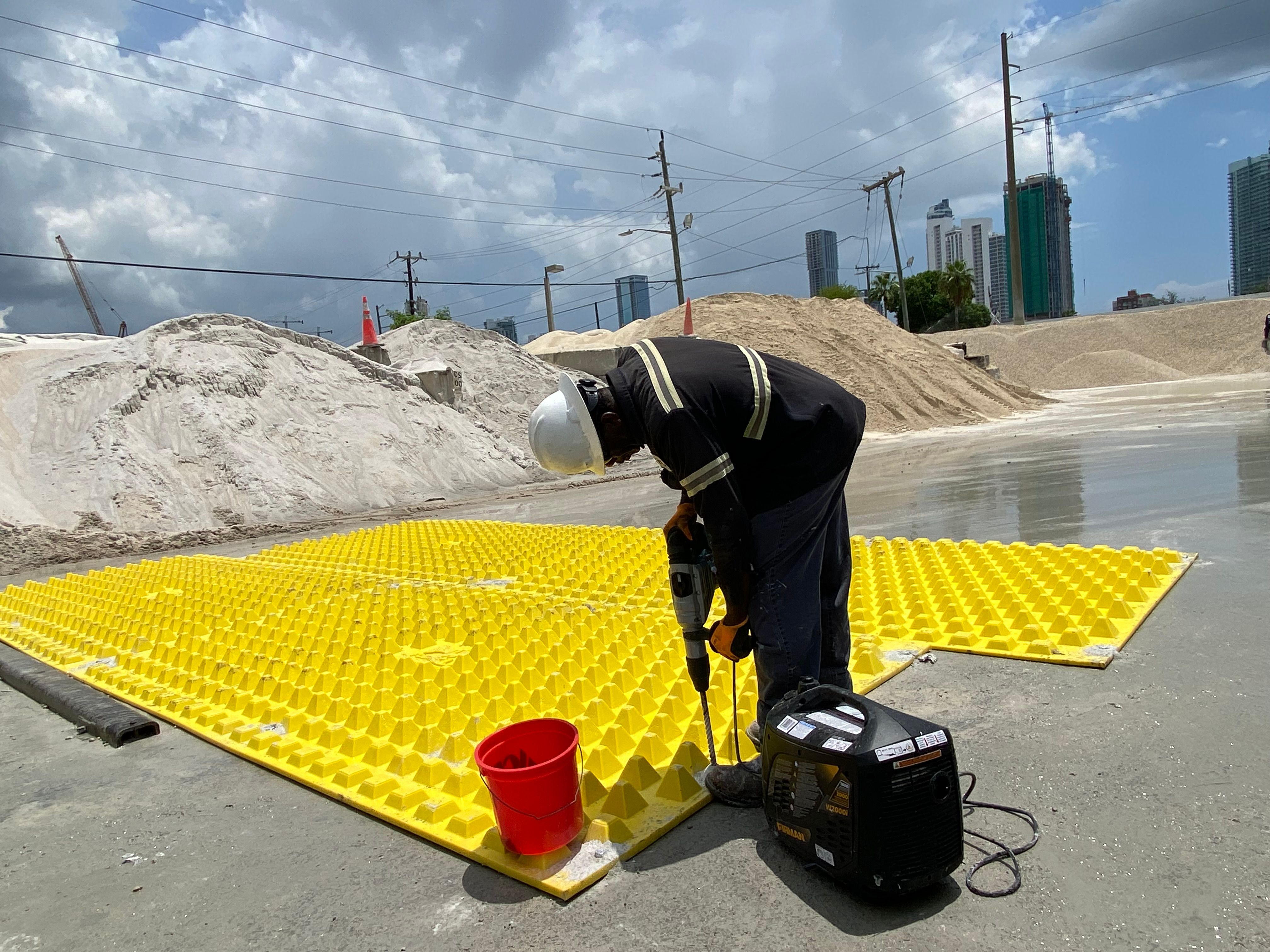
FODS Trackout Control Mats provide a manufactured alternative to traditional aggregate STPDs. Rather than relying on loose rock to dislodge tire debris, FODS mats use a rigid, textured HDPE surface formed into pyramid-shaped ridges. As vehicles pass over the mats, the ridges deform the tire and mechanically release sediment and debris from the tread. That material drops to the base of the pyramids, away from subsequent vehicle passes, keeping the surface clean and functional.
Because FODS mats are modular and do not degrade from rain, compaction, or repeated vehicle loads, they maintain consistent performance across Florida's wet seasons and throughout long construction timelines. Mats can be installed without excavation over soil, asphalt, or concrete and are repositioned as construction phases shift access points. A standard 1x5T layout provides 35 feet of cleaning surface and can be placed in about 30 minutes without heavy equipment.
For Florida SWPPP practitioners, FODS qualifies as a stabilized construction entrance under the CGP's requirement to use "appropriate stabilization techniques at all construction site access points so sediment removal occurs before vehicle exit." The system's documented effectiveness, deployed successfully on FDOT-permitted projects throughout the state, supports its use as a performance-based BMP.
FODS on Florida's Largest Construction Projects
FODS has been deployed across a wide range of Florida construction projects, including several of the state's most prominent and environmentally sensitive jobs. The system's reusability and portability make it a practical choice for phased highway and urban construction projects where access points change regularly.
Miami Signature Bridge: I-395 / SR 836 / I-95
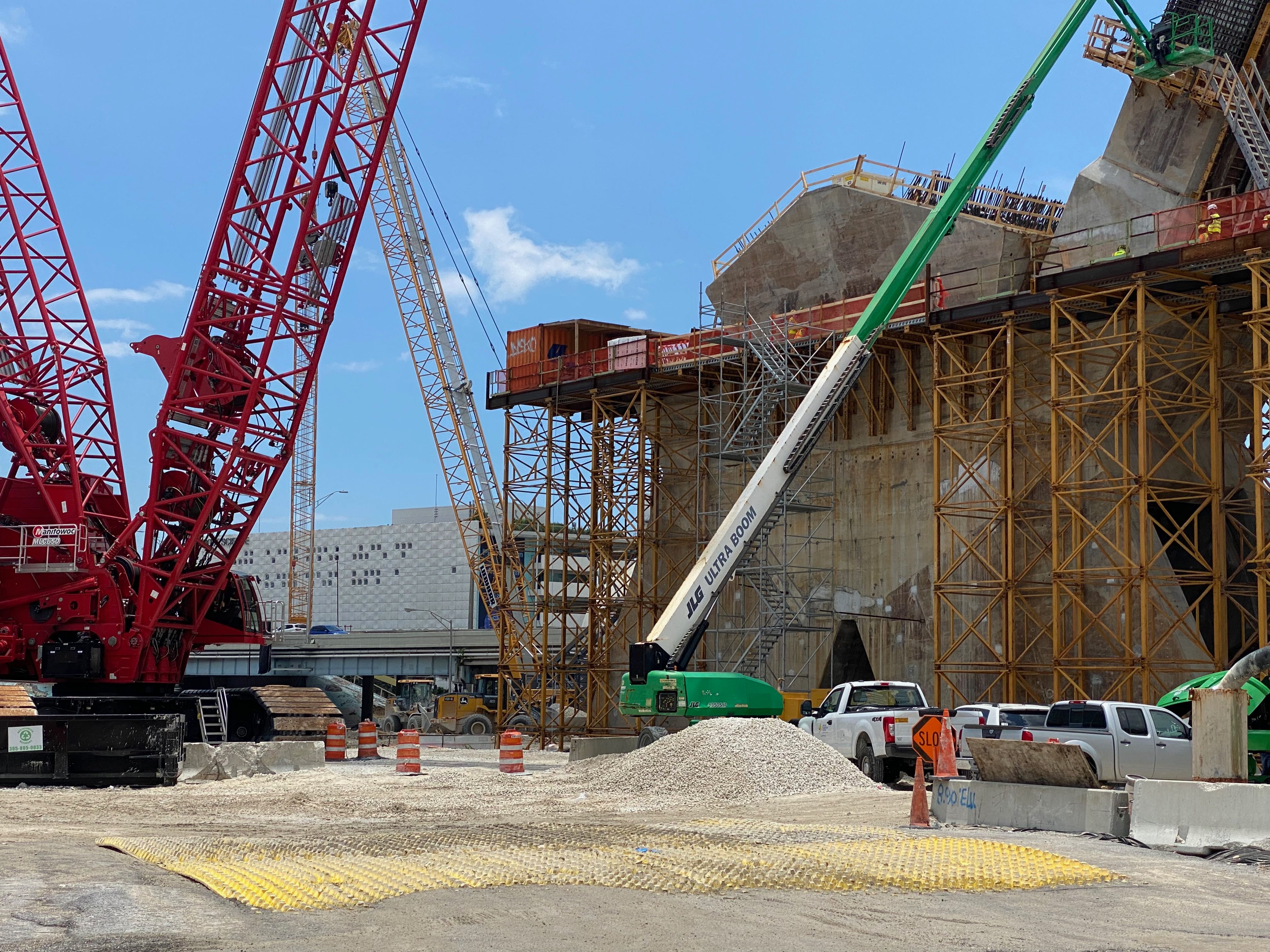
The I-395/SR 836/I-95 Design-Build Project is one of the most complex urban highway reconstruction efforts currently underway in South Florida. The $866 million project, delivered through a partnership between FDOT and the Greater Miami Expressway Agency (GMX), spans approximately five miles through the heart of downtown Miami and includes a 1,025-foot signature bridge spanning Biscayne Boulevard.
The project is being built by a joint venture between Archer Western and the de Moya Group, with engineering support from HDR. Construction occurs adjacent to the Miami River and within close proximity to Biscayne Bay, making erosion and sediment control a critical compliance priority throughout the project. FODS mats have been deployed at multiple construction entrances across the corridor, providing vehicle trackout control that can be relocated as the phased, linear project advances. The project is expected to reach full completion by late 2029.
Miami Freedom Park: Inter Miami CF Stadium
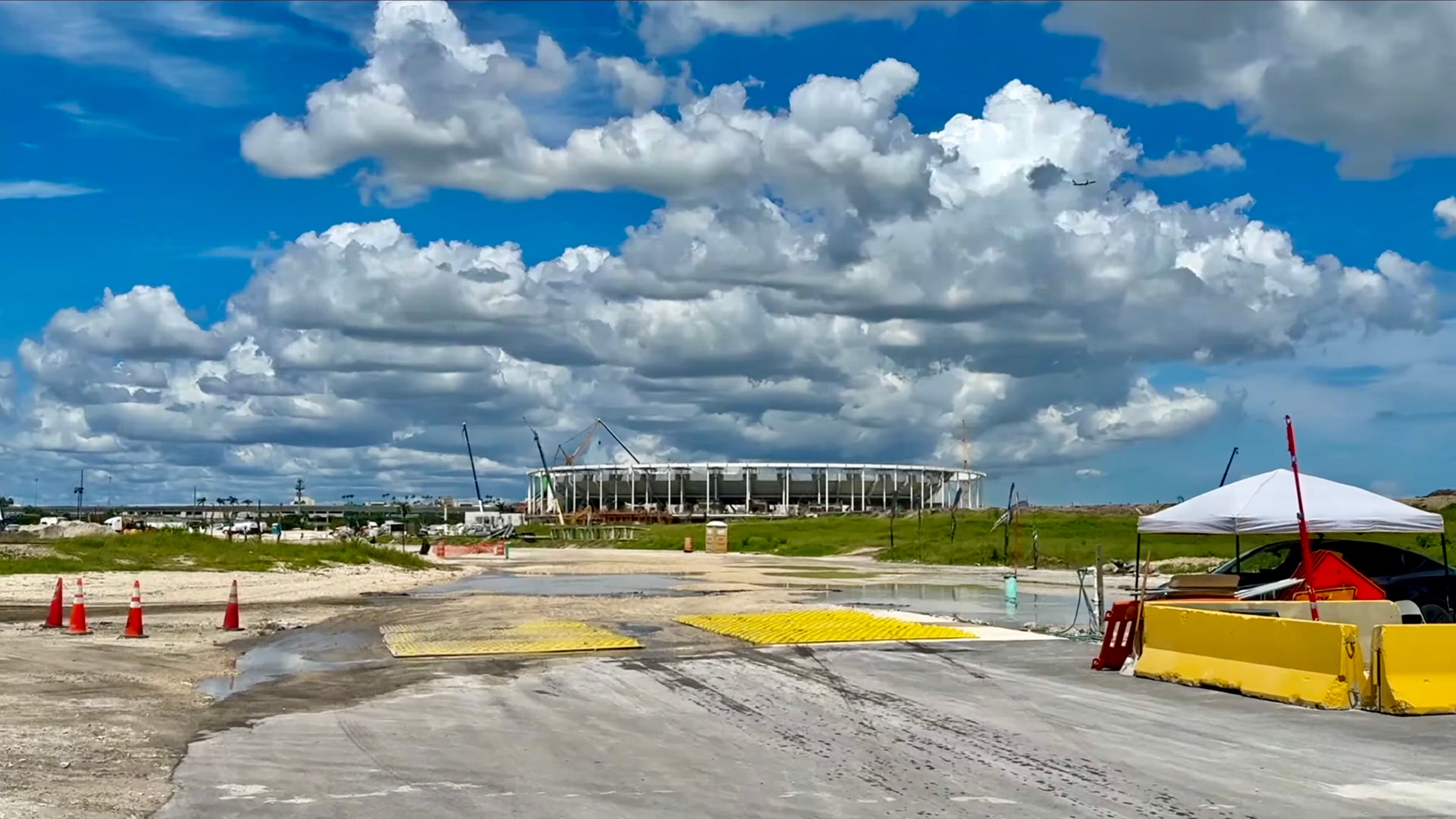
Miami Freedom Park is a $1.3 billion sports and entertainment complex currently under construction in Miami, sited at the former Melreese Country Club adjacent to Miami International Airport. The development, led by the ownership group behind MLS club Inter Miami CF, includes a 25,000-seat stadium, a 58-acre public park, and over one million square feet of mixed-use development.
The project site presented a significant environmental challenge: the Melreese brownfield contained elevated levels of arsenic, barium, and lead from decades of incinerator ash disposal. Construction oversight included close coordination with Miami-Dade County's Department of Environmental Resources Management (DERM), the EPA, and FDOT. In that context, preventing any tracked contamination from leaving the site was not simply a compliance issue but a direct environmental protection obligation. FODS mats were deployed at primary access points along LeJeune Road and Northwest 37th Avenue, supporting both SWPPP compliance and the site's larger soil remediation program.
I-4 Ultimate Improvement Project: Orlando
The I-4 Ultimate Improvement Project is the largest highway project in FDOT history, reconstructing a 21-mile corridor through the Orlando metropolitan area. The project was delivered by SGL Constructors, a joint venture between Skanska Construction, Granite Construction, and Lane Construction.
When SGL Constructors began work on the project, they initially installed aggregate-based STPDs at construction entrances per FDOT specifications. They quickly found that many points of egress had limited space, preventing the rock entrance from reaching the recommended 50-foot length. Rock entrances also proved ineffective in wet conditions and posed safety risks for motorists on adjacent active lanes when crushed rock was tracked onto the roadway. SGL Constructors switched to FODS mats and found that the composite system allowed them to create effective, clearly defined entrances in constrained spaces, with performance that held up through the extended project timeline.
NASA Kennedy Space Center: Crawlerway Restoration
Kennedy Space Center on Merritt Island is one of Florida's most recognizable landmarks and one of the most sensitive operational environments in the country. During the Crawlerway Restoration Project, demolition contractors removing the decommissioned Mobile Service Structure building installed FODS mats on the Saturn Causeway to contain debris and contaminants within the jobsite. The rockless system was selected in part because introducing aggregate at a facility with strict Foreign Object Debris (FOD) protocols would have created an unacceptable safety risk for equipment and operations.
Florida CGP Rulemaking Update
The Florida DEP issued a Notice of Rulemaking in late 2025, proposing amendments to Chapter 62-621, Florida Administrative Code, to update the Construction Generic Permit and associated forms, including the Notice of Intent (NOI) and a newly created Notice of Termination (NOT). A public workshop was held on November 19, 2025.
The current CGP remains in effect while those amendments proceed through the rulemaking process. Permit coverage continues to be required for construction activities disturbing one or more acres, with a five-year term. NOIs and NOTs are submitted electronically through the DEP Business Portal.
How FODS Supports SWPPP Compliance in Florida
Florida's CGP requires contractors to minimize off-site vehicle tracking of sediments onto paved surfaces and to remove any sediment that escapes the site at a frequency sufficient to minimize off-site impacts. Contractors are also required to restrict vehicle access to designated construction entrances and to use appropriate stabilization techniques at those access points.
FODS mats satisfy those requirements through a manufactured stabilized entrance that cleans vehicle tires at the point of exit. The system does not require aggregate replenishment, which eliminates the ongoing cost and logistics of refreshing a traditional stone pad. The mats can be inspected and cleaned with a FODS shovel in minutes, returning the entrance to full function after a rain event.
For SWPPP documentation, FODS should be specified as a manufactured stabilized construction entrance consistent with the intent of the FDOT STPD Type A standard. The Florida DEP and FDOT Erosion and Sediment Control Manual's supporting details provide a basis for demonstrating equivalence.
A standard 1x5T FODS layout replaces the function of a 70-foot traditional stone entrance. The modular design allows layouts to be tailored to site dimensions and traffic volume, and the system can be extended or reconfigured without additional material cost.
Additional Resources:
FODS Deployed at NASA’s Kennedy Space Center
Florida DEP & FDOT Erosion & Sediment Control - Designer & Reviewer Manual Excerpt
Florida DEP & FDOT Erosion & Sediment Control - Designer & Reviewer Manual
FDOT Traditional Soil Tracking Prevention Device Type A
Florida DEP Stormwater Program
Florida DEP Construction General Permit