
Nevada Stabilized Construction Entrances and Track-Out Control
NDEP, NDOT, and Clark and Washoe County Dust Control Compliance
Nevada is the driest state in the country, which makes both its limited surface water and its air quality unusually sensitive to construction activity. Much of the state lies within the Great Basin, a region of isolated mountain ranges and closed drainage basins where many valleys are endorheic, meaning runoff collects in internal sinks rather than flowing to the ocean. In the south, the Las Vegas Valley sits in the Mojave Desert and drains through the Las Vegas Wash to Lake Mead and the Colorado River, while the Truckee River carries Sierra snowmelt from Lake Tahoe through Reno, and the Humboldt River drains much of northern Nevada toward the Humboldt Sink. In this climate, sediment tracked off a job site is both a water quality problem and a source of airborne dust, and Nevada regulates it on both fronts.
Two layers of regulation apply to a Nevada construction exit. The Nevada Division of Environmental Protection administers stormwater permitting statewide, and the county air quality agencies in the Las Vegas and Reno areas administer dust control programs that specifically require track-out controls. A construction exit that satisfies both is essential to staying in compliance.
NDEP NPDES Construction Stormwater Permit
Authority to administer the National Pollutant Discharge Elimination System (NPDES) program in Nevada is delegated to the Nevada Division of Environmental Protection (NDEP) through the Bureau of Water Pollution Control. The Bureau issues the Construction Stormwater General Permit (NVR100000), which applies to most construction that disturbs one acre or more, or that is part of a larger common plan of development of that size. A project smaller than one acre can also be pulled in if it may affect receiving waters within a quarter mile. The current general permit is the 2015 permit, which NDEP has administratively continued while a renewal moves through the rulemaking process, so operators should confirm the latest version on the NDEP site when preparing an application.
To obtain coverage, an operator submits a Notice of Intent and prepares a Stormwater Pollution Prevention Plan (SWPPP) before construction begins. The SWPPP identifies every potential source of sediment and pollution on the site and the best management practices (BMPs) that will control it. Because construction entrances are a frequent source of off-site sediment, entrance stabilization, street sweeping, and drainage controls are core elements of a Nevada SWPPP. NDEP also maintains a BMP Toolbox that compiles state and local guidance for designing and inspecting these controls.
Clark County Dust Control and Track-Out Requirements
In the Las Vegas Valley, the most demanding track-out rules come from air quality regulation rather than stormwater. The Las Vegas Valley is a former PM10 nonattainment area, and the Clark County Department of Environment and Sustainability, Division of Air Quality (DAQ) enforces strict dust control on construction sites. A Dust Control Operating Permit is required for any soil-disturbing or construction activity of a quarter acre or more, and the permit is governed by Clark County Air Quality Regulation Section 94, which incorporates the Construction Activities Dust Control Handbook by reference.
Track-out prevention and cleanup is addressed as BMP 20 in that handbook. The county requires a track-out control device at every paved exit and lists the accepted options, including a gravel pad of at least 30 feet wide, 3 inches deep, and 50 feet long or the length of the longest haul truck, a grizzly or shaker rack, and a wheel wash device. When material still reaches the road, it must be cleaned up promptly, and visible track-out beyond a set distance from the exit is a violation. For contractors in Clark County, a durable, high-performing construction exit is not optional, it is the difference between passing and failing a dust inspection.
Washoe County Dust Control
In the Reno and Sparks area, Northern Nevada Public Health, through its Air Quality Management Division, administers a comparable program under the District Board of Health Regulations Governing Air Quality Management, Section 040.030 Dust Control. A dust control permit is required for surface disturbance of one acre or more, and controlling track-out onto paved roads is part of staying in compliance. As in Clark County, a reliable construction exit is central to meeting these requirements throughout northern Nevada.
NDOT Stabilized Construction Entrance Detail
On state transportation projects, the Nevada Department of Transportation (NDOT) Construction Site BMP Manual provides a stabilized construction entrance detail built on a traditional aggregate track-out pad. The guidance calls for crushed rock placed at least six inches deep and extending at least fifty feet, generally two inches or larger in diameter and sized for the vehicles using the site. Smaller stone is discouraged because it can be tracked onto roadways or lodged in dual tires and expelled at speed, creating a safety hazard. Aggregate entrances must be monitored frequently, since the stone compacts and fills with sediment, and when the surface loses its roughness the entrance must be topped with fresh rock, lengthened, or supplemented with additional track-out controls.
FODS as a Compliant Track-Out Control in Nevada
Nevada does not maintain a brand-name approval list for construction exits. NDEP, NDOT, and the county air agencies evaluate a track-out control on whether it performs the required function, removing sediment from tires before vehicles reach the road, and the operator specifies the chosen device in the project SWPPP and dust control plan. FODS Trackout Control Mats qualify as a manufactured track-out control device under this framework. They can be named directly in a Nevada SWPPP and listed as the track-out control on a Clark County or Washoe County dust control plan, alongside the gravel pad, grizzly, and wheel wash options the handbooks describe.
FODS satisfies the same purpose as a stone pad or wheel wash while removing the loose aggregate and standing water that those options depend on. In an arid climate where wheel washes consume scarce water and gravel pads shed dust and rock, a rockless, water-free mat is well matched to Nevada conditions and to the dust control outcomes the county programs are designed to achieve.
FODS Trackout Control System
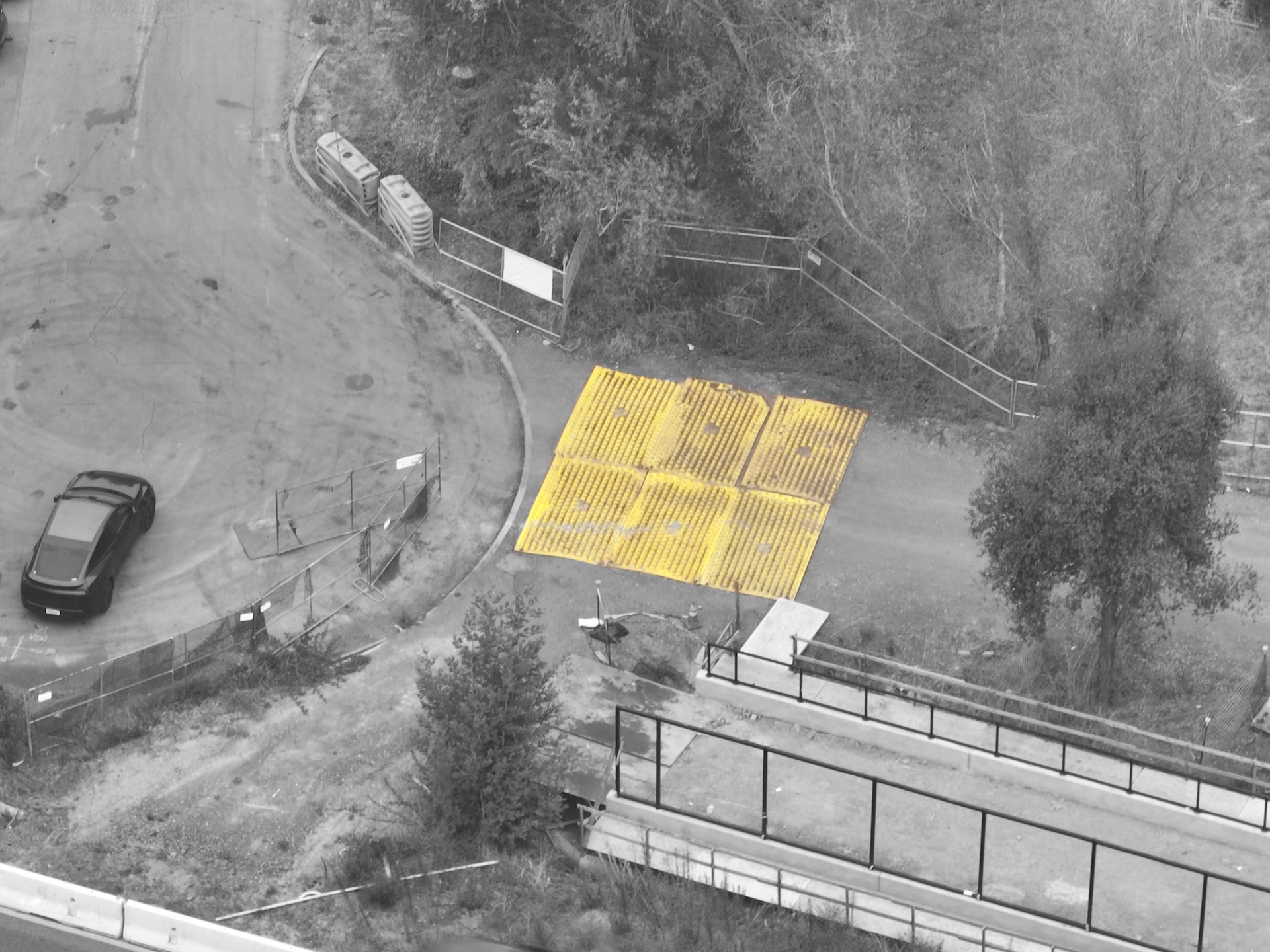
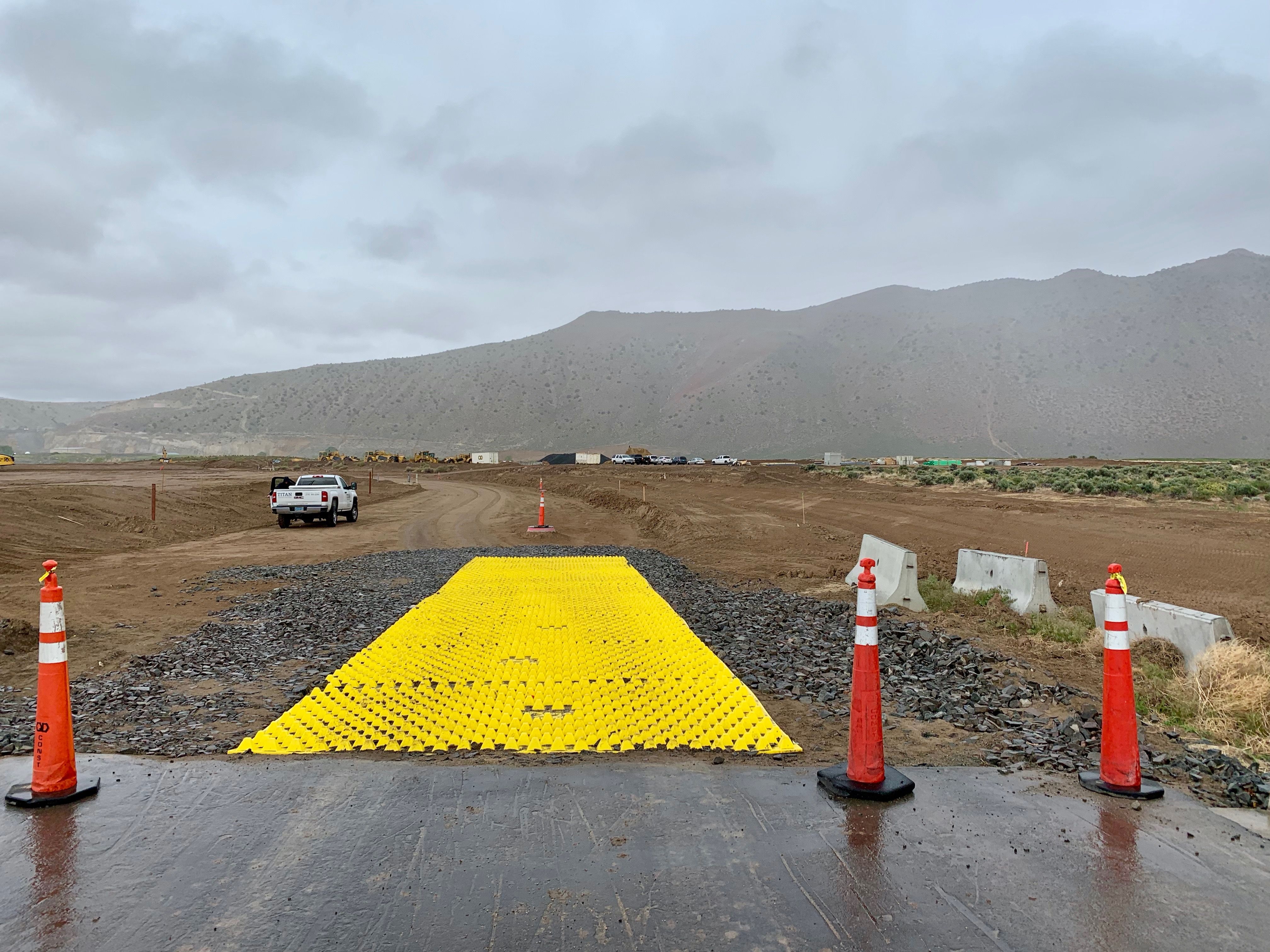
The FODS Stabilized Construction Entrance System is a manufactured track-out control BMP made of twelve-foot by seven-foot high-density polyethylene mats with pyramid-shaped surface features. As vehicles pass, the pyramids flex the tires and open the tread lugs so sediment is released and captured in the voids between the pyramids. The mats install over soil, concrete, or asphalt and operate without water or power, which suits both the water scarcity and the dust concerns that define Nevada construction.
Unlike aggregate, the FODS system does not compact over time and introduces no loose rock to the site, which eliminates the risk of stones being tracked onto active roadways or expelled from dual-tire vehicles. A standard one-by-five T layout runs about 35 feet and replaces a traditional 70-foot aggregate entrance while keeping an adequate turning radius for exiting vehicles. The system installs or relocates in under an hour, and with a service life of ten years or more the same mats can be reused across multiple phases and projects while maintaining stormwater and dust control compliance. FODS has already supported Nevada projects, including the Pebble Creek Estates development in Reno, where the mats provided a clean, reusable construction exit in place of a traditional rock pad.
Risks of Vehicle Trackout on Roadways
Safety is a primary concern wherever construction traffic meets a public road. Aggregate exits deposit rock and debris onto pavement, creating hazards for drivers and workers, and loose rock can lodge between dual tires. Wheel washes add the burden of supplying and containing water in a desert climate, and dripping vehicles can carry mud back onto the road. FODS uses a rockless, water-free technique to clean tires and does not carry the same risks or liabilities as aggregate entrances. The mats are durable and reusable across many projects, which reduces the dust, the water use, and the environmental impact tied to aggregate production, hauling, and disposal. In Nevada, keeping rock and sediment off the road also helps keep dust out of the air and sediment out of the washes that feed Lake Mead, the Truckee, and the Humboldt.