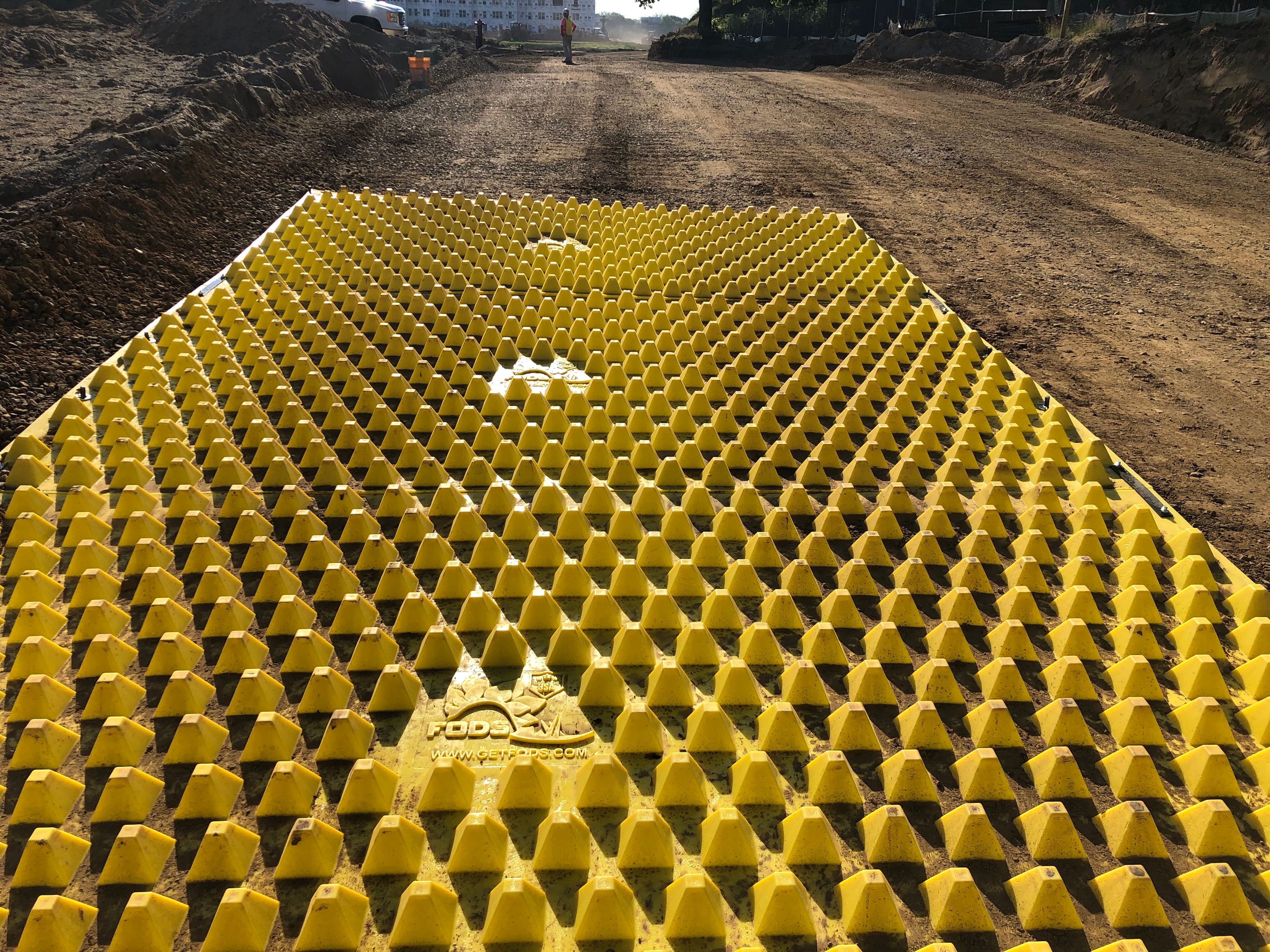

Michigan Stabilized Construction Access Road (S53)
A Rockless Trackout Control Solution Built for Michigan's Water-First Regulations
Michigan touches four of the five Great Lakes and holds the longest freshwater coastline of any state. With that much water at stake, it moved early to protect it, passing the Water Resources Commission Act in 1929, more than four decades before the federal Clean Water Act. That same instinct shapes construction today, where keeping sediment out of lakes, rivers, and streams is a core responsibility on every job site, and a stabilized construction access is one of the first BMPs an inspector will check. FODS Trackout Control Mats meet the intent of Michigan's Stabilized Construction Access (S53) and Access Road standards without rock, giving crews a durable, reusable, and inspection-ready way to stay compliant from the first day of earthwork.
How Michigan Regulates Soil Erosion and Sediment Control
The Michigan Department of Environment, Great Lakes, and Energy (EGLE), formerly the Michigan DEQ, oversees water quality statewide. The primary framework for construction is Part 91, Soil Erosion and Sedimentation Control, of the Natural Resources and Environmental Protection Act (NREPA). Part 91 requires a Soil Erosion and Sediment Control (SESC) permit before any earth change activity that disturbs one or more acres, or that takes place within 500 feet of a lake or stream. The permit is built around an SESC plan covering the site map, distances to water features, drainage, the schedule of earth-disturbing work, the location of every SESC measure, and a maintenance program.
What sets Michigan apart is that Part 91 is administered locally rather than from a single central office. Counties enforce it through a County Enforcing Agency (CEA), and many cities and townships add a Municipal Enforcing Agency (MEA) that issues permits within its jurisdiction. In practice, the agency reviewing your SESC plan and the inspector walking your entrance are usually local, so a trackout measure that stays clean and easy to document moves through review with far less friction than a rutted rock pad.
Permit-by-Rule and the MiEnviro Portal
Rather than make operators chase two separate stormwater permits, EGLE folds NPDES coverage into a streamlined Permit-by-Rule process under Rule 2190 of Part 31, NREPA. Sites disturbing one to five acres receive automatic coverage once the operator obtains the Part 91 SESC permit or is designated an Authorized Public Agency (APA). Sites of five or more acres must also file a Notice of Coverage (NOC) with the EGLE Water Resources Division, with the approved SESC plan, a site map, and the applicable fee. Permit-by-Rule also requires SESC measures to be inspected weekly and within 24 hours of a significant rain event by a certified storm water operator, so a pad that holds its shape and produces clean records directly supports compliance.
All stormwater submissions now run through EGLE's MiEnviro Portal, the current name for the platform that began as MiWaters and expanded to cover additional EGLE programs. If you have worked in Michigan under the older MiWaters name, it is the same system.
Michigan Stabilized Construction Access (S53) and Access Road Standards
A stabilized construction access stops sediment from migrating off disturbed ground and onto public roads on vehicle tires, where the next rain can wash it into storm drains and surface waters. Michigan does not rely on a single specification. The EGLE Nonpoint Source BMP Manual provides the core Access Road design reference, built from 2 to 3 inch aggregate over geotextile fabric, at least 50 feet long, 10 feet wide, and 6 inches deep, inspected daily. The DTMB SESC Guidebook applies the same idea to State of Michigan property as the (S53) Stabilized Construction Access, a 50 by 12 foot pad of 8 inch crushed rock. For highway work, the MDOT SESC Manual uses the term Gravel Access Approach, and the MACDC SESC Manual describes 28. Stone Construction Access. The names and dimensions vary slightly, but every standard asks for the same result, and every one shares the same weakness: loose rock ruts, migrates into the sub-base, and needs constant repair, sweeping, and replenishment to keep working.
FODS: A Modern Stabilized Construction Entrance for Michigan
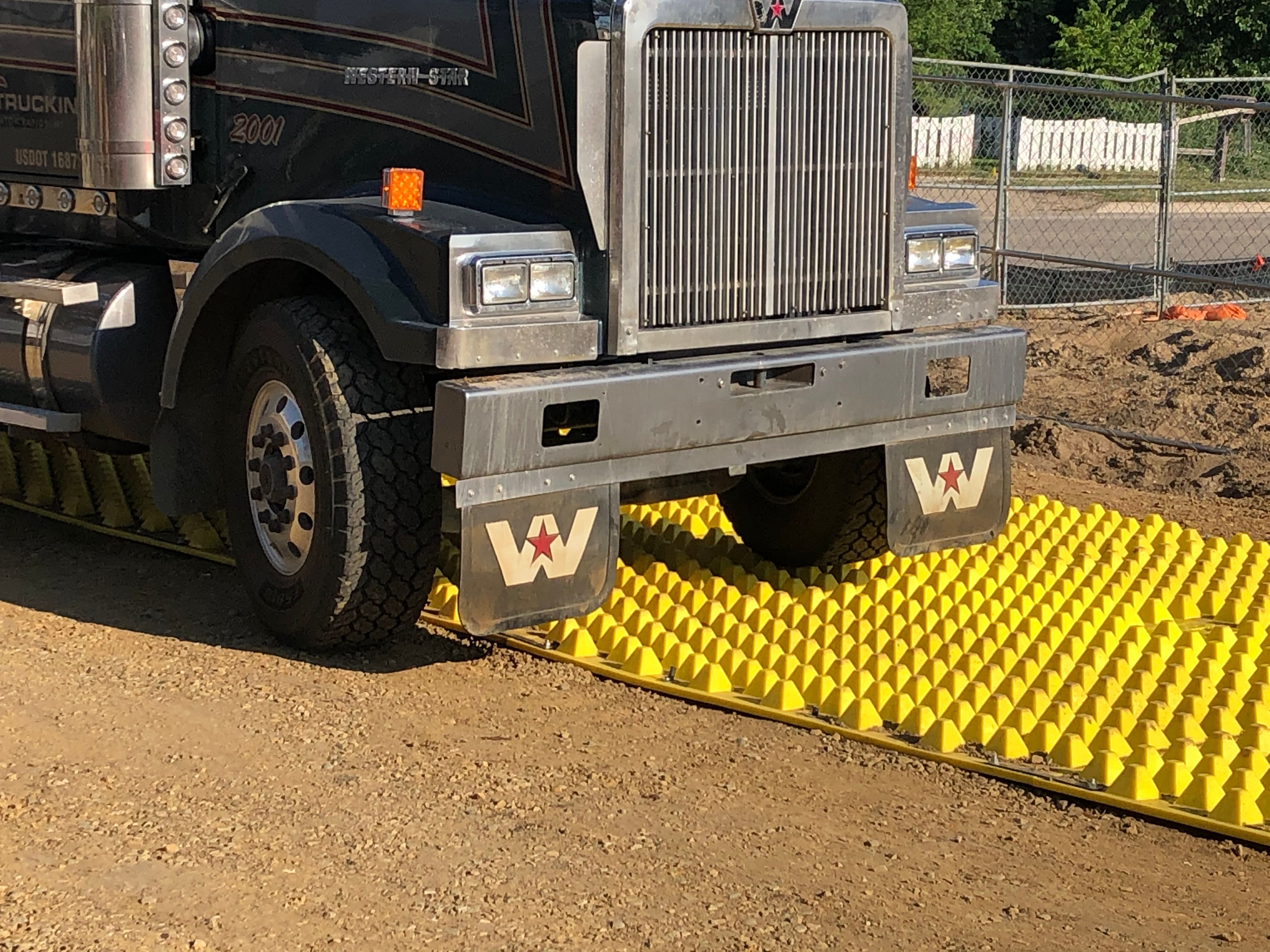
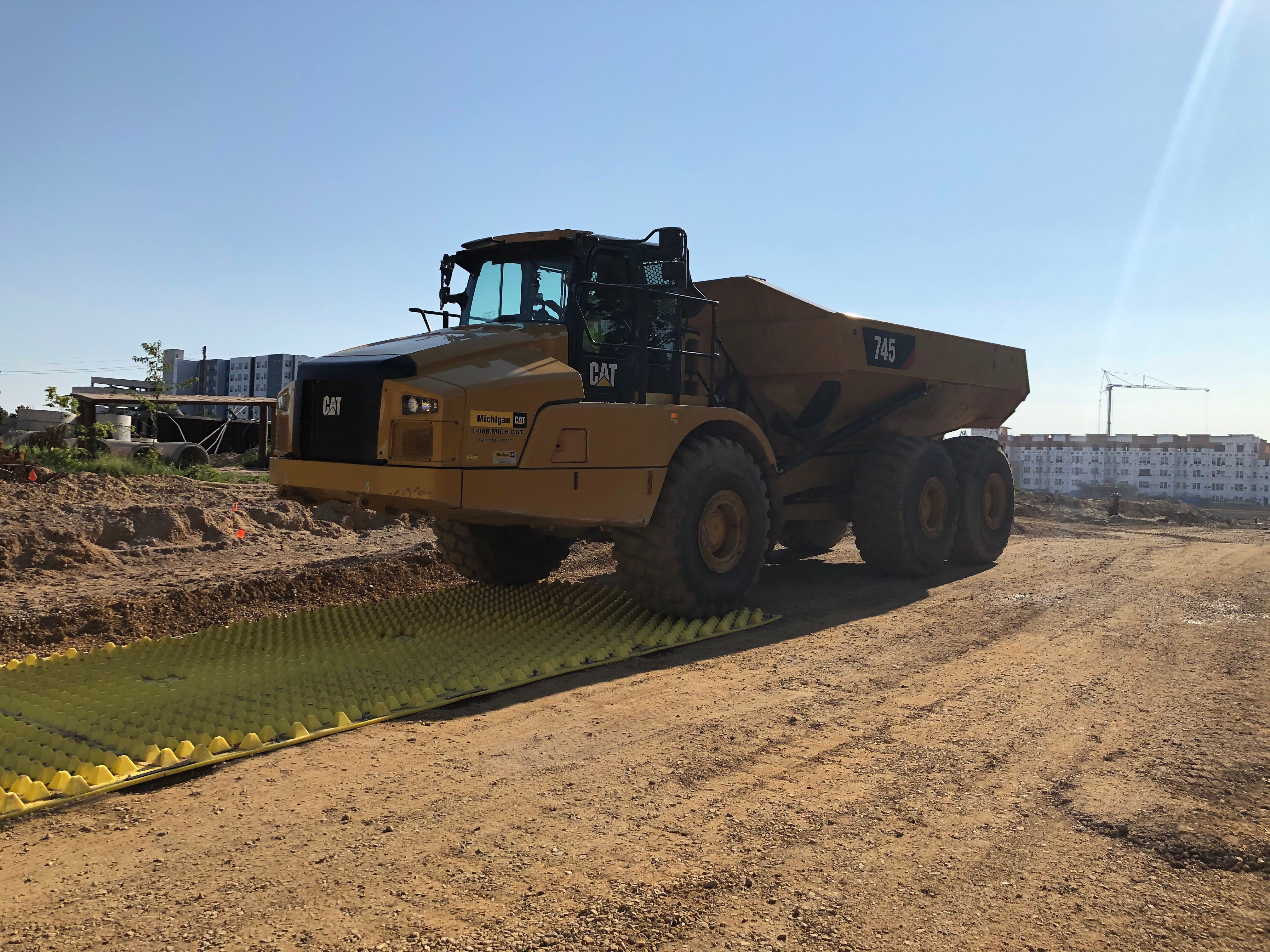
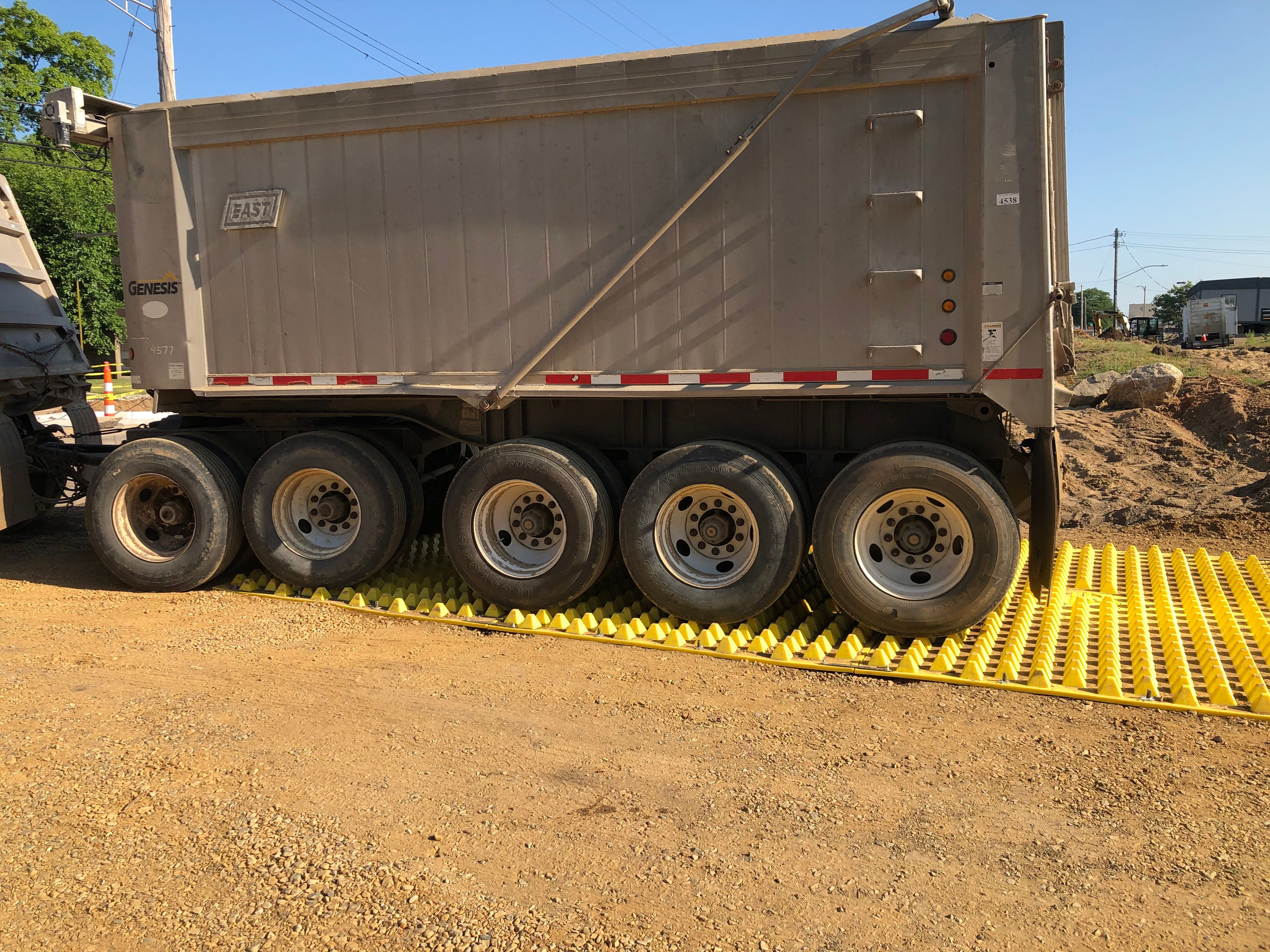
FODS Trackout Control Mats meet the intent of all of these standards as a manufactured alternative to the access road, stabilized construction entrance, gravel access approach, and stone construction access. The durable high-density polyethylene (HDPE) mats are molded into pyramid shapes that work like the rough edges of crushed stone, without the loose rock. As a vehicle drives across, the pyramids flex the tires and open the tread to break sediment loose, while the spaces at their base act like the voids in a traditional Access Road, and on high-traffic projects the system has been shown to reduce street sweeping by 59 percent.
Each mat holds up to 2.5 inches of sediment before tires contact previously deposited debris, and cleaning needs no added material, using a skid steer broom, a sweeper, or a FODS shovel, which makes weekly and post-rain inspections easy to document. With no aggregate, there is no rock wedging between dual tires or migrating onto active roads, so FODS suits the highway and urban projects where roadway safety matters most. The mats install over asphalt, concrete, or compacted ground without excavation, are reusable across phases and projects, and are designed for heavy-duty use with a service life of 10 years or more, cutting the recurring cost of replenishing rock.
Proven on Michigan Sites: PADNOS, Grand Rapids
FODS is already working in Michigan. At its LP Turner and LP Front Street Recycling Centers in Grand Rapids, PADNOS replaced a conventional aggregate trackout pad with the FODS Trackout Control System to meet the sediment control requirements in its SWPPP under Michigan's Industrial Stormwater General Permit, supplied by Michigan distributor Interface H2O. The Black River location runs a 28 by 12 foot configuration, and since installation PADNOS has reported less sediment along the perimeter and nearby roads, lower maintenance labor than its old gravel pad, and surfaces that held up through heavy truck traffic and spring freeze-thaw cycles, with inspections documented through EGLE's MiEnviro reporting. Protecting the Black River, which drains toward Lake Macatawa and Lake Michigan, is exactly the outcome Michigan's water-first regulations are written to encourage.
Where FODS Stands in Michigan
Michigan does not maintain a brand-name approved products list for trackout control. The state defines the performance a stabilized construction access must deliver, and contractors select a measure that meets it within their Part 91 SESC plan and SWPPP. FODS qualifies on that performance basis as an alternative to the Access Road, S53, Gravel Access Approach, and Stone Construction Access specifications, and it is already in service at industrial sites in West Michigan. To specify it, reference FODS in the SESC plan or SWPPP as the chosen stabilized construction access.
Contact us to learn more about FODS Reusable Construction Entrances in Michigan, or download the Michigan State Submittal Package for SESC and SWPPP documentation support.
Additional Resources:
EGLE Individual BMPs - Access Road
DTMB SESC Guidebook - (S53) Stabilized Construction Access
MDOT Manuals and Guidelines - Soil Erosion and Sedimentation Control Manual - Gravel Access Approach
MACDC SESC Manual - 28. Stone Construction Access