
Kentucky Stabilized Construction Entrance and Exit
KYPEL-Listed Trackout Control Solution for KPDES Compliance
Kentucky construction sits at the meeting point of several major waterways and one of the most sensitive landscapes in the country. The Ohio River forms the entire northern and western boundary of the Commonwealth, the Mississippi River touches the far west, and much of central and southern Kentucky rests on karst terrain, where sinkholes, springs, and cave systems such as those at Mammoth Cave connect surface runoff directly to groundwater. Active corridors run through Louisville, Lexington, Bowling Green, and the Northern Kentucky metros along Interstates 64, 65, 71, 75, and 24, and large industrial sites, such as the Nucor Steel mill in Gallatin County, carry steady heavy-vehicle traffic. In a setting like this, keeping sediment and debris off public roads is both a regulatory requirement and a practical safeguard for water quality.
To meet that requirement, construction sites must install stabilized entrances and exits that prevent mud, sediment, and contaminants from being tracked onto paved surfaces, where they can wash into storm drains and the waters of the Commonwealth. FODS Trackout Control Mats are listed on the Kentucky Product Evaluation List (KYPEL) and provide a reusable, rockless way to satisfy these requirements on projects across the state.
Kentucky Stormwater Regulation and the KPDES Program
The Division of Water (DOW), within the Kentucky Energy and Environment Cabinet's Department for Environmental Protection, administers the Clean Water Act in Kentucky through the Kentucky Pollutant Discharge Elimination System (KPDES). The KPDES regulates point sources of pollution, meaning discharges that originate within a well-defined area, including municipal wastewater dischargers, municipal separate storm sewer systems, manufacturing and industrial sites, and construction sites. The Division of Water sets the effluent limitations contained in each KPDES permit based on water quality standards and current treatment technology.
Construction sites that disturb one acre or more of land, including smaller sites that are part of a larger common plan of development, are required to obtain KPDES stormwater coverage before work begins. Coverage is obtained under the construction general permit KYR100000, and the operator must develop and implement a Stormwater Pollution Prevention Plan (SWPPP) that identifies potential pollution sources on the site and the Best Management Practices (BMPs) used to minimize polluted stormwater discharges. A Notice of Intent, submitted as the NOI-SWCA, must be filed at least seven days before construction activity begins, and operators use the Division of Water eNOI system to submit both the Notice of Intent and the Notice of Termination (NOT).
KYR10 Construction General Permit, Reissued for 2025
The Division of Water reissued the KYR10 construction general permit (KYR100000) with an effective date of January 3, 2025, replacing the 2019 version that expired on November 30, 2024. The master general permit carries a five-year term, so it remains the governing construction stormwater permit through the end of 2029. Individual coverages issued to operators last for two years unless extended or renewed.
The 2025 reissuance carried several changes that contractors should account for in current planning. SWPPPs and inspection reports may now be prepared and retained electronically rather than on paper. Uncontaminated air conditioning and compressor condensate were added to the list of authorized non-stormwater discharges, and projects that do not file a Notice of Termination now have coverage that terminates automatically two years after authorization, rather than after one year. Projects expecting to run beyond that two-year window must submit a new NOI-SWCA to extend or renew coverage. The Energy and Environment Cabinet publishes the permit, general instructions, and SWPPP guidance documents on its Wastewater Discharge Permits page to help operators prepare a complete submittal.
Stabilized Construction Exits in the Kentucky BMP Manual
The Kentucky Department for Environmental Protection developed the Kentucky Erosion Prevention and Sediment Control BMP Manual in partnership with the University of Kentucky. The manual describes common practices to contain pollution and reduce or eliminate polluted stormwater discharges, and it often offers multiple BMPs to address the same pollution source.
Stabilized Construction Exits are listed in the manual under Site Preparation BMP in Section 4.3.2. The practice is intended to be installed before clearing and grading begins, and it must be maintained until the site is fully stabilized. Its purpose is to reduce the off-site tracking of mud, sediment, and contaminants onto paved surfaces, where such material would otherwise reach storm drains and cause sedimentation or other water-quality damage. Construction exits are placed at every point of egress, and all departing traffic is required to use them.
The manual describes the traditional aggregate method as the baseline approach. A standard aggregate construction exit is a pad 12 feet wide by 50 feet long, built with at least 6 inches of 2 to 3 inch stone (KYTC No. 1 or No. 2, not No. 57s or dense graded aggregate), typically over a geotextile fabric that improves stability and keeps soil from working up into the rock. A stone exit must be kept in a condition that prevents the tracking or flowing of sediment, which requires inspection at least every seven calendar days and within 24 hours of any storm event that produces 0.5 inch or more of precipitation, along with maintenance and repairs as needed. The effectiveness of a stone pad depends on the surface roughness of the pad, and it stops working once the rock becomes compacted or the voids between the aggregate fill with soil. Restoring it means adding fresh stone as a top dressing, with the frequency of that work driven by total traffic, weather, and soil conditions.
The manual also identifies shaker plates and wheel-wash stations as additional methods to reduce vehicle tracking. Shaker plates, sometimes called rumble plates or rumble strips, use aggressive agitation to dislodge sediment from tires and are installed over an excavated void that captures the material, usually as a supplement to a rock pad rather than a standalone exit. Wheel wash stations can serve as a standalone control, but they require a sediment basin or other containment system to capture sediment-laden runoff from tires. Vehicles leave the site carrying excess water that can freeze in cold conditions and create a road hazard.
The FODS Reusable Construction Exit
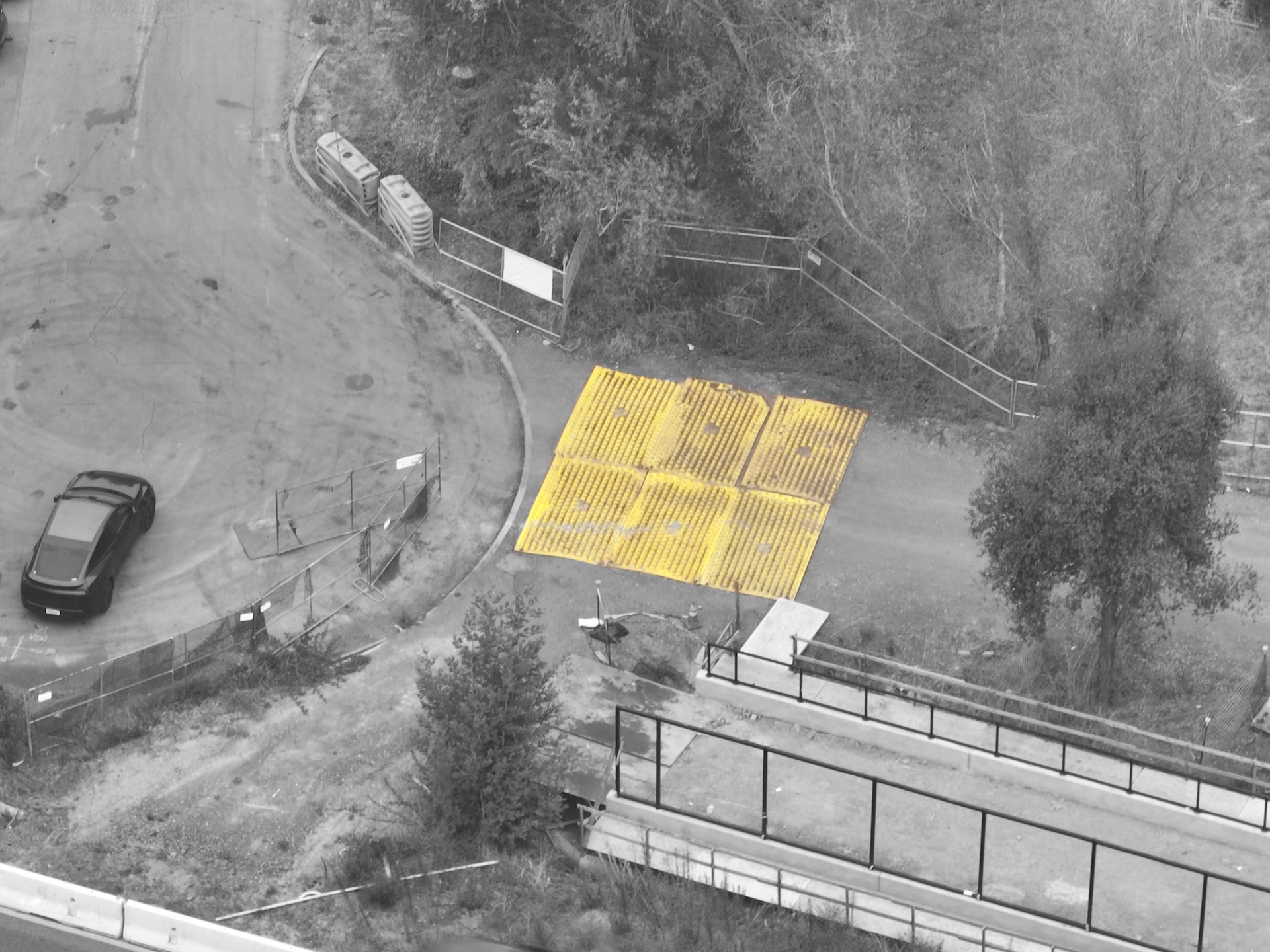
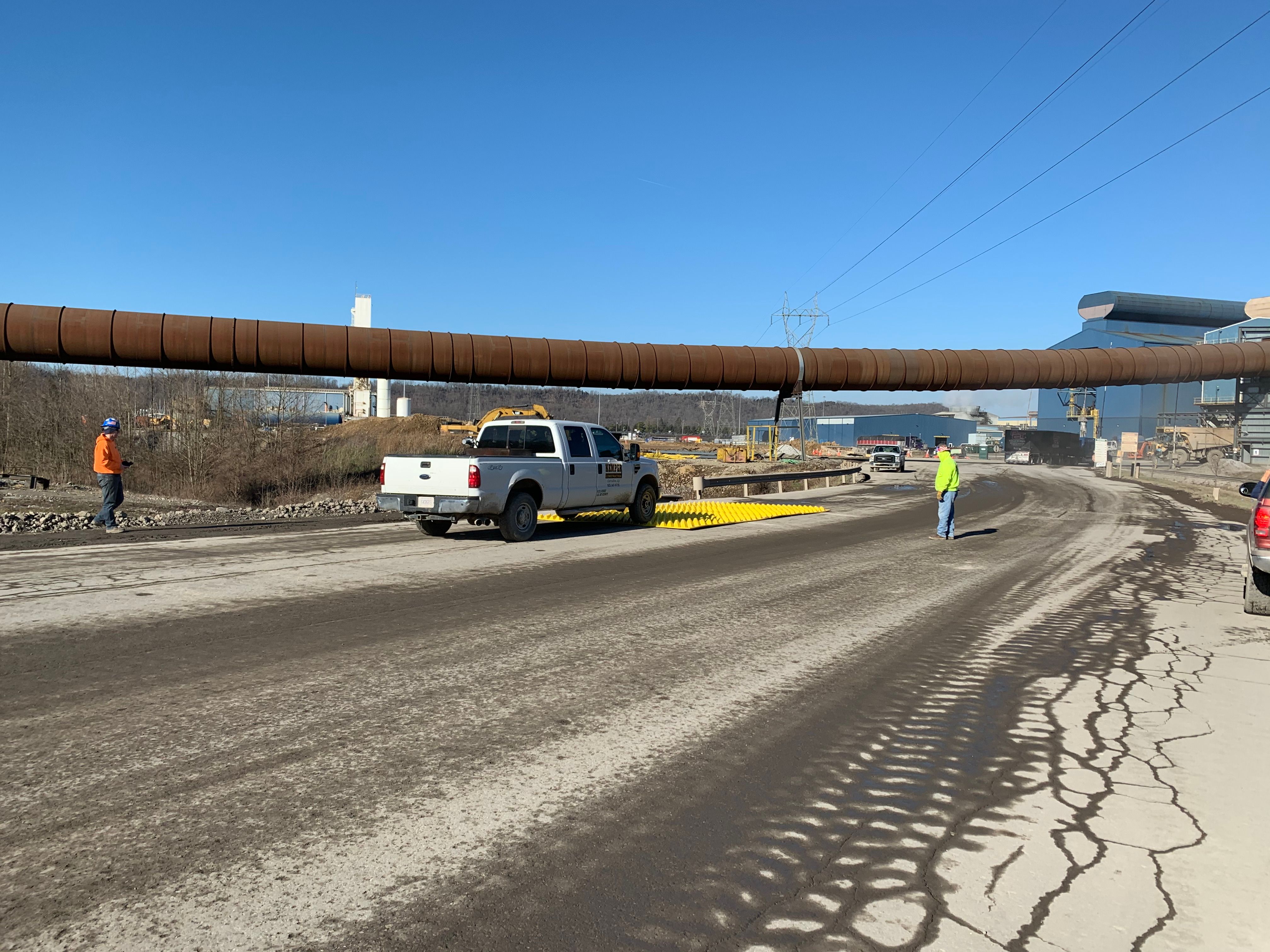
The FODS Stabilized Construction Exit System offers a different approach to preventing vehicle trackout. The system is built from modular high-density composite mats, each measuring 12 feet wide by 7 feet long, that can be arranged in different layouts to suit the soil conditions and space constraints of a given site. FODS installs without excavation and works over a range of substrates, including soil, asphalt, and concrete, with installation, relocation, and maintenance all completed without heavy equipment. Because the surface does not compact or degrade over time, even in wet weather, FODS functions as a durable, reusable, standalone exit rather than a pad that must be continually replenished.
FODS on the Kentucky Product Evaluation List
The FODS Trackout Control Mat is listed on the Kentucky Product Evaluation List (KYPEL), the Kentucky Transportation Cabinet's catalog of products reviewed by its Division of Materials. The product carries a KYPEL Phase 4 status, which the Cabinet defines as approved for experimental use on KYTC projects, with both the Maintenance Agency and KYTC reviewers recommending approval. Because no separate KYTC specification or special note exists for this product category, the listing directs project teams to coordinate with the Kentucky Transportation Cabinet prior to use, which is standard practice for manufactured trackout systems on state-let work.
The FODS Trackout Control System is well-suited to phased construction, such as highway and pipeline projects, where entrances must be established at the start of each phase and then moved as work advances. The portable entrance can be relocated as needed, which reduces costs per deployment, and because it introduces no aggregate, it lowers the risk of loose rock entering active travel lanes and reduces the associated hazard to vehicles. Heavy industrial sites in Kentucky, including the Nucor Steel facility in Gallatin County, have used FODS to maintain a clean, stable construction exit under continuous traffic.
Reducing the Risks of Vehicle Trackout
Safety is a central concern wherever construction traffic meets an active roadway. Aggregate-based exits create risk by depositing loose rock and debris onto public roads, posing hazards to drivers, flaggers, and vehicles, and they also entail recurring costs and labor for replenishment. FODS uses a rockless technique to clean tires at the point of exit, so it does not introduce that debris onto the roadway. Each mat is durable, reusable, and recyclable at the end of its service life, which reduces the environmental footprint associated with the production, hauling, and disposal of construction aggregate.
For assistance specifying FODS on a Kentucky project, or for help assembling the trackout control portion of a SWPPP, please contact us. The Kentucky State Submittal Package is available to support SWPPP documentation.
ADDITIONAL RESOURCES:
Kentucky Product Evaluation List - FODS
Kentucky Wastewater Discharge Permits
KPDES Wastewater Discharge Form 1
KYR10 - Stormwater Construction
General Permit KYR100000 KPDES Permit
Stormwater Pollution Prevention Plan - Best Management Practices Plan
Kentucky Erosion Prevention and Sediment Control Manual