
Hawaii Stabilized Construction Entrance/Exit TR-1
HDOT-Referenced TR-1 Trackout Control Solution
The Hawaiian Islands form a volcanic archipelago in the central Pacific Ocean, stretching across more than 1,500 miles of open ocean from the Big Island of Hawaii to the northwestern reefs near Kure Atoll. Construction activity on the eight main islands (Oahu, Maui, Hawaii Island, Kauai, Molokai, Lanai, Niihau, and Kahoolawe) takes place across some of the most ecologically sensitive terrain in the United States. Heavy year-round rainfall, steep volcanic slopes, and direct proximity to coral reef ecosystems place a premium on sediment and trackout control at every construction site in the state. On Oahu, where the majority of Hawaii's construction volume is concentrated around Honolulu, the H-1/H-2/H-3 freeway corridors, and active development in communities from Kapolei to Kaneohe, well-maintained construction entrances are a core component of SWPPP compliance. The same obligations apply to significant construction programs on Maui along the Honoapiilani Highway corridor, and on the Big Island where highway and utility projects regularly traverse volcanic terrain into Kona, Hilo, and beyond.
Hawaii Department of Health Clean Water Branch (CWB): State-Administered NPDES Program
In Hawaii, the National Pollutant Discharge Elimination System (NPDES) program is administered by the State Department of Health (DOH), not the U.S. Environmental Protection Agency. The Department of Health's Clean Water Branch (CWB) issues and enforces all NPDES permits for discharges to state waters, including construction stormwater. The CWB conducts coastal water surveillance, inspects permitted construction sites, investigates complaints, and administers enforcement actions. Hawaii is one of a relatively small number of states with a fully state-administered NPDES program, meaning all permit applications, Notices of Intent (NOIs), and compliance obligations flow through the state rather than the EPA regional office.
The CWB's mandate includes protecting inland streams, nearshore coastal waters, and the coral reef systems that surround each island. Unpermitted sediment discharge from construction sites (whether tracked onto roadways or released as stormwater runoff) represents a direct threat to these habitats and can result in enforcement actions carrying fines of up to $25,000 per day, per violation.
HAR Chapter 11-55, Appendix C: Construction Stormwater General Permit
Construction stormwater permits in Hawaii are codified in Hawaii Administrative Rules Chapter 11-55, Appendix C. The current Construction Stormwater General Permit became effective January 29, 2024, and expires January 28, 2029. Any construction project disturbing one or more acres of total land area, or part of a larger common plan of development that will ultimately disturb one or more acres, is required to obtain coverage under this general permit. Regulated land disturbance includes clearing, grubbing, grading, excavation, demolition, equipment staging on bare or grassed areas, and roadway work that reaches the base course.
To obtain permit coverage, operators must submit a Notice of Intent (NOI) through the CWB's e-Permitting Portal before the start of land-disturbing activity. As a prerequisite to the NOI, the project must develop and maintain a Storm Water Pollution Prevention Plan (SWPPP) identifying the site-specific Best Management Practices (BMPs) that will control sediment, trackout, and other regulated pollutants during construction. Upon approval, the CWB issues a Notice of General Permit Coverage (NGPC) confirming that the project is authorized to discharge under Appendix C. Coverage is granted for a maximum of five years in alignment with the permit's expiration cycle. Changes to the project that expand the permitted area or introduce new discharge points require a new NOI rather than a modification to the existing NGPC.
Stabilized Construction Entrance/Exit TR-1
The TR-1 designation appears in two principal Hawaii BMP reference documents: the HDOT Highways Construction Best Management Practices Field Manual (2021) and the City and County of Honolulu (CCH) Department of Environmental Services Storm Water BMP Manual. Both manuals are substantially derived from the California Stormwater Quality Association (CASQA) BMP Handbook practices, adapted for Hawaii's island site conditions.
Under the TR-1 standard, a stabilized construction entrance is a pad of aggregate underlain with filter cloth, installed at the point where construction vehicles transition between a site and a public right-of-way such as a street, alley, or sidewalk. The design objective is to dislodge and retain sediment from vehicle tires before those vehicles reach public pavement, preventing accumulation in storm drains and reducing windblown dust generation. Conventional aggregate entrances require periodic top dressing with stones three to six inches in diameter and must be graded to direct runoff back onto the site rather than toward the right-of-way. Where a wash rack is incorporated, a sediment trap must be provided to capture wash water runoff. On compact Hawaii job sites, where space constraints are common in Honolulu's older commercial corridors and in the tighter footprint of neighbor island municipalities, maintaining fully compliant aggregate entrances across multiple construction phases represents a recurring material and labor cost.
Stabilized Construction Roadway TR-2
TR-2 covers access roads, subdivision roads, parking areas, and other onsite vehicle transportation routes. These surfaces require stabilization promptly after grading and must be maintained throughout construction to prevent erosion and control dust. Gravel construction roads are a common implementation, though they require removal or permanent paving as part of final site stabilization at project close-out.
Entrance/Outlet Tire Wash TR-3
For sites with sustained or heavy trackout risk, TR-3 provides a tire wash station at the stabilized access point. The system removes sediment from tires and undercarriages before vehicles re-enter public roads. TR-3 installations require a water supply, a drainage channel directing wash water to a sediment-trapping device, and a turnout or double-wide exit configuration. This BMP should not be used where wet tires exiting the site would create a safety hazard on adjacent roadways.
FODS Trackout Control Mats in Hawaii
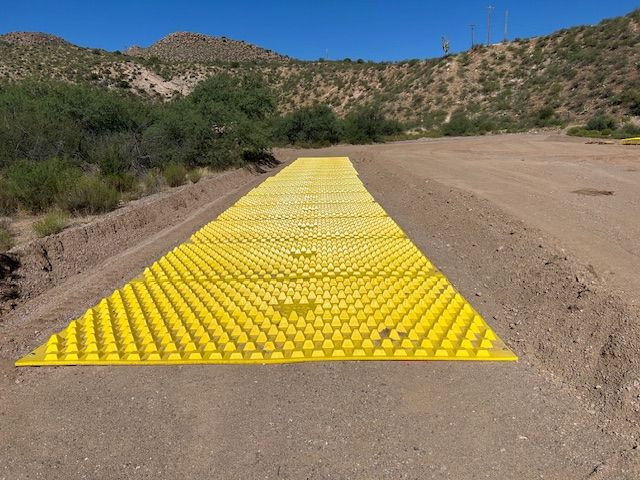
FODS Trackout Control Mats are a manufactured, reusable alternative to conventional aggregate TR-1 entrances. Each mat is fabricated from high-density polyethylene (HDPE) and features a rigid, textured surface engineered to dislodge sediment and debris from vehicle tires at the point of exit. Because the system contains no loose aggregate, it eliminates the periodic stone replenishment, sediment trap requirements, and roadway debris hazards that accompany traditional gravel construction entrances.
On Hawaii job sites, FODS mats install directly on concrete, asphalt, or compacted soil without excavation, and can be repositioned as site phases shift. A standard 1x5T configuration provides a 12-foot-wide, 35-foot-long entrance surface that accommodates the turning radius of typical construction vehicles. Sediment that collects within the mat's profile can be removed in place using the FODS shovel, restoring the mat to full performance without heavy equipment. The mats are rated for approximately 10 or more years of service life, supporting reuse across multiple projects.
FODS does not carry a formal brand-name approval letter from the Hawaii DOH CWB or HDOT for TR-1 compliance. Hawaii's construction stormwater program operates on a performance-based SWPPP framework: operators identify and document BMPs that achieve the sediment and trackout control objectives required under HAR 11-55 Appendix C, and those BMPs are reviewed as part of the NOI and site inspection process. FODS mats are specified on Hawaii construction projects through SWPPP documentation demonstrating that the system's trackout removal performance meets the intent of the TR-1 standard. FODS provides a state submittal package with supporting documentation to assist project teams in preparing SWPPP materials.
Additional Resources:
Department of Health: Clean Water Branch
Construction Storm Water General Permit FAQs
Stormwater Best Management Practice Manual
Honolulu DES Best Management Practice Manual Excerpt (TC-1, TC-2, TC-3)