
Mississippi Stabilized Construction Entrances and Vehicle Trackout BMPs
MDEQ and MDOT Compliant Construction Exit Control for Mississippi Sites
Mississippi takes its name from the second longest river in North America, which forms the state's entire western border and drains stormwater from 32 states across more than 1.1 million square miles. That river system, along with the Pearl and Pascagoula rivers, the Ross Barnett Reservoir near Jackson, the fertile Mississippi Delta, and the Gulf Coast estuaries around Gulfport and Biloxi, makes water quality a constant concern on construction sites statewide. The river serves as a migratory flyway for a large share of North American waterfowl and supports more than 230 species of fish, and the sediment that leaves a job site can travel a long way downstream. Keeping mud and soil out of the road, and out of the water, is one of the most basic compliance duties on any Mississippi project.
The Clean Water Act of 1972 established the National Pollutant Discharge Elimination System (NPDES), which requires a permit for stormwater discharges from municipal, industrial, and construction activities that disturb one acre or more. The Mississippi Department of Environmental Quality (MDEQ) is authorized by the EPA to administer and enforce the NPDES program in Mississippi.
MDEQ NPDES Construction Stormwater Permits
Most construction projects in Mississippi obtain coverage under a general permit, and MDEQ divides this coverage into two tiers. Small construction activities that disturb one to five acres are covered under the Small Construction General Permit, with coverage requested through a Small Construction Notice of Intent. Large construction activities that disturb five or more acres are covered under the Large Construction General Permit (MSR10), which was reissued on February 4, 2022 for a five-year term expiring January 31, 2027. Projects that do not fit the general permits may need an Individual Permit, which MDEQ reviews case by case.
To obtain coverage, an operator submits a Notice of Intent and prepares a Stormwater Pollution Prevention Plan (SWPPP). The SWPPP identifies every potential source of sediment and pollution on the site and the best management practices (BMPs) that will control it, including erosion control, dust control, and measures to minimize the tracking of construction sediment onto public roads. A stabilized construction exit is among the first BMPs an operator installs and one of the most closely watched during inspections.
Construction Exit BMPs in the MDEQ Erosion and Sediment Control Manual
MDEQ documents its recommended practices in the Erosion and Sediment Control Manual, the state's modern guidance for Erosion Control, Sediment Control and Stormwater Management on Construction Sites and Urban Areas. The manual was adapted from the widely used Alabama Handbook and organizes BMPs by function. Under Site Preparation in the Best Management Practices Design chapter, the manual defines the Construction-Exit Pad (CEP), the practice that governs stabilized construction entrances and exits in Mississippi.
The purpose of a construction exit is to provide a stabilized area at site access points that removes sediment, mud, and other material from tires before vehicles reach public roadways. To work as intended, site traffic must be restricted to the stabilized exits so vehicles cannot bypass the control. The exit should sit on high ground where possible, with drainage directed into a sediment basin or trap so runoff stays on site. The manual also calls for regular street sweeping or scraping, often daily, whenever sediment is tracked onto public roads, and for routine inspection of the exit so that maintenance or an additional BMP can be added if sediment is not adequately contained.
FODS as a Compliant Construction Exit in Mississippi
Mississippi does not maintain a brand-name approval list for construction exits. MDEQ evaluates a vehicle tracking BMP on whether it performs the function the Construction-Exit Pad practice describes, removing sediment from tires before vehicles reach the road, and the operator specifies the chosen practice directly in the project SWPPP. Because the manual sets a performance and dimensional standard rather than requiring a single material, FODS Trackout Control Mats can be named in the SWPPP as the site's construction exit without a separate approval letter.
FODS satisfies the same purpose the manual assigns to a stone Construction-Exit Pad, while removing the loose aggregate that the manual itself treats as a recurring maintenance burden. For inspectors and engineers, the result is a construction exit that meets the intent of the CEP practice and the permit, holds up under heavy and repeated traffic, and does not need to be rebuilt after each storm.
The Construction-Exit Pad and Its Limits
The traditional Mississippi construction exit is the stone stabilized pad. The manual specifies a stone entrance at least 50 feet long and at least 6 inches deep, built over a geotextile filter fabric that separates the stone from the native soil. The stone is DOT #1 coarse aggregate, gravel with a diameter of roughly 1.5 to 3 inches, coarse enough to knock soil loose as tires pass over it. The length may need to be extended to contain sediment adequately.
The weakness of the stone pad is that the same traffic it serves wears it out. As vehicles drive over the aggregate, the rough surface flattens and soil fills the voids between the rocks, which reduces sediment removal and forces the operator to top dress the pad with fresh stone. When tracking persists, a tire washing station may be added, using a pressure washer and a sediment trap to clean wheels before vehicles reach the road. Wash stations require a water source, ongoing cleanout of the collected sediment, and care in freezing conditions, since dripping vehicles can leave ice on the pavement. Each of these traditional options carries a recurring cost and a maintenance cycle that a durable manufactured system can avoid.
FODS Trackout Control System
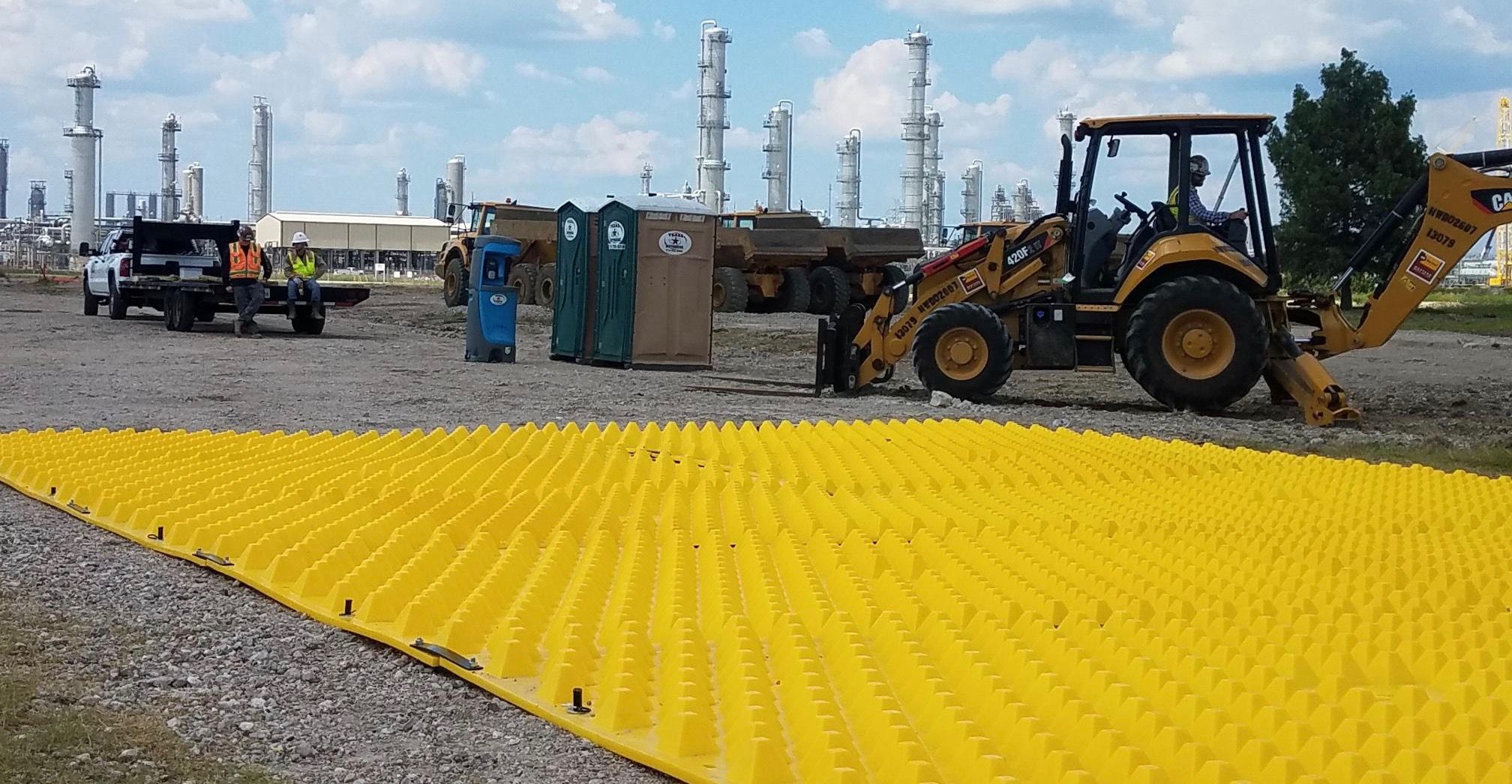
The FODS Trackout Control System is a durable, reusable BMP for trackout control. The system is a single layer of HDPE matting formed into pyramids on its surface. As tires pass over the mats, the pyramids flex and deform the tire, dislodging the debris and sediment caught in the tread. The mats install over dirt, concrete, or asphalt, link together with connecting hardware, and can be reconfigured and relocated through the phases of a linear project, which significantly reduces the cost of installing, maintaining, and removing a construction exit.
The pyramids do not degrade under construction traffic, but they do fill with sediment over time and require maintenance. The 3 inch pyramids hold up to 2.5 inches of sediment, because tires contact only the tips, and the mats are cleaned with a street sweeper or a skid steer with a broom attachment. Contractors can sweep the mats as part of the daily street sweeping the manual already requires, restoring performance without rebuilding the exit. Because the system removes sediment so effectively, FODS is commonly specified at roughly half the length of a stone stabilized pad, which saves both space and money on every project where the mats are used.
Risks of Vehicle Trackout on Roadways
Safety is a primary concern wherever construction traffic meets a public road. Stone exits deposit rock and debris onto pavement, creating hazards for drivers and workers, and loose rock can lodge between dual tires. Tire wash stations add a winter risk, since dripping vehicles can build ice on cold roadways. FODS uses a rockless technique to clean tires and does not carry the same risk of injury or liability as aggregate entrances. The mats are durable and reusable across many projects, which reduces the environmental impact tied to aggregate production, hauling, and disposal. On Mississippi sites that drain to the Pearl River, the Pascagoula, the Delta, or the Gulf Coast, keeping rock and sediment out of the road also helps keep it out of the water.
Additional Resources
Mississippi Erosion and Sediment Control Field Manual
Mississippi SWPPP Guidance Manual for Construction Activities