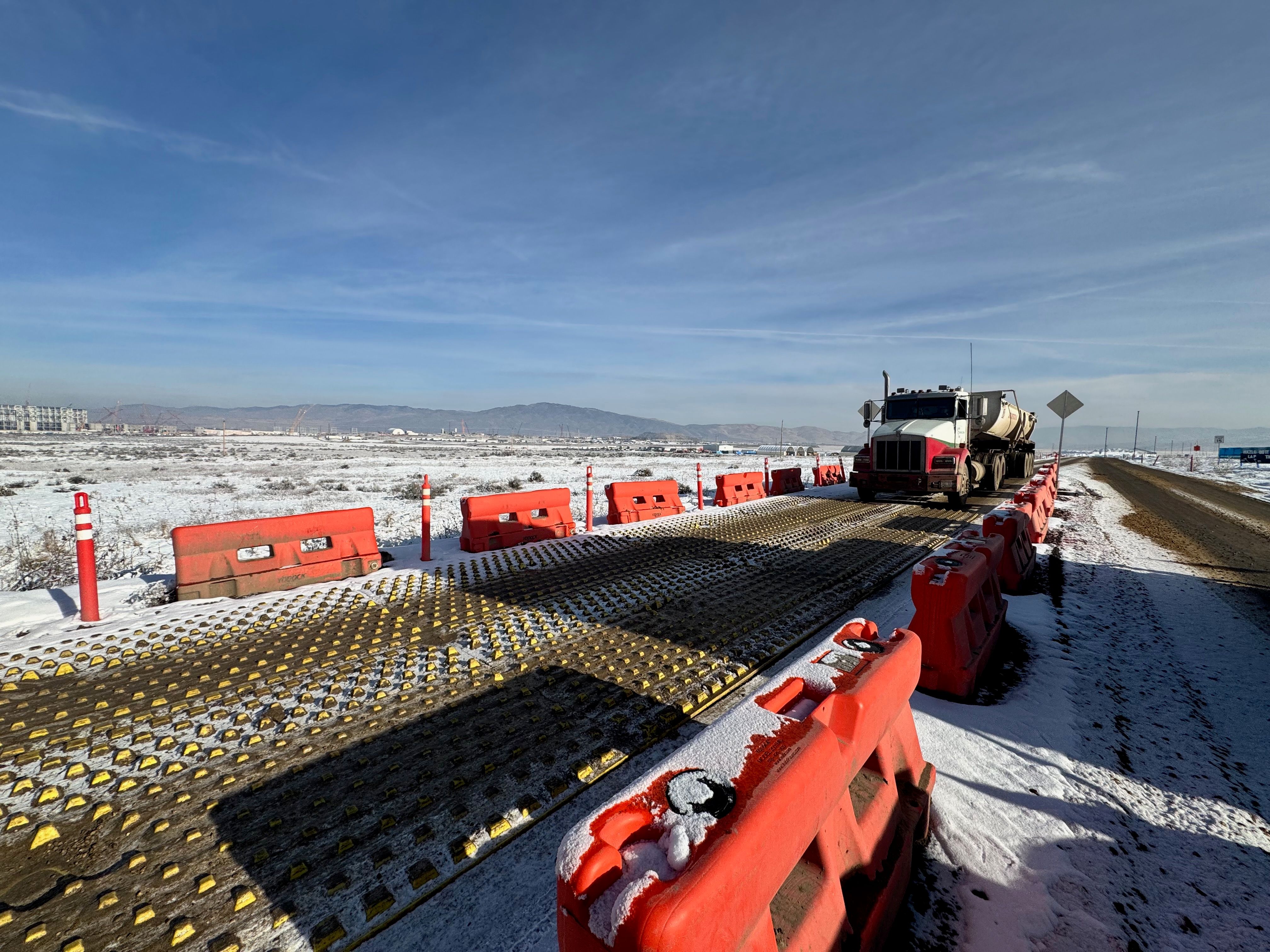

Idaho Vehicle Sediment Control BMPs
Idaho spans a remarkable range of terrain, from the rugged peaks of the Sawtooth and Bitterroot ranges to the volcanic plains of the Snake River Plain and the agricultural lowlands of the Treasure Valley. The state's waterways reflect this diversity: the Snake River cuts through southern Idaho on its journey to the Columbia, while the Salmon, Clearwater, and Boise Rivers drain the central and northern highlands. These rivers and their tributaries support fisheries, irrigation, and recreation across the state, and both federal and state regulations are in place to protect surface water quality during land-disturbing activities.
Construction projects along the Interstate 84 corridor through Boise and Nampa, the Highway 95 corridor from Lewiston south through the Palouse, and the expanding development footprint of Boise's metropolitan area all operate under stormwater permit requirements that include Best Management Practices for sediment control at construction entrances.
Idaho Pollutant Discharge Elimination System (IPDES)
The Clean Water Act, as amended in 1972, established the National Pollutant Discharge Elimination System (NPDES) permit program to regulate discharges of pollutants to waters of the United States. Idaho administers its own equivalent program under the Idaho Pollutant Discharge Elimination System (IPDES), with permitting authority formally transferred from the U.S. Environmental Protection Agency to the Idaho Department of Environmental Quality (DEQ) on July 1, 2021.
Under the IPDES program, construction activities that disturb one acre or more of land, including smaller sites that are part of a larger common plan of development or sale, must obtain coverage under the Construction General Permit (CGP), Permit No. IDR100000. To obtain coverage, operators submit a Notice of Intent (NOI) through DEQ's IPDES e-permitting system at least 14 days before construction begins. Along with the NOI, operators must develop and implement a Stormwater Pollution Prevention Plan (SWPPP) that identifies potential sources of water quality impacts on the site and the Best Management Practices (BMPs) selected to control those impacts.
Idaho DEQ publishes and maintains the Idaho Catalog of Storm Water Best Management Practices, which provides detailed specifications for BMP design, applicability, and maintenance. The catalog is the primary technical reference for SWPPP practitioners and inspectors throughout the state.
BMP 40: Vehicle Sediment Control
The Vehicle Sediment Control BMP is a standard requirement on Idaho construction sites where vehicles enter and exit onto public or private roads. Sediment tracked off-site by construction vehicles is a leading source of stormwater pollution: once deposited on paved roads, it flows readily into storm drains and surface waters during rain events and is difficult to collect after the fact.
The purpose of this BMP is to stabilize the construction entrance and exit so that sediment, mud, and debris are dislodged from vehicle tires before those vehicles leave the site. Idaho DEQ's BMP catalog identifies multiple acceptable approaches for this purpose, including aggregate pad construction entrances, wheel wash stations, rumble strips, and manufactured trackout control mats. The selected system must be capable of handling site traffic volumes, must be maintained regularly to preserve effectiveness, and must be documented in the SWPPP.
The entrance point must be located at all active construction egress locations, and all construction traffic must be routed through the stabilized entrance. Additional BMPs, including street sweeping and sediment basins, are typically combined with the entrance control to address residual trackout. Inspections must be conducted at a minimum of every two weeks and within 24 hours of any storm event of 0.25 inches or greater.
FODS Named in the 2025 Idaho Construction Erosion and Sediment Control Field Guide
The most significant recent update in Idaho's stormwater guidance is the 2025 revision of the Idaho Construction Erosion and Sediment Control Field Guide, published in February 2025. This Field Guide was developed through a collaboration between the Idaho Small Business Development Center (SBDC), Idaho Transportation Department (ITD), Ada County Highway District (ACHD), and the City of Boise. It is distributed statewide and serves as a practical reference for contractors, inspectors, and SWPPP practitioners on Idaho construction sites.
Under the Construction Entrance/Exit section, the 2025 Field Guide explicitly lists FODS by name as an accepted modular trackout pad:
"Modular track-out pads (e.g., FODs, rumble strips, scrape grates, grizzly pads) can supplement or replace rock exits. If used alone, pads must meet product specs, be long enough for 3-4 wheel rotations, and be cleaned regularly to remove dirt."
This recognition places FODS alongside conventional methods in an officially published, multi-agency Idaho guidance document. For contractors and SWPPP practitioners, the listing provides direct support for specifying FODS on Idaho projects without requiring additional product justification. The Field Guide also notes that if tracking persists despite the installed entrance, street sweeping or a wheel wash must be added, and that no visible tracking should be present on public or private roads.
FODS Trackout Control System
The FODS Trackout Control System is a reusable, manufactured construction entrance BMP consisting of 12-foot by 7-foot HDPE mats formed with pyramid-shaped protrusions on the surface. As vehicles exit the construction site over the mats, the pyramids flex and deform tire treads in multiple directions, dislodging sediment, mud, and debris that is lodged between tire treads. The system can be installed over existing substrates including compacted dirt, asphalt, and concrete, without excavation or heavy equipment.
FODS meets the 2025 Field Guide criteria for modular trackout pads: it is available in configurations sufficient for 3 to 4 wheel rotations (a standard 1x5T layout spans 35 feet, comparable in trackout performance to a 70-foot aggregate entrance), and it is cleanable by street sweeper, skid steer with a broom attachment, or manual tool. The pyramids hold up to 2.5 inches of accumulated sediment between cleanings, as tires contact only the tips of the pyramids during normal use.
Compared to aggregate pad construction entrances, the FODS system has been shown to reduce street sweeping requirements by 59% in high-traffic-volume applications. The system is fully reusable across multiple project phases and sites, with a service life exceeding 10 years, and is 100% recyclable at end of service.
FODS in Idaho: Micron Technology Boise Fabrication Plant
One of Idaho's most prominent recent construction projects, the Micron Technology semiconductor fabrication and R&D expansion in Boise, deployed the FODS Trackout Control System as the Vehicle Sediment Control BMP throughout the construction process. The $15 billion project, which constitutes the largest single private investment in Idaho history and received $6 billion in federal funding under the CHIPS and Science Act, is located on Micron's 340-acre campus near the Boise River.
The project's SWPPP was reviewed by Idaho DEQ under the IPDES program. Given the scale of the construction, including over 1.2 million square feet of new facilities and a significant Boise River restoration component, sediment control at construction entrances was a critical element of compliance. Micron selected FODS over traditional aggregate pads for its consistency, lower maintenance burden, and alignment with the project's environmental sustainability commitments.Additional Resources
Idaho DEQ General Permit for Discharges from Construction Activities